Introduction
Welcome to the final lesson of our course on the history of the Indian subcontinent. In our previous lesson, we examined the profound shift in India's political landscape from the era of Congress dominance to the complexities of coalition politics, and finally to the contemporary phase marked by the BJP's ascendance. We discussed how this political fragmentation and realignment was driven by deep-seated social changes.
Today, we will explore the very heart of those social changes. Our learning outcome is to: Describe the evolution of contemporary social challenges and movements related to caste, communalism, and environmental issues.
These three themes are not isolated; they are deeply intertwined with the political and economic transformations we've been studying.
- The assertion of caste-based identities was a primary force behind the decline of the Congress system and the rise of regional parties.
- The mobilization around communal issues, particularly in the 1980s and 90s, was central to the rise of the BJP.
- Environmental movements have emerged as a powerful critique of the state's post-independence development model, forcing a national conversation about its human and ecological costs.
This lesson will provide an analytical overview of these three enduring challenges, marking the culmination of our journey from ancient civilizations to the complexities of modern India.
Part 1: Caste in Contemporary India – Persistence and Politics
While the caste system has ancient roots, its role in contemporary India is a modern phenomenon, shaped by democracy, politics, and economic change. The constitutional promise of a casteless society remains elusive; instead, caste has become a powerful tool for political mobilization and a persistent axis of inequality.
A pivotal moment in the politicization of caste was the implementation of reservation policies. To understand this evolution, let's begin with a video that traces the history of reservations, from the constitutional debates to the transformative Mandal Commission.
How Caste and Reservation Shaped Indian Politics | Flashback with Palki Sharma
The video 'How Caste and Reservation Shaped Indian Politics' from Firstpost offers a concise history of affirmative action in India. It explains the initial logic, the dramatic expansion to include Other Backward Classes (OBCs), and the subsequent political and social fallout.
Please watch from 02:53 to 08:38. This segment covers: The constitutional provisions for reservation for Scheduled Castes (SCs) and Scheduled Tribes (STs). The Mandal Commission (from 04:55), its recommendation for 27% OBC reservation, and the nationwide protests against its implementation in 1990. An analysis of the effectiveness of reservation policies, highlighting the gap between quotas and actual representation, especially in higher-level positions.
The Mandal Commission was a watershed moment. It not only sought to address historical injustices but also unleashed the political power of the numerous OBC communities, leading to the rise of powerful regional parties based on caste identity (like the Samajwadi Party and Rashtriya Janata Dal), which we discussed in the previous lesson.
However, does political empowerment translate to socio-economic equality? While reservations have created avenues for mobility, deep-seated disparities remain. An academic study provides a more granular look at the data.
Caste in 21st Century India: Competing Narratives - PMC
The paper 'Caste in 21st Century India: Competing Narratives' uses nationally representative survey data to investigate whether caste still matters. It moves beyond the political sphere to look at tangible life outcomes.
Please read two key parts of this paper: Section 3.2 'Caste and Inequality': Scan Tables 2 and 3 and the accompanying text. Note the persistent and statistically significant gaps between forward castes, OBCs, Dalits, and Adivasis in areas like education, consumption expenditure, income, and even children's reading ability, even after controlling for other factors. Section 4.2 'Caste in the 21st Century: From Hierarchy to Elite Capture': Read this concluding section carefully. It argues that caste has adapted. Instead of being just a ritual hierarchy, it now functions as a network for consolidating resources, where privileged groups use modern mechanisms (caste associations, private education, access to capital) to maintain their advantage.
The key takeaway is that caste has transformed. While its traditional ritualistic and hierarchical aspects may have weakened in urban public life, it remains a powerful factor in determining economic opportunities, social networks, and political affiliation. The paper's concept of "elite capture" is particularly insightful, suggesting that caste groups function almost like powerful social corporations to reproduce privilege across generations.
Part 2: The Challenge of Communalism
Communalism—the ideology that religious identity forms the primary basis of society, politics, and culture—has been one of the most destructive forces in modern Indian history, culminating in the Partition of 1947. While the newly independent Indian state committed itself to secularism, communal tensions have continued to flare up, profoundly shaping the nation's politics.
To understand this complex issue, it's crucial to see communalism not as an ancient religious conflict, but as a modern political ideology.
[PDF] Emergence of Communalism in India - IJFMR
The article 'Emergence of Communalism in India' provides a framework for understanding this phenomenon. It draws on the work of prominent historians to define communalism and trace its growth.
Please read the following parts of the document: Definitions Section (Page 2): Focus on Bipan Chandra's definition of communalism as a belief system or modern ideology based on the 'false consciousness' that people of the same religion have common secular (economic and political) interests. Factors for Growth (Page 3): Note the multi-causal explanation, which includes the British 'divide and rule' policy, economic underdevelopment, and political manipulation by elites. Post-Independence Phases (Pages 4-5): Pay attention to the three major phases of communal outbursts identified: the late 1960s, the early 1980s, and the period of the Ramjanambhumi-Babri Masjid controversy. This last phase was instrumental in the political ascent of the BJP.
As the paper highlights, post-independence India has witnessed several waves of communal violence. The campaign for a Ram Temple in Ayodhya, which led to the demolition of the Babri Masjid in 1992, was a pivotal event. It brought communalism to the forefront of national politics, polarized society along religious lines, and was a key factor in the BJP's transformation from a marginal player into the dominant force in Indian politics. The tragic Gujarat riots of 2002 further underscored the deep and dangerous fault lines within Indian society. Today, communalism remains a central challenge to India's pluralistic and secular fabric.
Part 3: Environmental Movements and the Development Debate
A third major area of social contestation has centered on the environment. These movements are significant because they directly challenge the state-led, heavy-industrialization model of development that was a cornerstone of Nehruvian policy. They question who benefits from "development" and who pays the price.

Let's look at some of the most influential environmental movements.
7 Major Environmental Movements in India | Environment Primer | Drishti IAS English
The video '7 Major Environmental Movements in India' by Drishti IAS provides an excellent survey of the most significant campaigns that have defined environmentalism in the country.
Please watch the segments on these three key movements: Chipko Movement (03:40 - 05:26): Note its simple but powerful Gandhian tactic of 'hugging trees' to protest deforestation and its success in influencing policy, leading to the Forest Conservation Act of 1980. Save Silent Valley Movement (05:26 - 06:42): An early victory for biodiversity, where activists successfully stopped a hydroelectric project in a pristine tropical forest in Kerala. Narmada Bachao Andolan (NBA) (08:52 - 10:51): This is perhaps the most significant. Led by figures like Medha Patkar, it moved beyond simple conservation to launch a full-scale critique of the large-dam model of development. It brought issues of forced displacement and the rights of tribal communities to the national and international stage.
The Narmada Bachao Andolan, in particular, had a far-reaching impact. It forced a national debate on the true cost of large-scale development projects.
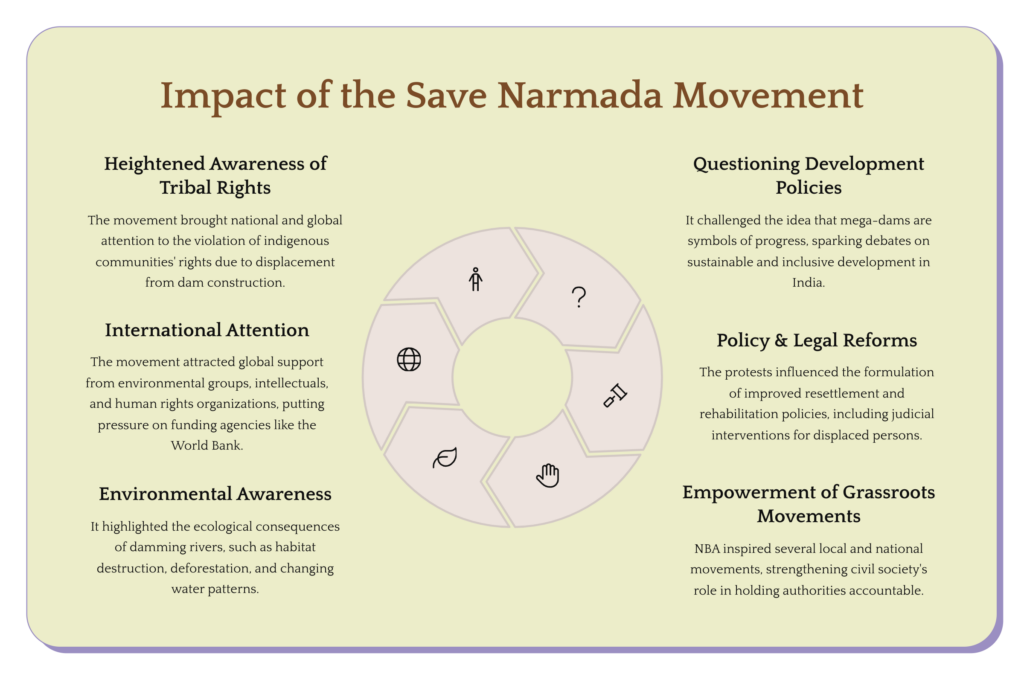
These movements signify the rise of a "civil society" that holds the state accountable. They have been instrumental in introducing concepts like environmental impact assessment, sustainability, and community rights into the vocabulary of Indian governance, even if the conflict between development and conservation continues to be a major source of tension.
Conclusion
In this final lesson, we have explored three critical and ongoing social challenges in contemporary India: the persistent inequality and political mobilization of caste, the divisive and often violent ideology of communalism, and the critical questions raised by environmental movements about the nature of India's development. These are not just social issues; they are the very dynamics that have fueled the political shifts and shaped the economic trajectory of modern India.
Key Takeaways:
- Caste has transformed from a traditional social hierarchy into a powerful axis of political identity and competition, even as deep-seated socio-economic disparities persist.
- Communalism is a modern political ideology that leverages religious identity for political ends and remains a serious threat to India's secular democracy.
- Environmental movements represent a crucial challenge from civil society to the state's development model, raising fundamental questions about sustainability, displacement, and social justice.
A Final Word on Our Journey
Over the past twelve lessons, we have journeyed through millennia of history on the Indian subcontinent. We started with the first urban settlements of the Indus Valley and have ended with the complex social and political fabric of the world's largest democracy.
Throughout this course, we have focused on understanding the systems behind the events—the administrative structures of empires, the economic logic of trade routes, the synthesis of cultures, and the evolution of social and religious traditions. We have seen how themes of continuity and change are woven throughout India's past. The caste system's modern form, for instance, is a product of this long evolution. The vibrant debates in independent India echo the rich philosophical traditions of the past.
This course has aimed to provide you with a structured, analytical foundation for understanding this vast and fascinating history. I hope it has sparked your curiosity and equipped you to continue exploring the many stories of the subcontinent on your own. Thank you for your engagement, and I wish you the best in your future studies.