Introduction
Welcome to the final lesson in our comprehensive course on the history of the Indian subcontinent. In our last lesson, we delved into the complex internal dynamics of contemporary India, exploring the social challenges and movements related to caste, communalism, and the environment. These internal forces have profoundly shaped India's domestic politics and society.
Today, we pivot from the internal to the external. We will examine how India has navigated its relationships with the rest of the world, from its early post-independence years to its current position as a major global player. The learning outcome for this capstone lesson is to: Assess India's changing role in the global order from the Cold War to the 21st century.
This is a story of evolution, from a newly independent nation finding its feet in a bipolar world to a rising power actively shaping a new, multipolar order. We will trace this journey through three key foreign policy concepts:
- Non-Alignment: The original doctrine of staying out of Cold War power blocs.
- Strategic Autonomy: The post-Cold War principle of maintaining independent decision-making.
- Multi-Alignment: The contemporary practice of engaging with multiple, often competing, powers simultaneously.
Given your background in finance and geopolitics, you'll find the strategic calculations and risk management inherent in this diplomatic evolution particularly interesting.
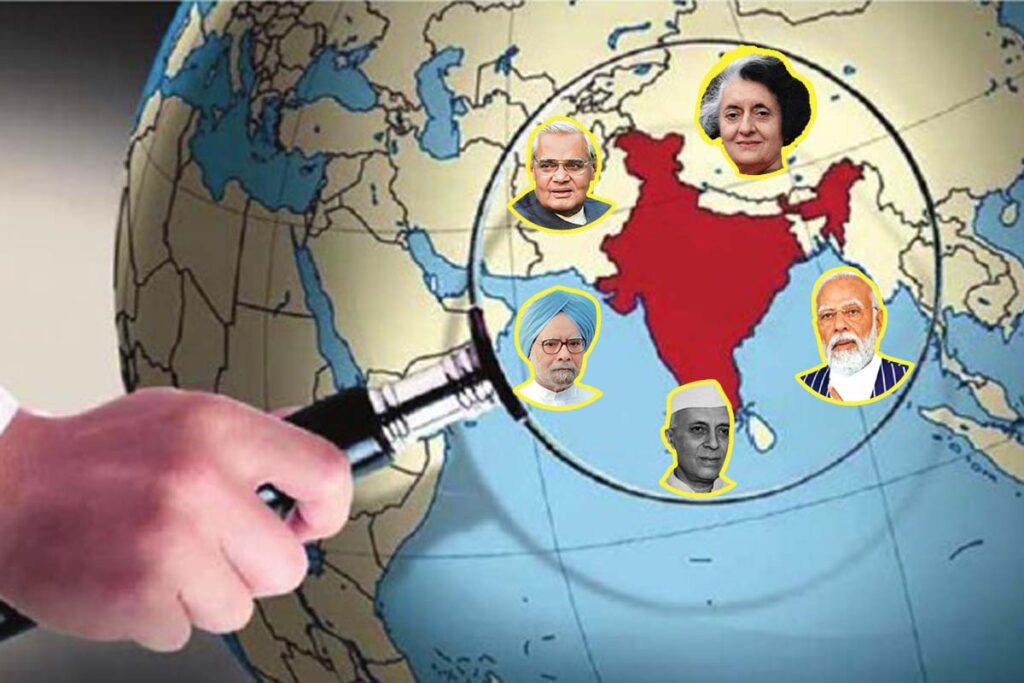
Let's begin by understanding the foundational policy of Non-Alignment.
Part 1: The Cold War Era – The Doctrine of Non-Alignment (1947-1991)
Emerging from colonial rule in 1947, India found itself in a world starkly divided into two camps: the capitalist bloc led by the United States and the communist bloc led by the Soviet Union. India's first Prime Minister, Jawaharlal Nehru, charted a "third way." This was the policy of Non-Alignment.
To understand its core principles and the context in which it emerged, please watch the following video.
Non Alignment to Multi Alignment | Vajiram and Ravi Optional Classes
The video 'Non Alignment to Multi Alignment' by Vajiram and Ravi Official provides an excellent, structured explanation of the evolution of Indian foreign policy. We'll start with the section that lays the groundwork for the entire lesson.
Please watch the segment from 02:09 to 10:35. This section explains: The Cold War context and the division of the world into two superpower blocs. The core meaning of non-alignment: a conscious decision to not join either bloc. The key reasons for this policy: preserving scarce resources for development, safeguarding hard-won sovereignty, and maintaining an independent foreign policy (the essence of strategic autonomy). How this policy enabled India to become a leader of the 'Third World' through the Non-Aligned Movement (NAM).
As the video explains, non-alignment was not isolationism or simple neutrality. It was an active policy designed to maximize India's freedom of action. However, this idealist policy was tested by geopolitical realities. Two key events marked a shift towards greater pragmatism:
- The 1962 Sino-Indian War: This conflict was a profound shock. The defeat exposed the limits of idealism and underscored the need for military preparedness, leading to a significant modernization of the Indian armed forces.
- The 1971 Indo-Soviet Treaty: Facing a potential US-China-Pakistan axis during the Bangladesh Liberation War, India signed a Treaty of Peace, Friendship and Cooperation with the Soviet Union. While criticized by some as a violation of non-alignment, it was a pragmatic move to secure India's strategic interests—an "insurance policy," as described in the CIDOB paper "India's foreign policy reconfiguration".
These events signaled a move away from pure idealism towards a more realist approach, even while the rhetoric of non-alignment continued.
Part 2: The Post-Cold War Transition – The Quest for Strategic Autonomy (1991-2014)
The early 1990s brought two seismic shocks that forced a fundamental re-evaluation of India's foreign policy.
- The Collapse of the Soviet Union (1991): India's most reliable strategic partner disappeared, and the bipolar world order that gave non-alignment its meaning vanished.
- India's Economic Crisis (1991): A severe balance of payments crisis forced India to abandon its state-led economic model and embrace liberalization, privatization, and globalization (LPG reforms).
This new context demanded a new approach. The following reading explains this pivotal transition.
India’s foreign policy reconfiguration: from non-alignment to multi-alignment
Let's turn to the academic paper, 'India's foreign policy reconfiguration: from non-alignment to multi-alignment,' by Patrizia Cogo Morales for CIDOB. This text clearly outlines the shift from non-alignment to strategic autonomy.
Please read the section titled 'New beginnings: the switch to the principle of strategic autonomy (1991–2014)'. This section details how India reoriented its foreign policy in response to the end of the Cold War and its own economic reforms. Focus on: How non-alignment 'lost its relevance' in a unipolar world. The emergence of strategic autonomy as the new guiding principle, aiming to give India 'leeway' in its decisions. The use of 'strategic partnerships' as a flexible tool instead of rigid alliances. Key policy initiatives of this era: economic liberalization, the 'Look East Policy,' and the gradual rapprochement with the US, culminating in the landmark Indo-US nuclear deal.
This period was defined by a pragmatic search for new partnerships. While Russia remained an important defence supplier, India began to "Look East" towards Southeast Asia, mend ties with China on the economic front, and, most significantly, end decades of estrangement with the United States. The 1998 nuclear tests were a bold declaration of this new self-reliance, and while initially met with sanctions, they paradoxically paved the way for the US to eventually recognize India as a legitimate nuclear power and a key strategic partner.
Part 3: The 21st Century – The Era of Multi-Alignment
The contemporary world is no longer unipolar. It is an increasingly multipolar system, characterized by the continued strength of the US, the assertive rise of China, a revanchist Russia, and the growing influence of other powers, including India itself. In this complex environment, India's foreign policy has evolved into what is now termed Multi-Alignment.
This strategy is best understood as putting strategic autonomy into practice in a multipolar world. Dr. Shashi Tharoor, a diplomat and politician, provides an eloquent overview of this new global landscape and India's role within it.
Lecture: India in the New World Order by Dr.Shashi Tharoor
In his lecture, 'India in the New World Order,' Dr. Tharoor explains the current state of global affairs and articulates the essence of India's multi-alignment strategy.
Please watch the following segments: The Evolving World Order (05:08 - 12:40): Dr. Tharoor provides a concise history of global orders: bipolar (Cold War), unipolar (post-1990 US dominance), and the current complex phase with the rise of China and 'the rest'. The Essence of Multi-Alignment (13:58 - 17:04): This is a crucial section. He explains multi-alignment as maintaining different relationships with different countries for different purposes. Note the examples of India being the only common member in groupings like RIC, BRICS, BASIC, and IBSA. India in Global Forums (17:04 - 21:13): Listen to his explanation of India's key role in the Quad (with the US, Japan, Australia) and the G20, and the expansion of BRICS (with China, Russia, and others). This demonstrates multi-alignment in action.
As Dr. Tharoor highlights, India today is a member of competing geopolitical formations. It is a key pillar of the Quad, an initiative largely seen as a counterbalance to China. Simultaneously, it is a founding member of BRICS and the Shanghai Cooperation Organisation (SCO), forums dominated by Russia and China.
This is the core of multi-alignment: a pragmatic, issue-based engagement with all major powers. From a strategic perspective, this is akin to a 'hedging' strategy or portfolio diversification, which prevents over-reliance on any single power and maximizes India's options.
To get a final, up-to-date analysis of these relationships, let's return to the CIDOB article.
India’s foreign policy reconfiguration: from non-alignment to multi-alignment
The final section of the CIDOB paper analyzes India's foreign policy under the current government, providing concrete examples of its multi-alignment strategy.
Please read the section titled 'A rising India: The era of multi-alignment (2014–present)'. Focus on its analysis of India's delicate balancing act in its relationships with: The United States: Deepening cooperation on defence and technology, driven by shared concerns about China. China: A relationship of deep mistrust and security competition (border disputes, BRI) coexisting with significant economic interdependence. Russia: A legacy relationship that remains important for defence and energy, which India has carefully maintained despite Western pressure over the war in Ukraine.
Today, India leverages its growing economic clout, its large military, its technological prowess (like the Unified Payments Interface, UPI), and its role as a "leading voice of the Global South" to navigate this complex world. It aims to be a leading power, not just a balancing power, shaping global conversations on everything from climate change to digital governance.
Conclusion
In this final lesson, we have assessed the remarkable transformation of India's role in the global order. We traced its journey from the principled Non-Alignment of the Cold War, through the pragmatic adaptation to Strategic Autonomy in a unipolar moment, to the sophisticated practice of Multi-Alignment in today's multipolar world.
Key Takeaways:
- India's foreign policy has evolved from an ideological stance (Non-Alignment) to a highly pragmatic and transactional one (Multi-Alignment).
- The core objective throughout this evolution has been the preservation of strategic autonomy—the ability to make independent decisions based on national interest.
- In the 21st century, India navigates complex geopolitics by engaging with all major power centers, participating in competing alliances like the Quad and BRICS simultaneously.
- This 'strategic hedging' is underpinned by India's growing economic, military, and demographic weight, which allows it to command a more significant position on the world stage.
A Final Word on Our Journey
Over the past twelve lessons, we have traversed more than five millennia of the Indian subcontinent's history. We began with the sophisticated urban planning of the Indus Valley Civilization and concluded with the intricate foreign policy of the world's largest democracy.
Our goal was to move beyond a simple narrative of kings and battles to understand the underlying systems that have shaped India: the administrative frameworks of empires like the Mauryas and Mughals; the economic logic of trade routes like the Silk Road and the Indian Ocean network; the philosophical depth of its religious traditions; and the stunning creativity of its art and architecture.
You have seen how themes of continuity and change are deeply interwoven in this history. The politicization of caste is a modern phenomenon, yet it draws on ancient social structures. The policy of multi-alignment is a 21st-century strategy, but its core impulse for autonomy has been a constant since 1947.
I hope this course has provided you with a robust analytical framework for understanding the Indian subcontinent's rich and complex past, and that it has kindled a desire to continue exploring its many fascinating stories. Thank you for your dedicated engagement throughout this journey.