Introduction
Welcome to your twelfth and penultimate lesson in our course on Indian history. In our last session, we delved into the 1991 economic crisis and the subsequent liberalization reforms. We analyzed how a balance of payments crisis, born from long-term structural issues and short-term shocks, forced a paradigm shift from a state-controlled economy to a market-oriented one. As we previewed, that economic earthquake had profound political aftershocks.
This lesson directly addresses that political transformation. Our learning outcome is to: Analyze the shift from one-party dominance to an era of coalition politics and the rise of regional parties.
For the first four decades of independence, Indian politics was defined by the 'Congress System'—the dominance of the Indian National Congress. Starting in the late 1980s, this system fragmented, ushering in a long period where no single party could govern alone. We will examine:
- The Decline of the Congress System: What caused the erosion of single-party dominance?
- The Rise of Regional Parties and Coalitions: How did regional forces and multi-party alliances reshape the political landscape?
- The Dynamics of Coalition Governance: We'll analyze the evolution from unstable alliances in the 1990s to more stable coalitions in the 2000s.
- The Contemporary Landscape: We will conclude by assessing the post-2014 political scene and whether it marks a return to one-party dominance.
Given your background in finance and your interest in political economy, you will find the interplay between social change, economic policy, and political power particularly relevant.
Part 1: The Decline of the "Congress System"
The "Congress System" refers to the period from 1947 to 1989 when the Indian National Congress was the undisputed giant of Indian politics, consistently winning majorities and governing at the national level. Its decline was not a single event but a gradual erosion driven by deep-seated social and political changes.

To understand the complex factors that dismantled this system, we will turn to an insightful academic paper.
[PDF] India: The Weakening of the Congress Stranglehold and the ...
The paper 'India: The Weakening of the Congress Stranglehold' by Desh Gupta provides a detailed analysis of the forces that eroded Congress's dominance.
Please read Section 3, 'The Weakening Relative Position of the Congress Party' (pages 7-14). As you read, focus on the interconnected reasons for the party's decline: Marginalisation in Key States (3A): How did the rise of parties based on regional identity (e.g., DMK in Tamil Nadu over language) and caste assertion (e.g., Samajwadi Party and BSP in Uttar Pradesh, representing OBC and Dalit interests) chip away at Congress's base? Alienation of Vote Banks: Note how Congress's handling of issues like the Shah Bano case and the Babri Masjid dispute led to the alienation of its traditional Muslim vote bank. Emergence of the BJP (3B): How did the BJP position itself as a viable national alternative, consolidating the Hindu vote and capitalizing on Congress's strategic errors? Internal Splits (3C): How did splits, like the formation of the NCP in Maharashtra, further weaken the party organizationally?
In essence, the Congress party, once a broad coalition accommodating diverse interests, found itself unable to manage the rising aspirations of newly empowered social groups, particularly the Other Backward Classes (OBCs) and Dalits, and the consolidation of Hindu nationalist sentiment. This created a political vacuum that was filled by a host of new political actors.
Part 2: The Rise of Regional Parties and the Dawn of the Coalition Era
The direct consequence of Congress's decline was the ascent of regional and state-based parties. These parties, often built around a specific regional, linguistic, or caste identity, became powerful players in their respective states and, consequently, "kingmakers" in national politics.
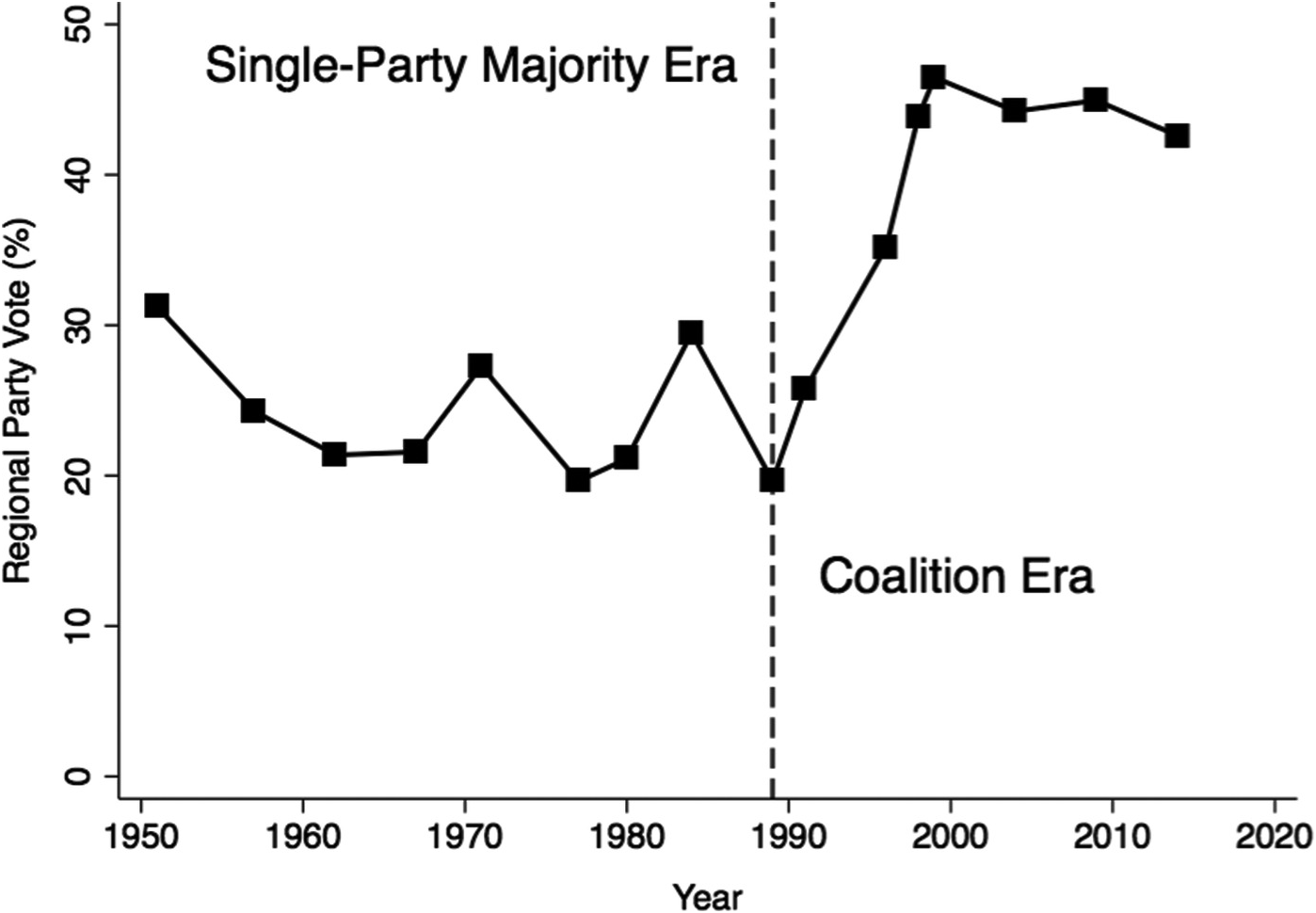
The 1989 general election was the first to produce a hung parliament, leading to a minority government under V.P. Singh's National Front, supported from the outside by both the BJP on the right and the Left Front. This initiated a period of intense political instability and experimentation.
To understand the mechanics and challenges of these early coalitions, let's examine the 1996 elections, a textbook case of a fractured mandate.
1996: An Era of Coalition Politics Dawns | Milestone | Making of Modern India
This video, '1996: An Era of Coalition Politics Dawns', chronicles the formation and collapse of the United Front governments, perfectly illustrating the chaotic nature of early coalition politics.
Please watch the entire video. It lucidly explains: The fractured 1996 election results with no clear winner. The formation of the 'United Front', a motley coalition of 13 regional and left parties, with the sole purpose of keeping the single largest party, the BJP, out of power. The dependence on 'outside support' from the Congress party, which ultimately proved fatal. The reason for the coalition's failure: the lack of a strong, dominant 'anchor' party at its core.
The experience of the United Front governments (1996-1998) demonstrated that a coalition built merely on anti-incumbency or opposition to another party, without an internal anchor or ideological coherence, was inherently fragile.
Part 3: Maturing Coalitions and Their Impact (1999-2014)
The lessons from the 1990s were crucial. The subsequent period saw the emergence of more stable coalitions that completed full five-year terms: the BJP-led National Democratic Alliance (NDA) from 1999-2004, and the Congress-led United Progressive Alliance (UPA) from 2004-2014. The key difference was that each was built around a large national party that served as a stable anchor.
A research paper provides a systematic overview of these major coalitions and analyzes their broader impact on the Indian political system.
[PDF] The Impact Of Coalition Government On The Indian Political System
The paper 'The Impact Of Coalition Government On The Indian Political System' gives us a structured framework for understanding the evolution and consequences of coalition politics.
Please read the following sections: 'Major Coalition Governments in India' (specifically points 3 and 4 about the NDA and UPA, pages h853-h854) to see how these alliances differed from the earlier ones. 'Impact of Coalition Government on the Indian Political System' (page h855) to understand the effects on stability, policy-making, and federalism. 'Merits and Demerits of Coalition Government' (page h860) for a concise summary of the pros and cons.
Drawing from the paper, we can summarize the dual-edged impact of coalition governments:
Merits:
- Greater Inclusivity: Gave a national voice to diverse regional and community interests.
- Strengthened Federalism: Empowered state-level leaders and forced the central government to be more responsive to regional demands.
- Checks and Balances: The need for consensus among partners often prevented unilateral or drastic policy decisions, fostering a more consultative style of governance.
Demerits:
- Instability: Governments were constantly vulnerable to the withdrawal of support by partners, as seen vividly in the 1990s.
- Policy Paralysis: Conflicting interests among allies could lead to gridlock on crucial reforms. This was a significant challenge for the UPA-II government (2009-2014).
- Political Bargaining: Smaller parties could wield disproportionate influence, sometimes leading to governance compromises in exchange for political support.
Part 4: The Contemporary Landscape – A Return to Dominance?
The 2014 and 2019 general elections, which gave the BJP an absolute majority on its own, appeared to signal an end to the national coalition era. This has led to a debate: is India back in an era of one-party dominance, or is this a new phase in its political evolution?
Let's hear from one of India's foremost political commentators, Pratap Bhanu Mehta, on this question.
Has Indian democracy entered a one-party era? Pratap Bhanu Mehta explains | SpeakEasy - Episode 2
In this interview, 'Has Indian democracy entered a one-party era?', Pratap Bhanu Mehta offers a nuanced analysis of the current political situation and the future of coalition politics.
Please watch the selected clips: 01:33 - 04:21: Mehta distinguishes between literal 'one-party rule' and 'one-party dominance,' arguing the latter is deeply entrenched due to ideological shifts and the BJP's organizational power. 16:15 - 21:33: He explains the structural difficulties faced by opposition parties, like the Congress, in building credibility and mobilizing support to challenge the dominant narrative. 23:00 - 25:48: He analyzes why creating a new national challenger is difficult and why forming effective opposition coalitions is harder now than in the 1990s, partly due to the dominant party's coercive power.
Mehta's analysis suggests that while the formal structure of a multi-party system remains, the political dynamics have shifted towards a dominant-party system where the BJP sets the ideological and political agenda. Coalition-building now seems more a strategy for the opposition to survive and challenge this dominance, rather than a necessary condition for governance at the national level.
Conclusion
Today, we have traced the arc of Indian politics from the monolith of the 'Congress System' to the mosaic of the coalition era, and into the current phase of BJP dominance.
Key Takeaways:
- The decline of one-party dominance was driven by the rise of identity politics (caste and region), the alienation of key vote banks from Congress, and the emergence of the BJP as a national alternative.
- The rise of regional parties was a direct consequence, transforming them into indispensable players in national government formation from 1989 to 2014.
- The era of coalitions evolved from highly unstable alliances in the 1990s to more stable, 'anchored' coalitions under the NDA and UPA, which had mixed effects on governance, promoting inclusivity but sometimes causing policy paralysis.
- The post-2014 period marks a shift towards a new dominant-party system at the national level, fundamentally altering the dynamics and challenges of coalition-building for opposition parties.
Preview of the Next Lesson:
This transformation in India's domestic polity has had significant implications for its engagement with the rest of the world. In our final lesson of the course, we will assess India's changing role in the global order from the Cold War to the 21st century. We will connect how the shift from a single-party, non-aligned, state-led economy to a multi-party, globally-integrated, market-driven power has redefined India's foreign policy and its place on the world stage.