Introduction
Welcome to your next lesson. In our previous session, we examined the monumental process of framing the Indian Constitution, focusing on its guiding principles of justice, liberty, equality, and fraternity. We saw how the Directive Principles of State Policy, in particular, laid down a blueprint for a social and economic democracy, envisioning an active role for the state in nation-building.
Today, we will analyze how Jawaharlal Nehru, India's first Prime Minister, sought to translate that constitutional vision into reality. This lesson addresses the learning outcome: Analyze the Nehruvian model of economic development (five-year plans, mixed economy) and foreign policy (Non-Aligned Movement). We will explore the two central pillars of the Nehruvian era: a state-directed economic strategy aimed at industrial self-sufficiency, and an independent foreign policy that sought to carve out a unique path for India in a world divided by the Cold War.
Part 1: The Nehruvian Economic Model: A Tryst with Socialism
Drawing inspiration from the Directive Principles and his own Fabian socialist convictions, Nehru envisioned a "socialistic pattern of society." This was not a wholesale adoption of Soviet-style communism but a unique Indian experiment in a mixed economy. The state would control the "commanding heights" of the economy—heavy industry, infrastructure, and strategic sectors—while the private sector would operate in consumer goods and other areas, albeit under state regulation.
The primary instrument for this state-led development was the Planning Commission, established in 1950. Its task was to formulate Five-Year Plans that would allocate resources and set targets for the entire economy.
To understand the key policies and the rationale behind them, let's start with a video that outlines the major economic steps taken in this era.
30 years of Socialism (1947-1980) | Economic history of India | License Permit Raj | Modern History
This video, '30 years of Socialism' by Amit Sengupta, provides a chronological overview of the key economic policies implemented from 1947 onwards. It effectively illustrates the establishment of the planning framework and the process of nationalization.
Please watch the segment from 00:45 to 05:30. As you watch, focus on: The creation of the Planning Commission and the adoption of the Soviet-inspired Five-Year Plan model (00:45 - 01:49). The Industrial Development and Regulation Act of 1951, which laid the foundation for the 'License-Permit Raj' by giving the central government vast regulatory powers over industries (01:49 - 03:40). The wave of nationalizations (Air India, Life Insurance) and the emphasis on the public sector and rapid industrialization in the Second Five-Year Plan, guided by the Industrial Policy Resolution of 1956 (03:40 - 05:30).
As the video explains, the Nehruvian economic strategy, particularly the model designed by statistician P.C. Mahalanobis for the Second Plan (1956-61), prioritized capital-intensive heavy industries over consumer goods. The goal was Import Substitution Industrialization (ISI)—to build domestic capacity and achieve self-reliance by producing everything from steel to machinery at home. This led to a protectionist regime with high tariffs and strict controls on imports and foreign investment.
While this strategy helped build a diversified industrial base and crucial scientific institutions, it also came with significant economic costs. For a deeper analysis of the model and its consequences, the following text is essential.
The Indian Economy Since Independence
The paper 'The Indian Economy Since Independence' provides a critical academic analysis of the planning era. It moves beyond just describing the policies to evaluating their effectiveness, which is central to our learning outcome.
Please read the first three pages, focusing on these sections: 'Indian Planning process': Note the stated objectives (socialistic pattern, self-reliance, social justice) and the Nehru-Mahalanobis Plan's emphasis on heavy industry and a dominant public sector. The end of the section: Read the part discussing the limitations, such as the failure of the 'trickle-down' approach and the public sector's inability to generate surpluses. 'The Failure of the Planning Process': This is a crucial section. It critiques the model for delivering slow growth (the 'Hindu rate of growth'), turning the public sector into a drain on national savings, and the erosion of accountability in 'public servant' roles. Given your background in finance, you'll recognize this as a critique of inefficient capital allocation and poor returns on investment.
Analysis of the Economic Model
Let's synthesize what we've learned from these resources. The Nehruvian economic model was a comprehensive vision with clear achievements and significant drawbacks.
Key Components & Achievements:
- Centralized Planning: The Five-Year Plans created a framework for systematic, state-led investment.
- Public Sector Undertakings (PSUs): The creation of entities like BHEL, SAIL, and ONGC, which Nehru called the "temples of modern India," built a strong foundation in core industrial and energy sectors.
- Institutional Base: This era saw the establishment of premier scientific and technical institutions like the IITs and CSIR labs, which have had a lasting positive impact.
Criticisms & Unintended Consequences:
- The "License-Permit-Quota Raj": The regulatory framework designed to direct the economy devolved into a complex, bureaucratic system that stifled private initiative and bred corruption. For any entrepreneur, obtaining licenses for setting up, expanding, or even importing raw materials became a herculean task. This created significant barriers to entry and distorted market competition.
- Inefficiency and Low Growth: The PSUs, shielded from competition and often subject to political interference, became notoriously inefficient. Instead of generating surpluses for further investment as planned, many became loss-making enterprises dependent on government bailouts. This, combined with the constraints on the private sector, led to a decades-long period of sluggish economic growth, averaging around 3.5% per year.
- Neglect of Primary Education & Agriculture: The heavy focus on industrialization meant that agriculture (until the food crises of the 1960s) and, crucially, mass primary education and health received less priority. This contrasts sharply with the East Asian "Tiger" economies, which built their economic miracles on a foundation of high literacy.
Part 2: Foreign Policy - The Non-Aligned Movement
In parallel with his domestic economic strategy, Nehru crafted a distinctive foreign policy for India. Emerging into a world starkly divided by the Cold War between the United States and the Soviet Union, India chose not to join either bloc. This policy became known as the Non-Aligned Movement (NAM).
It's crucial to understand that non-alignment did not mean passive neutrality or isolationism. Nehru saw it as a positive and independent policy that would allow India to maintain its sovereignty, judge international issues on their merits, and focus on its own development.
This short video provides an excellent overview of the origins and principles of NAM.
India's Foreign Policy Evolution From 1947 to 2025 | The India Story | Vantage with Palki Sharma
The video 'India's Foreign Policy Evolution' from Firstpost clearly explains the geopolitical context of the Cold War and India's rationale for pursuing non-alignment.
Please watch from 00:53 to 04:34. Pay attention to: The concept of staying out of the two power blocs (00:53 - 02:21). The key milestones like the Asian Relations Conference (1947) and the Bandung Conference (1955), which brought Asian and African nations together. The reality check of the 1960s: the 1962 war with China and economic dependence on foreign aid, which challenged the practical application of non-alignment (02:21 - 04:34).
The core principles of Nehru's foreign policy were first articulated in the Panchsheel (Five Principles), which were part of an agreement with China in 1954:
- Mutual respect for each other's territorial integrity and sovereignty.
- Mutual non-aggression.
- Mutual non-interference in domestic affairs.
- Equality and mutual benefit.
- Peaceful co-existence.
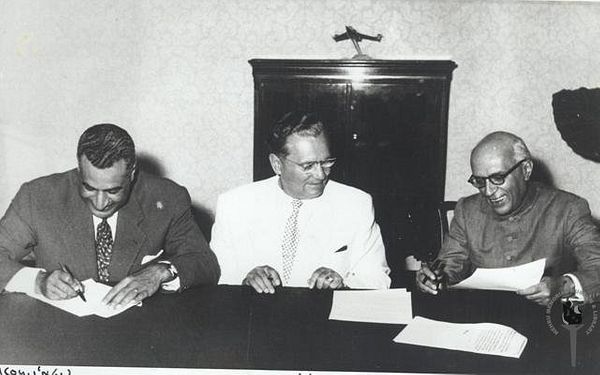
These principles, along with anti-colonialism and disarmament, formed the ideological bedrock of NAM, which was formally established at the Belgrade Conference in 1961.

Analysis of the Foreign Policy Model
For a more formal analysis of NAM and its eventual evolution, let's turn to our final resource.
Rise and Demise of Nehruvian Consensus: A Historical Review
The paper 'Rise and Demise of Nehruvian Consensus' offers a succinct academic perspective on Nehru's foreign policy framework and the factors that led to its modification over time.
Please read the two short sections on foreign policy: 'Foreign Policy Consensus': This details the ideals of non-alignment, Panchsheel, and anti-imperialism. Note the argument that Nehru had a relatively free hand in foreign policy compared to domestic policy. 'Foreign Policy' (under The Erosion of the Consensus): This section explains how the consensus was challenged. Focus on the impact of the 1962 war with China, which exposed India's military weakness and diluted the moralistic tone of its foreign policy, forcing a turn towards realism and greater defense spending.
Synthesizing these points, we can evaluate NAM's legacy.
Successes:
- Strategic Autonomy: NAM allowed India to maintain an independent foreign policy and avoid being drawn into military alliances that would have diverted resources from development.
- Global Stature: It gave India a prominent voice on the world stage, far exceeding its economic or military weight at the time. Nehru was seen as a global statesman and a leader of the "Third World."
- Flexibility: India was able to receive economic and technical assistance from both the US and the USSR, skillfully navigating the rivalries of the Cold War.
Challenges and Criticisms:
- Idealism vs. Realism: The devastating defeat in the 1962 Sino-Indian War was a major blow. It demonstrated that the idealistic principles of Panchsheel were no substitute for military preparedness and pragmatic alliances. This led to a period of introspection and a more realistic turn in Indian foreign policy.
- Charges of Hypocrisy: India’s non-aligned credentials were often questioned. The takeover of Goa from the Portuguese in 1961 was criticized by the West. Later, the 1971 Indo-Soviet Treaty of Friendship and Cooperation, signed in the lead-up to the Bangladesh Liberation War, was seen by many as a de facto alliance with the Soviet Union, undermining the core principle of non-alignment.
Conclusion
The Nehruvian model represented a grand, ambitious vision for a newly independent India. It sought to build a self-reliant, industrial economy on a socialistic pattern while simultaneously navigating a treacherous international landscape with an independent, non-aligned foreign policy.
Key Takeaways:
- Economic Model: The Nehruvian economy was a mixed economy driven by centralized planning (Five-Year Plans) and focused on Import Substitution Industrialization. It succeeded in building a heavy industrial base but was plagued by the inefficiencies of the "License-Permit Raj" and a slow "Hindu rate of growth."
- Foreign Policy Model: The Non-Aligned Movement (NAM) was Nehru's answer to the Cold War. It aimed to preserve India's strategic autonomy and give a collective voice to newly independent nations.
- Interconnection: The two policies were linked. An inward-looking economy (self-reliance) complemented an independent foreign policy (non-alignment).
- Legacy of Contradictions: The model left a complex legacy. It created foundational industrial and scientific institutions but also entrenched economic inefficiencies that would persist for decades. Its foreign policy enhanced India's global prestige but was ultimately forced to reconcile its high ideals with geopolitical realities.
Preview of the Next Lesson:
The challenges inherent in the Nehruvian model, particularly in agriculture, led to severe food crises in the 1960s. In our next lesson, we will explore the major post-Nehruvian political and economic shifts, focusing on the state's response to these crises through the Green Revolution and the dramatic political upheavals culminating in the 1975 Emergency.