Introduction
Welcome to your next lesson. In our last session, we examined the consolidation of the Sikh Empire in the 19th century, focusing on Maharaja Ranjit Singh's military and administrative reforms that created a powerful, centralized state in the Punjab. Today, as previewed, we are taking a significant step back in time and moving south to the Deccan to explore one of medieval India's most powerful and prosperous empires: the Vijayanagara Empire (c. 1336–1646 CE).
This lesson directly addresses the learning outcome: Explain the administrative system (Nayankara) and trade networks of the Vijayanagara Empire.
We will dissect the two pillars that underpinned Vijayanagara's strength. First, we'll analyze its unique politico-military structure, the Nayankara system, a sophisticated method of delegating authority that both empowered the empire and contained the seeds of its eventual fragmentation. Second, we will map out the vast trade networks that fueled its economy, making its capital one of the most fabled cities of its time. Your background in finance and business strategy will be valuable in appreciating how the empire structured its administration through a system of delegated responsibilities and incentives, and how it leveraged its strategic geography to dominate key commercial arteries.
The Administrative Framework of the Empire
Like any large state, the Vijayanagara Empire required a structured administrative hierarchy to govern its vast territories. The empire was organized with the king (Raya) at the apex, assisted by a council of ministers and a central secretariat. The territory was then divided into provinces, districts, and finally, villages.

At the heart of its provincial governance was a distinctive institution known as the Nayankara system. This was the primary mechanism through which the emperor controlled the territories outside the immediate vicinity of the capital.
To begin, let's watch a short video that defines this system and outlines the role of the key players, the Nayakas.
NAYANKARA SYSTEM||VIJAYANAGAR EMPIRE||UPSC
This video from LEARNING LIB provides a concise and focused explanation of the Nayankara system, defining the Nayakas and their relationship with the central authority.
Please watch the entire video (around 5 minutes). Focus on: The definition of the Nayakas as high-grade military officers. The concept of amaram as a land grant given in lieu of service/salary. The primary duties of the Nayakas: maintaining an army, collecting revenue, and ensuring law and order.
The Nayaka System: A Deeper Look
As the video explained, the Nayankara system was a politico-military arrangement where the king granted land tenures, known as amaram, to military commanders or chiefs called Nayakas. In return for these grants, the Nayakas had several key obligations.
To build on this, let's examine a more detailed description of how this system functioned.
The resource 'Vijayanagara Empire at its Peak' from Itihaas offers a clear summary of the system and its place within the broader administration.
Please read the short section titled 'The Nayaka System'. Note the obligations of the Nayakas, including annual tribute and military service, and their level of autonomy.
To synthesize and expand on these resources, the core components of the Nayankara system were:
- The Nayakas: These were powerful military chiefs, not just civil administrators. They held titles and were responsible for the governance of their assigned territories.
- The Amaram Grant: The territory granted to a Nayaka was his amaram. This was not an outright land ownership but a right to the revenue from that land. From this income, the Nayaka had to cover his personal expenses, administrative costs, and, most importantly, maintain a stipulated contingent of elephants, horses, and soldiers for the king.
- Obligations to the Center: Nayakas were required to pay an annual tribute to the royal treasury, personally attend the royal court to express loyalty, and provide military support to the emperor during campaigns.
- Local Autonomy: Within their territories, Nayakas wielded significant power. They maintained their own courts, collected taxes from peasants and traders, and were responsible for the upkeep of temples and irrigation works.
Feudalism or a Unique System?
A key debate among historians, which you might find interesting given your background in analyzing organizational structures, is how to classify the Nayankara system. Some scholars have compared it to European feudalism, where lords held land from a king in exchange for military service.
However, many historians argue against a direct comparison. To explore this nuance, let's turn to a more academic text.
Unit III: Vijaynagar Administration and Socio-Cultural Aspects
This PDF from Y.K. College delves into the scholarly debate on the nature of the Nayankara system.
Please read the section titled 'The amara-nayaka system' (starting on page 1). Focus on the different interpretations offered by scholars like Krishnaswami (feudal), and Venkataramanayya and D.C. Sircar (who refute the feudal theory).
As the text discusses, scholars like D.C. Sircar argue that the system was more a form of "landlordism," where Nayakas were essentially officers of the state holding an office (kara) conditional on military service, rather than hereditary feudal lords bound by personal fealty. The king could, and often did, transfer Nayakas from one place to another to assert his authority.
This system was a double-edged sword. It allowed the empire to maintain a large, decentralized army without draining the central treasury. However, it also created a class of powerful regional magnates. When the central authority weakened in the 17th century, many of these Nayakas—in places like Madurai and Thanjavur—declared independence, hastening the empire's collapse.
The Economic Engine: Vijayanagara's Trade Networks
The splendor of Vijayanagara, which amazed foreign travelers, was built on a foundation of immense wealth derived from agriculture and, critically, extensive trade. The empire's strategic location in the peninsula gave it control over major ports on both the west and east coasts.
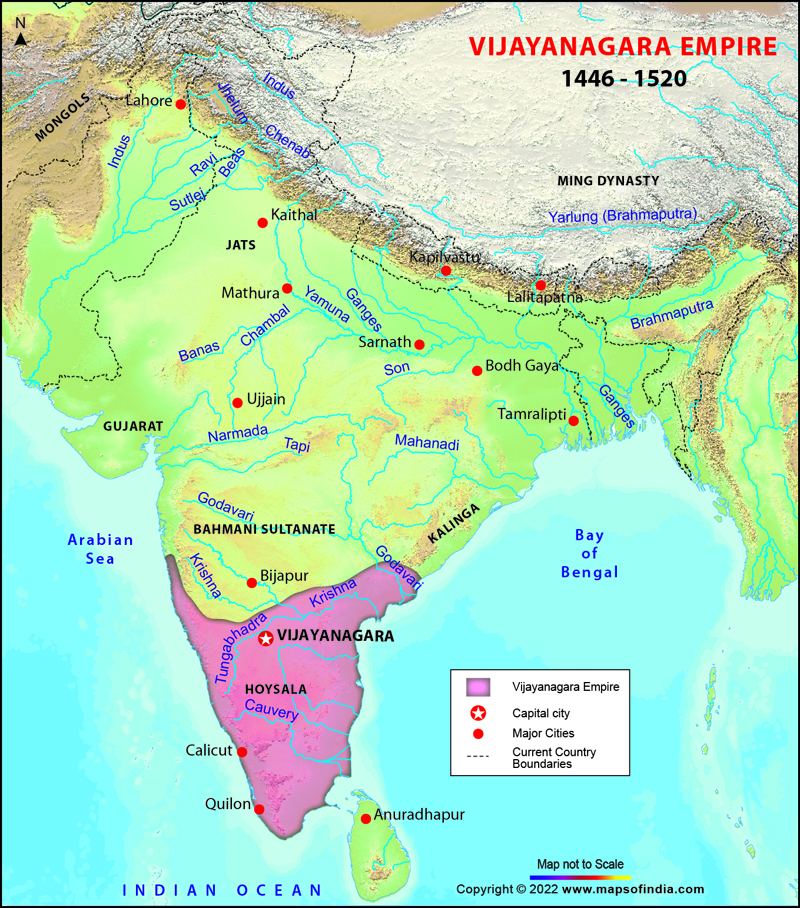
Vijayanagara was a nexus for overlapping trade routes, connecting the interior of the Deccan with the bustling maritime commerce of the Indian Ocean.
Economic Geography of the Vijayanagara Empire
The 'Economic Geography' section from the Itihaas resource provides an excellent, comprehensive overview of the empire's trade.
Please read the subsections 'Trade Networks and Routes' and 'Major Ports and Trading Centers'. Pay close attention to: The major commodities of import and export. The crucial strategic importance of the horse trade. The key ports on both coasts and their respective specializations.
As the reading highlights, the empire's trade was complex and multi-layered:
Key Imports:
- Horses: This was the most strategic import. High-quality war horses were not bred in South India and had to be imported from Arabia and Persia. Control over the western ports like Bhatkal and Mangalore gave Vijayanagara a critical military advantage over its rivals, the Deccan Sultanates. The Portuguese, after their arrival, became key players in this horse trade.
- Luxury Goods: The elite of the empire imported velvet, silk from China, and precious stones.
Key Exports:
- Textiles: Fine cotton fabrics were a major export, particularly from the eastern Coromandel Coast.
- Spices: Pepper, cardamom, and ginger from the Malabar Coast and Western Ghats were highly sought after in global markets.
- Precious Stones: The empire controlled access to the famous diamond mines of the region (often associated with Golconda).
- Other Goods: Iron, rice, and sugarcane were also significant exports.
Trade Hubs and Routes:
- Western Coast: Ports like Bhatkal, Mangalore, and Honavar were gateways to the Middle East, crucial for the horse trade.
- Eastern Coast: Ports like Pulicat (a major textile center) and Nagapattinam connected the empire to Bengal and, more importantly, to the maritime networks of Southeast Asia.
- Inland Centers: The capital, Vijayanagara (Hampi) itself, was a massive commercial hub, with sprawling markets described vividly by foreign travelers like Domingo Paes and Fernão Nuniz.
The state actively fostered this trade, collecting significant revenue from customs duties and tariffs. This commercial wealth was essential for funding the large army, the extensive temple building, and the opulent lifestyle of the court.
Conclusion
In this lesson, we have explored the administrative and economic foundations of the Vijayanagara Empire. We saw how its power rested on a clever, if ultimately fragile, balance between central authority and regional autonomy, and on its ability to harness the immense wealth generated by transoceanic trade.
Key Takeaways:
- The Nayankara system was a politico-military institution where military chiefs (Nayakas) were granted revenue rights over territories (amaram) in exchange for maintaining troops and providing tribute to the king.
- This system allowed for the efficient administration and military mobilization of a vast empire but also created powerful, semi-independent lords who would later contribute to imperial decline.
- Vijayanagara was a central player in the Indian Ocean trade network, controlling key ports on both the east and west coasts.
- The empire's economy was fueled by the export of textiles, spices, and diamonds, and its military was sustained by the strategic import of war horses from Arabia and Persia.
Preview of the Next Lesson:
Having examined the political and economic structures, we will next turn to the cultural achievements of this period. Our next lesson will focus on the cultural and architectural contributions of the Vijayanagara Empire and the Deccan Sultanates, looking at iconic sites like Hampi, Bijapur, and Golconda. This will allow us to explore the vibrant artistic synthesis that took place in the Deccan, fulfilling your request to delve into the art and architecture of major Indian empires.