Introduction
In our last lesson, we explored the rich literary and religious culture of the Gupta period, focusing on the poetry of Kalidasa and the compilation of the Puranas. We saw how a stable and prosperous empire provided the fertile ground for an "intellectual renaissance." This same environment of inquiry and patronage also spurred remarkable advancements in the fields of science and mathematics.
Today, we will delve into this scientific dimension of the Gupta "Golden Age." Our focus will be on fulfilling the learning outcome: Explain the major scientific and mathematical advancements of the period, citing the contributions of Aryabhata and Varahamihira.
We will first examine the groundbreaking work of Aryabhata, whose insights in mathematics and astronomy laid the foundation for a new era of scientific thought. Then, we will turn to Varahamihira, a great polymath who synthesized existing knowledge and expanded it across a vast range of disciplines.
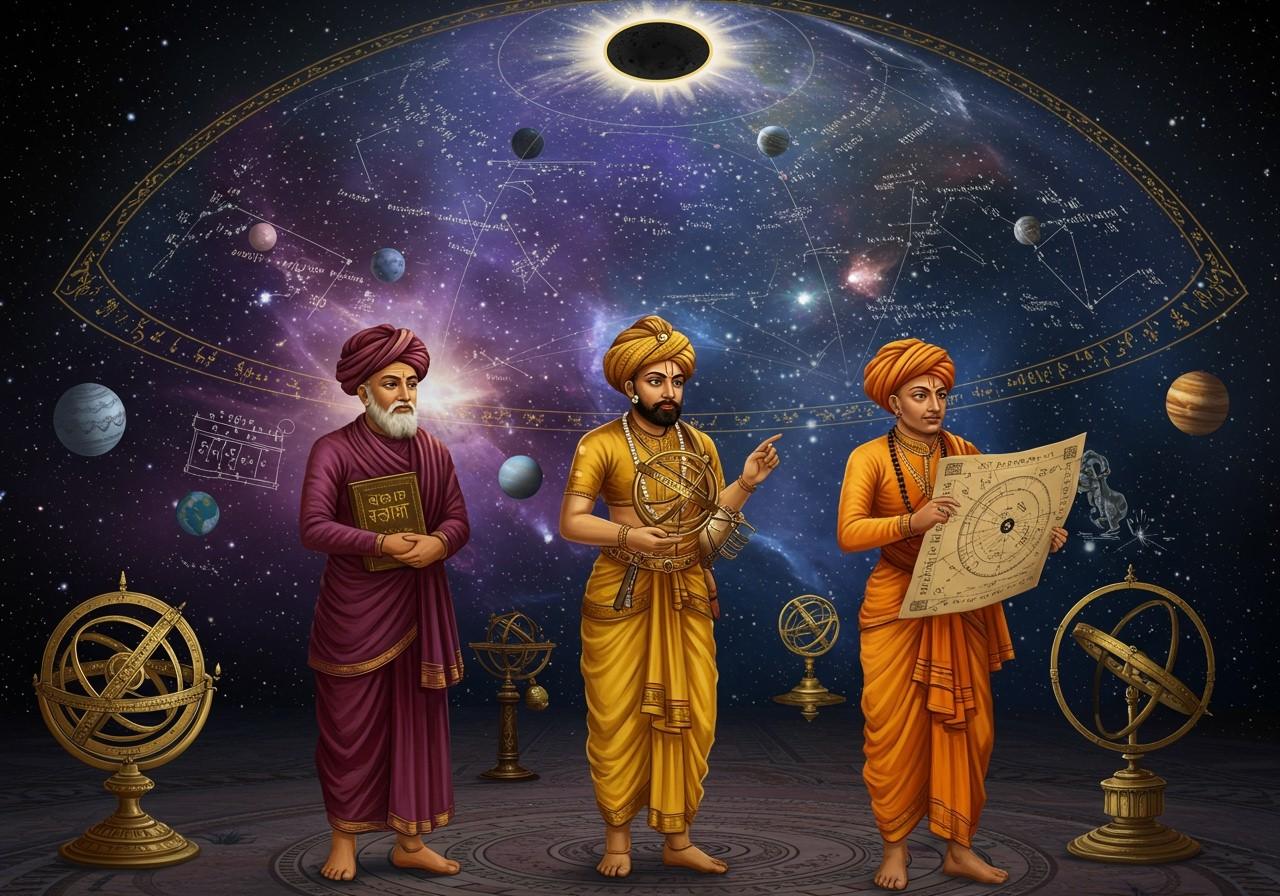
The Foundations of a Scientific Revolution
While the Gupta period is rightly celebrated for its original contributions, it's important to understand that these advancements didn't occur in a vacuum. Indian mathematics and astronomy (Ganita and Jyotisha) had long traditions. The innovation of the Gupta era was to systematize this knowledge and, crucially, to synthesize it with ideas from other cultures, particularly Hellenistic (Greek) astronomy. This fusion of indigenous tradition and external knowledge, sponsored by the Gupta court, led to an unprecedented leap forward.
Aryabhata: The Pioneer of Indian Astronomy and Mathematics
Aryabhata (born 476 CE) is arguably the most important figure in the history of classical Indian science. His only surviving work, the Aryabhatiya, is a concise but profoundly influential treatise written in Sanskrit verse. It provides a summary of the state of mathematics and astronomy and introduces several revolutionary concepts.
To understand the depth and breadth of Aryabhata's contributions, let's explore his key ideas.
ARYABHATTA - The Forgotten Genius || Project SHIVOHAM
The video 'ARYABHATTA - The Forgotten Genius' by Project SHIVOHAM offers a detailed look at Aryabhata's work. Watching these selected clips will provide you with a solid understanding of his most significant innovations, from the number system to his astronomical models.
Please watch the following segments. Pay close attention to how Aryabhata's concepts represented a major leap from previous ideas. Place Value System and Zero (21:00 - 22:14): Focus on the explanation of the base-10 place value system. Understand why this system was revolutionary for performing arithmetic calculations compared to, for example, Roman numerals. The Value of Pi (π) (12:25 - 14:11): Note Aryabhata's remarkably accurate calculation of pi (3.1416) and, more importantly, his explicit statement that this value is 'approximate' (āsanna). This suggests a deep understanding of the nature of this irrational number. Trigonometry and the Sine Function (18:36 - 21:00): This section explains Aryabhata's development of sine tables and the origins of the word 'sine' from the Sanskrit term jya. This was a critical tool for astronomical calculations. A Scientific View of Eclipses (22:14 - 25:21): Understand how Aryabhata provided a correct, scientific explanation for solar and lunar eclipses, attributing them to the shadows cast by the Moon and the Earth, directly challenging prevailing mythological beliefs.
Beyond the concepts in the video, another of Aryabhata's radical astronomical ideas was his theory of the Earth's rotation. He argued that the apparent daily movement of the stars was caused by the Earth spinning on its axis. This heliocentric perspective, while not fully developed, was a major departure from the established geocentric models.
For a more detailed textual exploration of Aryabhata's work, the following paper provides an excellent academic summary.
Aryabhata and His Contributions to Indian Mathematics
This research paper, 'Aryabhata and His Contributions to Indian Mathematics,' offers a structured look at his innovations in both mathematics and astronomy.
Read the sections '4. Mathematical Innovations' (covering his numeration system, place value, and algorithms) and '5. Contributions to Astronomy' (covering celestial mechanics and eclipses). This will reinforce and expand upon the concepts presented in the video.
Aryabhata's major contributions can be summarized as:
-
Mathematics:
- Place-Value System: Pioneered the base-10 system that is the ancestor of the numerical system used globally today.
- Concept of Zero: While the symbol for zero came later, his place-value system was functionally built around it.
- Approximation of π: Calculated π as ≈ 3.1416 and identified it as an irrational, approximate number.
- Trigonometry: Developed tables of sines (jya), which were fundamental for astronomy.
- Algebra: Provided solutions for indeterminate linear equations, a method known as kuttaka.
-
Astronomy:
- Axial Rotation: Postulated that the Earth rotates on its own axis.
- Scientific Explanation of Eclipses: Correctly explained solar and lunar eclipses as phenomena caused by celestial shadows.
- Heliocentric Model: Laid the groundwork for a model where planets' periods are calculated with respect to the Sun.
Varahamihira: The Great Synthesizer
If Aryabhata was the revolutionary pioneer, Varahamihira (c. 505–587 CE) was the brilliant polymath and synthesizer of his age. Living a generation after Aryabhata, he compiled and expanded upon existing knowledge from both Indian and Hellenistic sources. His work is encyclopedic, reflecting a mind curious about nearly every aspect of the natural world.
Gupta Empire as Golden Age | Art and Culture | Ancient India | Historical debates | UPSC GS
The following brief clip from StudyIQ IAS introduces Varahamihira and his most important works, highlighting his role as a key scientific figure of the Gupta age.
Watch the segment from 04:45 to 05:29. Focus on identifying his two most famous compositions, the Pancha Siddhantika and the Brihat Samhita, and the wide range of subjects they cover.
Varahamihira's primary contributions are contained in three major works:
-
Pancha Siddhantika ("Treatise on the Five Astronomical Canons"): This seminal work is a testament to his role as a synthesizer. It summarizes the principles of five different astronomical schools of thought that were prevalent in his time, including two that were heavily influenced by Greek and Roman astronomy (Romaka Siddhanta and Paulisa Siddhanta).
-
Brihat Samhita ("The Great Compilation"): This is a truly remarkable encyclopedic text. It covers an astonishing array of topics, demonstrating the interconnectedness of science, society, and belief in this period. Its subjects include:
- Astronomy and planetary movements
- Architecture and water divination (dākārgalam, the science of finding underground water)
- Gemology and perfumes
- Meteorology (predicting weather)
- Agriculture and botany
- Marriage and omens
-
Brihat Jataka ("Great Birth Chart"): This is one of the foundational texts of Hindu astrology (Jyotisha), dealing with horoscopes and the influence of planets on human life.
This infographic provides a quick visual summary of his multifaceted genius.

Varahamihira's work is significant because it not only advanced scientific knowledge but also illustrates how this knowledge was integrated into daily life, from building temples to forecasting rain.
Other Scientific Advancements
While Aryabhata and Varahamihira were the leading lights, the Gupta period saw progress in other fields as well:
- Metallurgy: The most famous example is the Iron Pillar of Delhi, located in the Qutub complex. Erected in the 4th century CE, it has stood for over 1600 years without rusting, a testament to the advanced metallurgical skills of Gupta-era craftsmen.
- Medicine: The foundational texts of Ayurveda, the Charaka Samhita and the Sushruta Samhita, were likely compiled into their present form during this period. Sushruta, in particular, is famed for his detailed descriptions of surgical procedures, including plastic surgery. Dhanvantari is celebrated in tradition as a great physician of this era.
Conclusion
In this lesson, we have moved from the literary arts to the scientific achievements of the Gupta Empire, seeing how the same intellectual dynamism animated both spheres.
Key Takeaways:
- The Gupta period was a time of major scientific and mathematical advancement, marked by the synthesis of Indian and Hellenistic knowledge.
- Aryabhata was a revolutionary figure who introduced the place-value system, accurately calculated pi, developed trigonometry, and proposed a scientific theory of eclipses and the Earth's axial rotation.
- Varahamihira was a great polymath who synthesized and compiled knowledge from various traditions in his encyclopedic works, the Panchasiddhantika and Brihat Samhita, covering everything from astronomy to architecture.
- The era also saw significant progress in other fields like metallurgy, evidenced by the rust-resistant Iron Pillar of Delhi.
- The mathematical innovations of this period, especially the place-value system and zero, were transmitted to the Arab world and from there to Europe, forming the very foundation of modern global mathematics.
Preview of the Next Lesson:
The cultural and scientific flourishing of the Gupta era was underwritten by a powerful and stable imperial structure. However, by the late 5th and 6th centuries, this structure began to weaken. In our next lesson, we will investigate the reasons for this decline, addressing the learning outcome: Discuss the emergence of feudal tendencies during the late Gupta period and the impact of Huna invasions on the empire's decline.