Introduction
Welcome back. In our last lesson, we explored the vast Harappan trade network and saw how standardized weights and seals acted as the "soft infrastructure" of commerce, ensuring trust and efficiency across thousands of kilometers. These artifacts were not just for merchants, however. They were components of a much larger societal system.
This lesson builds directly on that foundation. Our learning outcome is to analyze what Harappan seals, standardized weights, and burial practices reveal about administrative systems and social organization. We will move from the marketplace to the heart of Harappan society to investigate how it was governed and structured.
The central question we'll tackle is a fascinating one: How did a civilization of this scale maintain such remarkable uniformity in its cities, crafts, and economic tools, all while showing little to no evidence of the kings, palaces, or grand royal tombs that defined its contemporaries in Egypt and Mesopotamia? Your background in analyzing complex systems will be an asset as we piece together the evidence to build a picture of this unique socio-political structure.
1. The Instruments of a Regulated Economy
The most tangible evidence for a sophisticated administrative system comes from the very tools that facilitated the Harappan economy: seals and weights. Their uniformity across a vast territory is a powerful indicator of a centralized or highly coordinated authority.
Harappan Seals: More than a Merchant's Mark
We previously discussed seals as a tool for authenticating goods. However, their use and discovery contexts suggest a much broader administrative role.

Seals were likely multi-purpose instruments of administration, functioning as:
- Proof of Ownership and Authority: Like a modern corporate stamp or official signature, a seal impression authenticated documents and goods, linking them to a specific person, office, or institution.
- Identification: High-ranking individuals or officials may have carried seals as markers of their status or office, similar to an ID badge.
- Access Control: Seal impressions on clay (sealings) could secure storerooms or document containers, with a broken sealing indicating unauthorized access.
The discovery of high concentrations of seals in specific buildings, like the so-called "bureau" at Harappa, further supports their use in administrative and bureaucratic activities, not just private trade.
To see how these seals were used for more than just commerce, let's watch a brief segment.
Indus Valley Civilization - Ancient Civilizations DOCUMENTARY
The documentary 'Indus Valley Civilization' briefly touches upon the bureaucratic function of these seals.
Watch the segment from 08:37 to 09:09. The narrator describes seals as a 'sort of “Made in Indus” guarantee' but also links them to bureaucratic management of production.
Furthermore, the craftsmanship of the seals tells its own story. The skill involved was highly standardized within the Indus Valley, but distinct from similar artifacts made elsewhere. This suggests a controlled, high-quality production system.
Maritime trades between the Harappan Civilization and Bahrain | Dr Akinori Uesugi | ASC IITGN
In this video, Dr. Akinori Uesugi analyzes Indus-related seals found in Bahrain. His comparison highlights the superior and standardized carving technology of seals from the Indus region itself, pointing to a well-established craft tradition overseen by some authority.
Please watch the segment from 44:10 to 53:33. Focus on Dr. Uesugi's comparison of the carving quality between the 'Gulf type' seals found in Bahrain and the seals from the Indus region (like the one from Bagasara). Note his conclusion that the Gulf seals, while influenced by Indus models, were cruder and likely made by local artisans, not by master Harappan carvers. This contrast underscores the high degree of skill and standardization within the Harappan core.
Standardized Weights: The Hand of a Regulator
As we touched upon in the last lesson, the Harappans employed a highly standardized system of weights across their entire civilization.
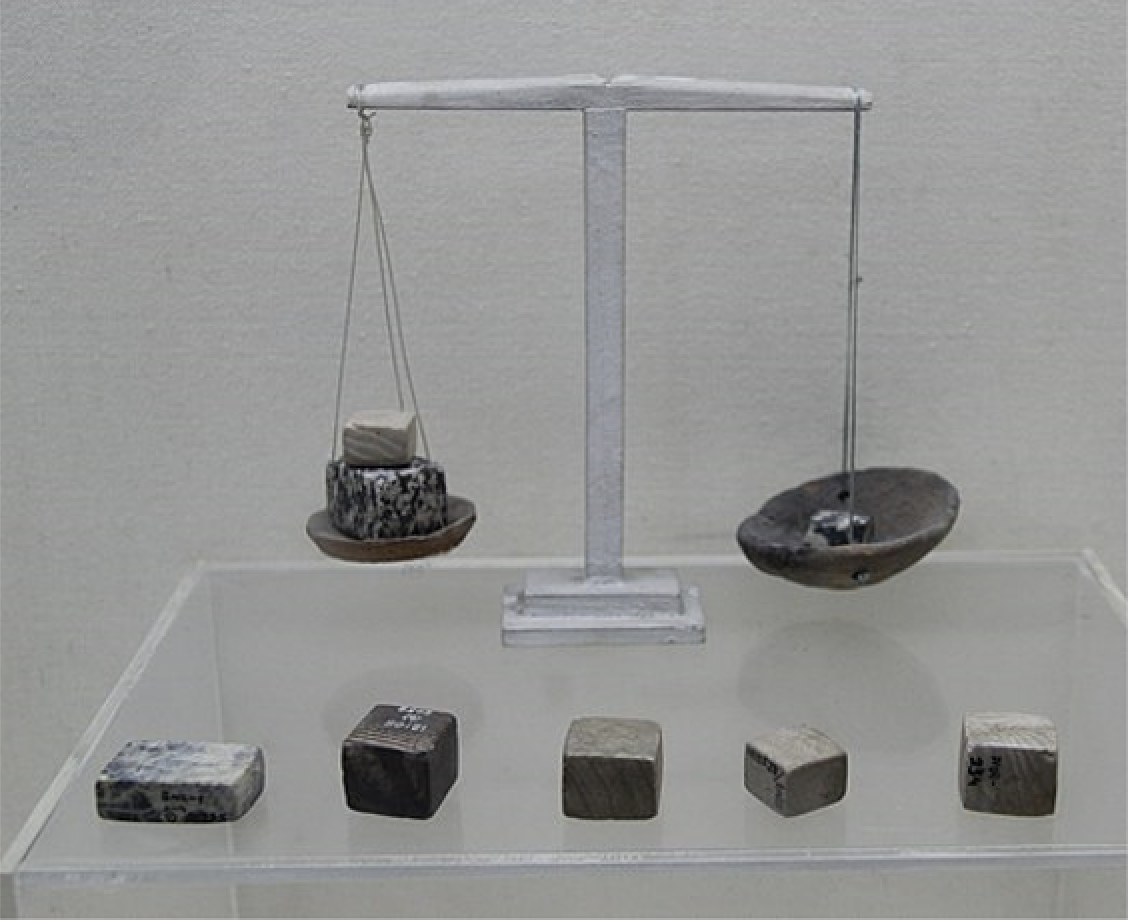
The existence of such a system implies more than just convenient trade. It points directly to a regulatory authority with the power to enforce these standards across hundreds of cities and towns. This is analogous to modern governments or international bodies (like the ISO) setting standards for weights, measures, and currency. It creates a unified economic zone, prevents fraud, and simplifies taxation and tribute collection.
The reach of this system was not just internal. In the Q&A section of the previous video, Dr. Uesugi confirms that cubical weights corresponding to the Harappan standard have been found in Bahrain, demonstrating the system's recognition and use in international trade.
2. Social Organization Revealed in Burials
While seals and weights point to a strong, centralized administration, burial practices offer a different, more nuanced window into Harappan social structure. In stark contrast to the lavish royal tombs of Egypt and Mesopotamia, Harappan cemeteries are remarkably modest.
- General Egalitarianism: The vast majority of Harappan graves are simple pits containing the deceased along with a few pottery vessels. There are no grand monuments or vast hoards of treasure to distinguish a ruler from a commoner.
- Subtle Status Markers: While not ostentatious, there are differences. Some graves contain more pottery than others, and a few include personal ornaments like shell bangles, beads of semi-precious stone, or even small copper mirrors. The presence of brick-lining in some graves also suggests a higher status.
This evidence suggests a society with some degree of social stratification, but one that either lacked the extreme wealth disparities of other Bronze Age kingdoms or chose not to express status and power ostentatiously in death.
Indus Valley Civilization - Ancient Civilizations DOCUMENTARY
Let's return to the 'Indus Valley Civilization' documentary for a concise summary of what the burials tell us about social stratification.
Watch the segment from 13:15 to 14:20. It directly addresses the debate about social structure and notes that the largely egalitarian nature of burials suggests that severe social stratification was not prevalent.
The simplicity of Harappan burials fuels the debate about the nature of their leadership. Was it a society governed by a council, a priestly class that valued austerity, or an oligarchy of merchants who displayed wealth in life but not in death? The graves themselves don't give a final answer, but they strongly argue against the model of a single, all-powerful, divine monarch.
3. Synthesis: A State Without a King?
So, what do we make of this contradictory evidence? On one hand, we have urban planning, seals, and weights that scream of a powerful, centralized state. On the other, we have a near-total absence of palaces, royal iconography, and lavish tombs that would signal a king.
This has led to a fascinating debate among historians. To explore this, let's examine two papers that synthesize the evidence on Harappan governance.
[PDF] Reconstructing the History of Harappan Civilization
The paper 'Reconstructing the History of Harappan Civilization' by Vahia and Yadav analyzes the rapid emergence of uniformity as a key feature. It argues that this points to a state-level organization, but perhaps one formed by consensus rather than conquest.
Please read the following sections: Start on page 90, from the paragraph beginning 'The HC was formed by a conglomeration...' and read to the end of the numbered list on page 91. This section lists the features that suddenly appeared around 2600 BC, including writing, town planning, and weights, arguing for a rapid transformation into a state. On page 95, read point 10 under the list. It makes the key observation that the civilization accepted a high level of standardization despite not being heavily centralized. Finally, read the section 'Standardization of HC' on page 105-106. This section proposes the intriguing idea that such widespread standardization, without a clear ruling authority, might have been achieved through 'mutual agreements'.
The idea of standardization through "mutual agreements" is a compelling one, suggesting a polity where different centers or power groups collaborated to create a common system, much like modern industry consortiums agree on technical standards.
Now, let's look at another paper that directly tackles the question of governance and outlines the tools the Harappan administration used.
[PDF] REVISITING THE POLITICAL LANDSCAPE OF THE INDUS VALLEY ...
The paper 'Deciphering Authority: Revisiting the Political Landscape of the Indus Valley Civilization' by Dr. Sharmistha Rakshit synthesizes the arguments for the existence of a state and identifies its key administrative tools.
Please read the following sections: 'Whether there was a State...?' (pages 40-42): Skim this section to understand the arguments for and against the existence of a state. Focus on the conclusion at the bottom of page 41, which argues that a central system of governance must have existed. 'Tools of administration' (pages 43-44): This is the most crucial section. Read it carefully. It explicitly lists seals, weights and measures, stone bangles (as symbols of authority), religion, and taxation as the instruments of control. 'Conclusion' (page 44-45): Read the conclusion, which reinforces the idea that the sheer complexity and organization of the civilization point to a state-like administrative system.
These resources paint a picture of a highly organized society—a state, for all practical purposes. It was likely not a conventional monarchy but a unique political formation that used a sophisticated toolkit of economic regulation, standardized symbols, and shared ideology to govern a vast and diverse population.
Conclusion
By analyzing the key artifacts of Harappan life, we can move beyond simple descriptions to reconstruct the invisible systems of power and social order.
Key Takeaways:
- Seals and Standardized Weights are undeniable evidence of a sophisticated administrative system capable of enforcing economic and symbolic uniformity over an enormous area. They were tools for regulation, authentication, and identification, far beyond simple commerce.
- Burial Practices reveal a society that, while stratified, avoided the ostentatious displays of wealth and power common in other ancient civilizations. This suggests a different kind of social ethos, perhaps one that was more collective or that valued austerity in death.
- The combination of these lines of evidence points to a unique political entity: a "faceless" state. It possessed the administrative capacity for large-scale organization (as seen in cities, trade, and standards) but lacked the focus on an individual, glorified ruler (as seen in the lack of palaces and royal tombs). Its power lay in systems, standards, and ideology, not in the cult of a king.
Preview of the Next Lesson:
In this lesson, we noted that religion and ideology were likely key tools of social control. Our next lesson, "Identify evidence for Harappan religious practices," will delve into this fascinating topic. We will examine the evidence—from iconic seals depicting a "proto-Shiva" figure to mother goddess figurines and the enigmatic Great Bath of Mohenjo-daro—to piece together the spiritual world of the Harappan people.