Welcome back to your course on the history of the Indian subcontinent.
In our first lesson, we examined Mehrgarh as a "prototype" of the Neolithic Revolution in South Asia, tracing how a nomadic, food-gathering society gradually transitioned to a settled, food-producing economy. This agricultural model, however, was not confined to one location. It proved to be a profoundly successful economic and social strategy that spread across the subcontinent.
This lesson maps the diffusion and adaptation of this new way of life. We will identify the key regional cultures that emerged during the Neolithic (New Stone Age) and Chalcolithic (Copper-Stone Age) periods. Understanding this geographic spread is crucial, as these scattered farming communities formed the extensive economic and demographic foundation upon which India's first great urban civilization, the Indus Valley Civilization, was built.
Learning Outcome: By the end of this lesson, you will be able to identify the geographic spread of key Neolithic and Chalcolithic cultures across the Indian subcontinent (e.g., Burzahom, Chirand, Inamgaon).
1. From a Single Site to a Subcontinent of Villages
The transition to agriculture that began at sites like Mehrgarh triggered a slow but steady wave of colonization by farming communities across India. As these groups moved into new environments—from the valleys of Kashmir to the Gangetic plains and the plateaus of the Deccan—they adapted their technologies and subsistence strategies, giving rise to distinct regional cultures.
Archaeologists broadly group these early farming cultures into two major technological phases:
- Neolithic: Characterized by the use of polished stone tools (axes, adzes) for agriculture and clearing forests.
- Chalcolithic: Characterized by the continued use of stone tools alongside the new technology of copper metallurgy.
Let's start by exploring the spread of the Neolithic cultures. The following map shows the locations of major excavated Neolithic sites.

To get a comprehensive overview of these cultures, we will rely on a foundational academic paper.
[PDF] Prehistoric human colonization of India
The paper 'Prehistoric human colonization of India' by eminent archaeologist V. N. Misra provides a clear, region-by-region summary of India's early farming cultures. We will use it as our primary reference for this lesson.
First, please read the introductory section titled '6. Emergence of farming societies outside the zone of the indus civilization' (page 507). This section provides a clear distinction between Neolithic and Chalcolithic cultures. Then, read section '7. Neolithic cultures' (pages 508-513). As you read, focus on identifying the distinct characteristics of each regional culture mentioned below. You don't need to memorize every site, but rather grasp the unique adaptation of each culture.
As you've just read, the Neolithic way of life was not monolithic. Let's briefly synthesize the key features of these regional expressions.
Key Neolithic Cultural Zones
-
Kashmir Valley (e.g., Burzahom, Gufkral):
- Unique Adaptation: To survive the cold winters, these people constructed subterranean pit-dwellings.
- Economy: Cultivated wheat, barley, and lentils. They had a sophisticated bone tool industry (harpoons, needles) and practiced ceremonial burials, sometimes burying dogs with their masters.
- Connections: The discovery of a pot similar to those from Kot Diji (a pre-Harappan site) suggests early contact with cultures on the plains.
-
Middle Ganga Valley & Northern Vindhyas (e.g., Chirand, Koldihwa, Mahagara):
- Key Development: This region is significant for the early cultivation of rice. This marks a major shift in agricultural systems, as rice is suited to the wetter, monsoonal climate of the Gangetic plains, unlike the wheat/barley complex of the northwest.
- Economy: A mixed economy of farming (rice, barley), animal husbandry, and hunting.
-
Eastern and Northeastern India (e.g., Daojali Hading):
- Distinctive Features: Characterized by shouldered stone axes and cord-impressed pottery. These artifact types show strong cultural links with Neolithic cultures in Southeast Asia and South China, suggesting a corridor of cultural transmission.
-
Southern India (e.g., Hallur, Piklihal, Utnur):
- Economy: Primarily an agro-pastoral economy. They cultivated millets (ragi) and pulses, which are well-suited to the semi-arid climate of the Deccan plateau.
- Unique Feature: The presence of large ash mounds. These are massive accumulations of burnt cow dung, pointing to the central role of cattle herding and large-scale pastoralism in their economy and possibly their rituals.
2. The Chalcolithic Expansion: The Dawn of Metallurgy
The Chalcolithic period represents the next major technological and economic phase. The introduction of copper metallurgy, while not replacing stone tools, allowed for more efficient tools and weapons, further stimulating economic activity and social complexity.
This map shows the primary zones where Chalcolithic cultures flourished.
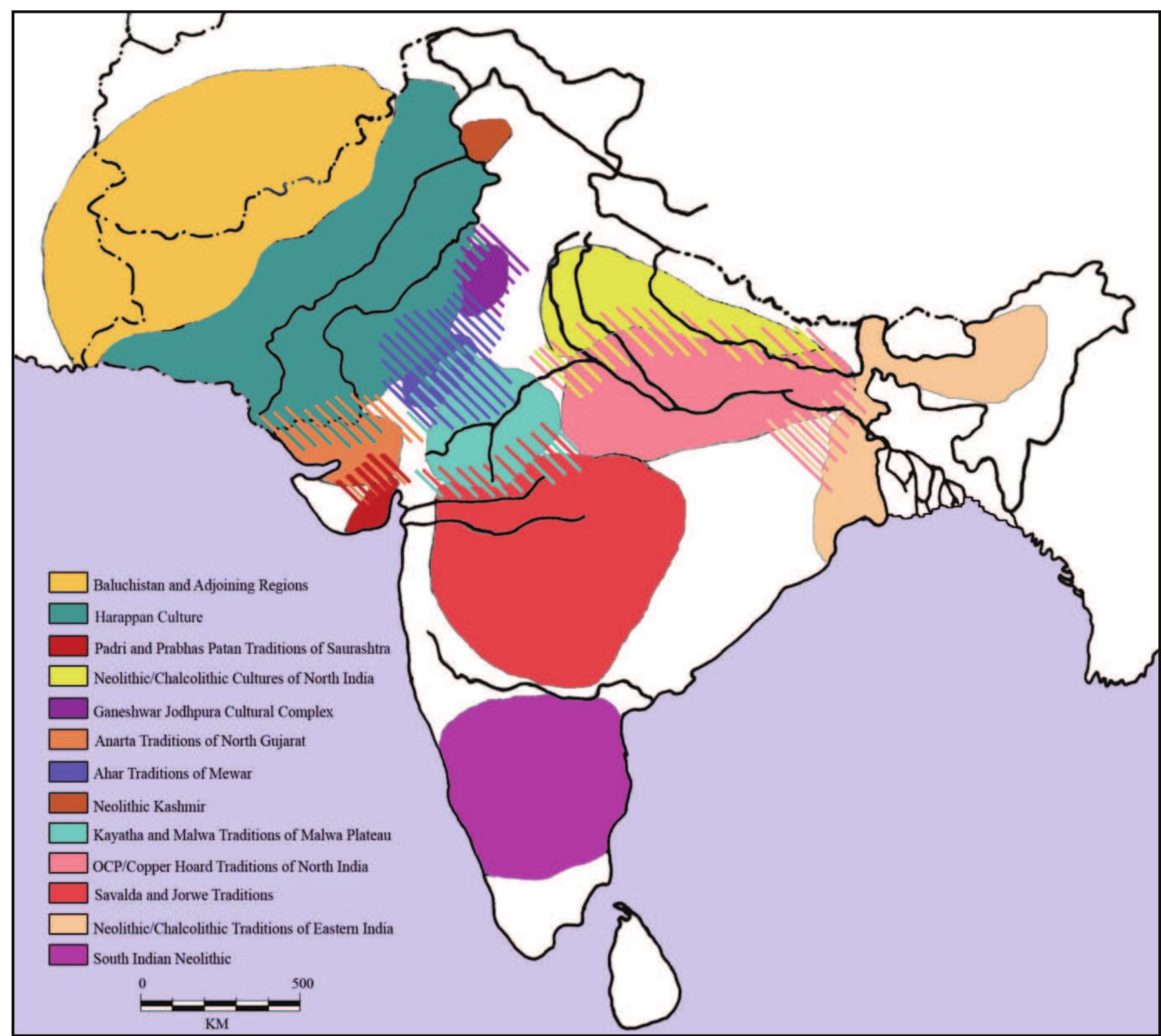
To get a quick and clear visual summary of the main Chalcolithic cultures and their key sites, the following video is very helpful.
Chalcolithic Period | Ancient History for UPSC
The video 'Chalcolithic Period' from Bookstawa provides a concise overview of the major Chalcolithic cultural groups.
Watch from 06:01 to 09:36. The video is in Hindi, but the on-screen text, maps, and site names are in English. Focus on the visual classification of the five major Chalcolithic zones and the key features mentioned for each: Jorwe Culture (Maharashtra): Fortified settlements, water management at Inamgaon. Kayatha & Malwa Cultures (Central India): Deep pit-silos for grain storage. Ahar-Banas Culture (SE Rajasthan): Focus on metallurgy due to proximity to copper deposits. Ganga-Yamuna Doab: Ochre Coloured Pottery (OCP).
Now, let's add more detail to this framework by returning to our primary text.
[PDF] Prehistoric human colonization of India
Please return to the paper 'Prehistoric human colonization of India' and read about the Chalcolithic cultures in more detail.
Read section '8. Chalcolithic cultures' (pages 513-520). Focus on the distinct economic and social characteristics of the following cultures: Ahar Culture: Its location in a copper-rich zone and its advanced metallurgy. Malwa Culture: Its distinctive pottery and wide geographical spread. Jorwe Culture: Pay close attention to the evidence for settlement hierarchy (regional centers, villages, farmsteads) and the shift in housing from the Early to Late Jorwe periods, which reflects changing economic conditions.
The reading highlights that these cultures were not just defined by their tools and pottery, but by sophisticated economic systems. The Ahar culture, for instance, leveraged a key local resource—copper—to become a specialized metallurgical center. The Jorwe culture at Inamgaon shows evidence of early state-like organization, with a settlement hierarchy, public architecture like a granary, and even evidence of irrigation channels. This demonstrates an increasing complexity in administration and resource management, a theme central to your interests.
3. Synthesis: A Comparative Overview
To help you consolidate this information, here is a comparative table of the key cultures we have discussed.
| Culture/Period | Key Sites | Region | Time Period (Approx.) | Key Characteristics |
|---|---|---|---|---|
| Neolithic | Burzahom, Gufkral | Kashmir Valley | 2400-1500 BCE | Pit-dwellings, advanced bone tool industry, wheat/barley cultivation. |
| Neolithic | Chirand, Koldihwa | Middle Ganga Valley | 2000-1500 BCE | Early evidence for rice cultivation, bone and antler tools. |
| Neolithic | Piklihal, Hallur | South India (Deccan) | 2500-1000 BCE | Ash mounds indicating cattle pastoralism, cultivation of millets (ragi). |
| Chalcolithic | Ahar, Gilund | Southeast Rajasthan | 3600-1500 BCE | Exploitation of local copper mines, distinctive Black-and-Red Ware pottery. |
| Chalcolithic | Kayatha, Navdatoli | Central India (Malwa) | 2000-1450 BCE | Distinctive chocolate-slipped and painted buff pottery, extensive farming of wheat. |
| Chalcolithic | Inamgaon, Daimabad | Maharashtra (Deccan) | 2300-900 BCE | Jorwe Culture: Settlement hierarchy, chiefdoms, spouted jars, shift from rectangular to round huts over time. |
This table provides a snapshot, but the crucial insight is that by 2500 BCE, the Indian subcontinent was a mosaic of established agricultural and pastoral societies. These societies were engaged in local and regional trade, had developed specialized craft industries, and were steadily growing in social and political complexity. This was the world that gave birth to the Harappan cities.
Conclusion
In this lesson, we have mapped the spread of early farming communities across the Indian subcontinent, moving beyond the single-site study of Mehrgarh. You have seen how the agricultural revolution unfolded differently in various regions, leading to a diverse array of Neolithic and Chalcolithic cultures.
Key Takeaways:
- The Neolithic cultures established agriculture across India, with regional specializations like rice in the Gangetic plains, wheat/barley in Kashmir, and pastoralism with millets in South India.
- Key Neolithic sites include Burzahom (pit-dwellings), Chirand (rice), and Hallur (ash mounds).
- The Chalcolithic cultures introduced copper metallurgy and saw the emergence of more complex societies, particularly in Rajasthan, Central India, and the Deccan.
- Key Chalcolithic cultures include Ahar (metallurgy), Malwa (widespread), and Jorwe, with sites like Inamgaon showing evidence of a settlement hierarchy and early administrative structures.
Preview of the Next Lesson:
We've now painted a picture of a subcontinent filled with thousands of farming villages. In the next lesson, we will focus on the Indus and Ghaggar-Hakra river plains, where a network of these Chalcolithic villages underwent a dramatic transformation. We will explore how they evolved into one of the world's great ancient urban civilizations, focusing on their most striking achievement: their sophisticated and highly standardized urban planning.