Introduction
Welcome to your next lesson. In our previous discussion, we pieced together a picture of the Harappan administrative system—a "faceless" state that relied on standardized weights, seals, and shared urban planning rather than the cult of a king. We concluded by suggesting that a shared ideology or religion must have been a powerful glue holding this vast civilization together.
Today, we will investigate that very ideology. Our learning outcome is to identify evidence for Harappan religious practices, such as proto-Shiva iconography, mother goddess figurines, and the Great Bath.
Because the Harappan script remains undeciphered, we are in the position of archaeologists interpreting silent objects. This lesson is therefore not just about what the Harappans may have believed, but how we construct these interpretations from material evidence. You'll see that nearly every piece of evidence is part of an ongoing scholarly debate, a process of inference and argument that I think you'll find intellectually engaging.
1. The Great Bath: A Center for Ritual Purification?
Perhaps the most impressive, and least ambiguous, piece of religious architecture in the entire Indus Valley is the Great Bath of Mohenjo-daro.
Indus Valley Civilization Part 1 - Ancient India History for UPSC | Harappa Civilization
Let's begin with a look at this remarkable structure. This short clip from StudyIQ IAS provides an excellent description of the Great Bath and its key features.
Please watch from 12:23 to 12:59. Note the construction details, such as the use of bitumen for waterproofing, which underscore its importance and its function related to water.
The careful construction and central location of the Great Bath strongly suggest it was not for recreational swimming. Its design is functionally perfect for holding water, implying a special, communal purpose. Most scholars agree that it was likely used for ritual purification. The importance of ceremonial bathing is a significant feature in many later Indian religions, and the Great Bath is often cited as the earliest large-scale evidence of this practice on the subcontinent.
The following reading elaborates on this interpretation.
[PDF] Religious Aspects of Indus Valley Civilization-An Analysis
The paper 'Religious Aspects of Indus Valley Civilization-An Analysis' connects the city's extensive water infrastructure to religious practice.
Read the short paragraph under the sub-heading 'Practice of Yoga' that begins 'According to Wheeler...'. This section explicitly links the Great Bath and the city's drainage systems to the concept of purification through ceremonial ablutions.
2. The Harappan Pantheon: Interpreting Deities from Artifacts
While the Great Bath suggests a focus on ritual action, thousands of small artifacts—figurines and seals—offer clues about the gods and goddesses the Harappans may have worshipped.
The "Mother Goddess"
One of the most common finds at Harappan sites are small terracotta figurines of women, often with elaborate headdresses and prominent jewelry.
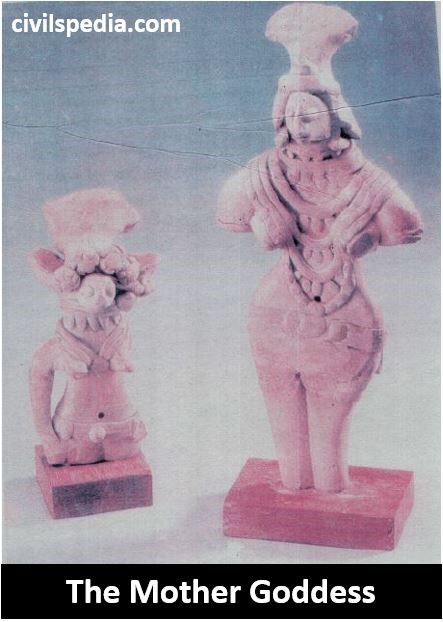
Early archaeologists, notably John Marshall, identified these as representations of a "Mother Goddess," linking them to fertility cults prevalent in many ancient societies and to the later Hindu tradition of Shaktism (worship of the divine feminine).
However, this interpretation, while popular, is not universally accepted. To understand the complexity of this issue, it's essential to look at the arguments on both sides.
Religion of the Indus Valley Civilisation - Wikipedia
The Wikipedia article on Harappan religion provides a concise summary of the debate surrounding these figurines.
Read the section titled 'Terracotta figurines'. It presents the initial 'mother goddess' identification and then outlines the strong counter-arguments from more recent scholarship, which suggest they could have been toys or had other, non-divine functions.
This debate highlights a central challenge in studying the Indus Valley: are we seeing evidence of a widespread religious cult, or are we projecting later ideas onto objects that may have had a more mundane purpose?
The "Proto-Shiva" or Pashupati Seal
Arguably the most famous and debated artifact of the Indus Valley Civilization is a seal from Mohenjo-daro depicting a seated figure surrounded by animals.

John Marshall, who first excavated the seal, famously identified the figure as a "proto-Shiva." He pointed to several parallels with the later Hindu god Shiva:
- Pashupati: Shiva is known as Pashupati, the "Lord of Animals."
- Yogic Posture: Shiva is the archetypal yogi, or Mahayogi.
- Three Faces: Some depictions of Shiva show him with multiple faces.
- Trishula: The horned headdress resembles a trident (trishula), Shiva's primary weapon.
This interpretation suggests a direct, ancient lineage for one of Hinduism's most important deities.
Religion of Harappans | Prof Meenakshi Jain | #sangamtalks
Professor Meenakshi Jain, a proponent of this view, discusses the significance of the Shiva-related findings. This clip will give you a clear sense of the 'continuity' argument.
Watch from 02:01 to 03:07. She discusses the 'Proto-Shiva' seal and the discovery of what she identifies as Shiva lingams, arguing for clear connections to later religious traditions.
As with the Mother Goddess figurines, this "proto-Shiva" identification has been intensely debated. Later scholars have raised significant challenges.
Religion of the Indus Valley Civilisation - Wikipedia
Let's turn back to the Wikipedia article for a detailed breakdown of the scholarly debate over this iconic seal.
Read the section 'Pashupati seal'. Pay close attention to the critiques of Marshall's theory. Notice the alternative interpretations, such as a female deity, a buffalo-man, or a version of the widespread ancient 'Master of Animals' motif, which is not unique to India.
Whether the figure is a proto-Shiva, a Master of Animals, or something else entirely, the seal clearly depicts a powerful deity in a central, commanding position, offering a profound glimpse into the Harappan spiritual world.
3. Other Forms of Worship
Beyond these primary figures, the evidence suggests a range of other religious practices.
Phallus and Ring Stone Worship
Archaeologists have found numerous smooth, conical stones and perforated ring stones. Marshall interpreted these as lingams (phallic symbols) and yonis (symbols of the female principle), representing a fertility cult and another link to modern Shaivism.
However, many of these objects were found in contexts like streets and drains, which seems inconsistent with sacred objects. Critics argue they could be pestles, architectural elements, or components of a game. This is another area where initial interpretations are now heavily questioned, though not entirely dismissed by all.
Animism: Worship of Trees and Animals
The art on Harappan seals is dominated by animals. The "unicorn" is the most common motif, but bulls, elephants, and tigers also feature prominently. The humped bull, in particular, is often depicted with reverence and may be a precursor to Nandi, the sacred bull associated with Shiva.
Trees also appear to have been sacred, especially the Pipal tree, which is often shown with divine figures or in ritual scenes.
[PDF] Religious Aspects of Indus Valley Civilization-An Analysis
The paper 'Religious Aspects of Indus Valley Civilization' provides a detailed account of tree worship as seen on seals.
Read the section 'Tree-Worship' (page 97-98). It describes the veneration of the Pipal and Acacia trees and the complex mythology surrounding them, involving guardian spirits and demons. This gives a sense of a rich narrative tradition that we can only glimpse through the seals.
This animistic belief system, where natural forces, plants, and animals are imbued with divine spirit, was likely a fundamental part of Harappan religion.
Conclusion
Our exploration of the silent artifacts of the Indus Valley reveals a rich and complex religious landscape, even if its precise details remain shrouded in mystery.
Key Takeaways:
- Ritual Purity: The Great Bath at Mohenjo-daro provides strong evidence for the practice of communal, ritual bathing, suggesting a cultural emphasis on purity.
- Deity Worship: The Harappans likely worshipped a pantheon of gods and spirits. Key evidence points to a powerful male deity (the "proto-Shiva" or "Master of Animals") and revered female figures (the "Mother Goddess" figurines, though their function is debated).
- Fertility and Nature Cults: The possible worship of lingams and yonis, along with the clear veneration of animals (especially the bull) and trees (especially the Pipal), suggests that fertility and the forces of nature were central to their belief system.
- A Story of Interpretation: Our understanding of Harappan religion is a case study in historical and archaeological interpretation, with early theories of direct continuity with Hinduism now being challenged and nuanced by comparative analysis and a more critical look at the evidence.
Preview of the Next Lesson:
Having explored the spiritual and administrative systems, we will next turn to the material foundation of the civilization. The lesson, "Describe the craft economy of the Harappan civilization," will examine the remarkable skills of Harappan artisans in bead-making, metallurgy, pottery, and textile production—the very crafts that produced the artifacts we have analyzed today.