Introduction
Welcome to your next lesson. In our previous discussion, we focused on the Kushan Empire in northern India, analyzing how their control over the overland Silk Road fostered a unique cultural synthesis, most visibly in the Gandhara and Mathura schools of art. We saw how economic prosperity and cross-cultural contact can drive artistic innovation.
Today, we shift our focus from the northern land routes to the southern sea lanes. While the Kushans were dominant in the north, another powerful dynasty, the Satavahanas, was building the first major empire in the Deccan. This lesson directly addresses the learning outcome: Describe the Satavahana administrative structure and their role in facilitating Deccan trade with Rome and Southeast Asia.
We will investigate the machinery of the Satavahana state, contrasting its governance model with the Mauryan blueprint. Then, we'll explore its vibrant economy, examining how the Satavahanas positioned themselves as crucial intermediaries in the lucrative maritime trade network that linked the Roman Empire with the riches of India and beyond. This aligns perfectly with your interest in understanding the underlying administrative and economic systems that powered historical empires.
The Satavahana State: An Overview
The Satavahanas rose to prominence in the Deccan around the 1st century BCE, filling the power vacuum left after the decline of the Mauryan Empire. Their rule, lasting for about 300 years, established a period of stability and prosperity, creating the first large-scale state in the region. They controlled territories across present-day Maharashtra, Andhra Pradesh, Telangana, and parts of Karnataka and Gujarat.
The Satavahana Administrative Structure
The Satavahanas inherited certain administrative traditions from the Mauryas but adapted them significantly to suit the unique political and social landscape of the Deccan. Their system was less centralized and exhibited distinct military and feudal characteristics.
To understand the character and logic of their administration, let's start with a detailed analysis.
The Age of The Satvahanas FULL CHAPTER | RS Sharma Chapter 17 | Ancient History
The following video from OnlyIAS UPSC offers a thorough explanation of the Satavahana administrative model. The speaker highlights its military and feudal traits, which distinguish it from the more bureaucratic Mauryan system.
Please watch the segment on 'Pattern of Administration' from 57:36 to 01:12:15. As you watch, focus on understanding: How the king's authority was projected (adherence to Dharmashastras, claims of divine attributes). The evidence for Mauryan influence (e.g., the term Ahara for a district). The key concepts of military and feudal traits: What does it mean for a Senapati (military general) to also be a provincial governor? What was the role of the Gaulmika (village military head)? The contrast drawn with the centralized, bureaucratic Mauryan state.
The video explains that the Satavahana state was built on a foundation of military control, necessary for integrating diverse tribal groups and securing vast territories. Now, let's drill down into the specific hierarchy and the titles of the officials who ran this system.
Administrative System of the Satavahanas
This article from Tone Academy provides a clear, structured breakdown of the Satavahana administrative hierarchy, from the central ministers down to the village level.
Please read the sections from 'Administrative System of the Satavahanas' down to 'Town Administration in the Satavahana Kingdom'. Focus on identifying the specific roles of key officials like: Central Ministers: Amatyas like the Vishwasamatya (Prime Minister) and Mahamatya (Finance Minister). District and Local Administrators: Vishayapati (head of a Vishaya) and Gramika (village head). Specialized Officers: Note the functions of officials like Rajuka (judge) and Hiranika (treasurer). Urban Governance: The role of the Nigama Sabha in towns.
To bring all these details together, the following flowchart provides a powerful visual summary of the entire administrative apparatus, clearly distinguishing between the territories under direct rule and those governed by feudatories.
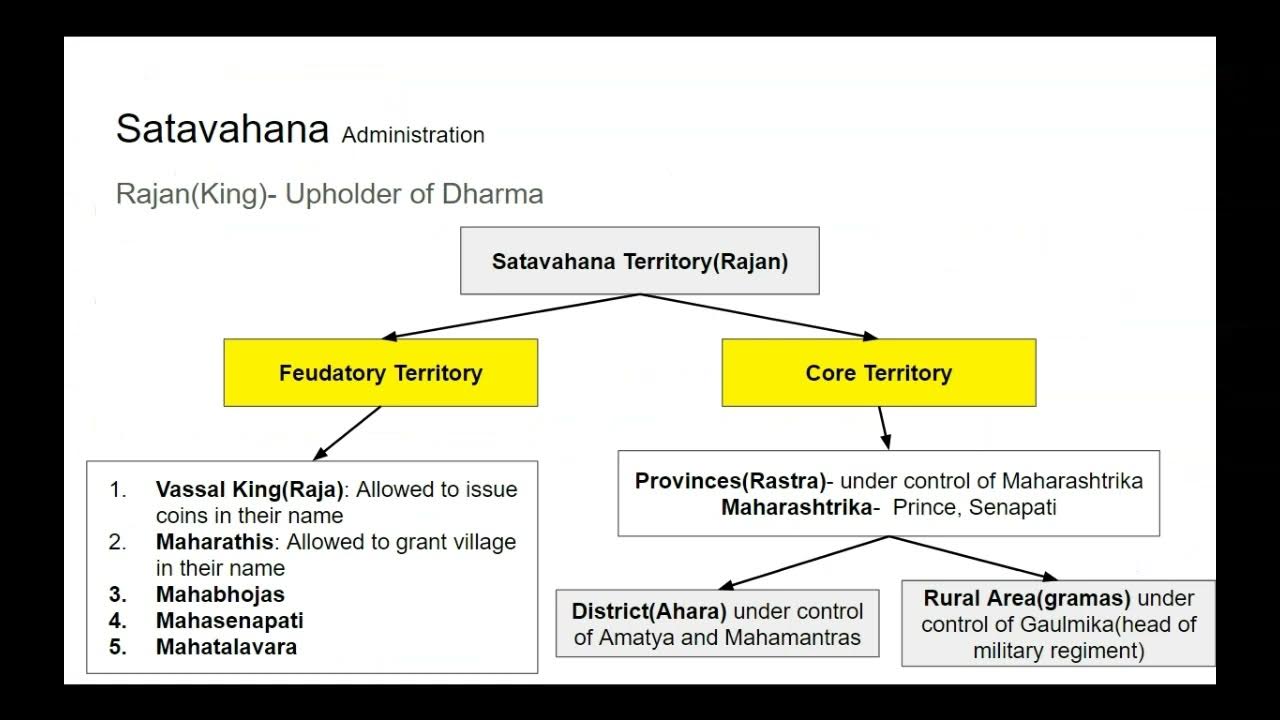
In summary, the Satavahana administrative structure was a pragmatic blend of:
- Hereditary Monarchy: The king was the supreme authority, ruling according to Dharma Shastra.
- Mauryan Legacy: They used Mauryan terminology for administrative divisions like the Ahara (district).
- Feudal Elements: Powerful feudatories (Mahabhojas, Maharathis) governed their own territories in exchange for loyalty and military support.
- Military Character: Provincial governors were often military generals (Senapatis), and even village administration had a military component under the Gaulmika. This indicates a system reliant on coercion and military presence to maintain order.
- Land Grants: A key administrative innovation was the practice of granting land (and the revenue/administrative rights over it) to Brahmins and Buddhist monks. As discussed in the
OnlyIASvideo (segment from 47:45), this served multiple purposes: legitimizing the ruler's authority, promoting agricultural expansion, and assimilating tribal populations into the agrarian social order.
Facilitating Deccan's Maritime Trade
While their administration secured the land, the Satavahanas' real prosperity was built on the sea. Their control over the Deccan plateau, which connects India's western and eastern coastlines, placed them at the heart of the burgeoning maritime trade with the Roman Empire.
This map shows the vast network of trade routes that connected the ancient world. The Satavahana kingdom was a pivotal node in this network.

To see how this trade functioned in practice, let's watch a short video that brings the era to life.
Satavahanas: The Deccan's First Empire Builders | Tales & Trails
This video from Peepul Tree World, titled 'Satavahanas: The Deccan's First Empire Builders', excellently visualizes the connection between the Satavahanas' power and their control over trade with Rome.
Please watch the following segments: Trade Routes and Tolls (00:22 - 01:31): This introduces the Naneghat pass, a critical trade artery connecting the coast to the Deccan interior, and highlights the empire's foundation on trade wealth. Evidence of Trade (02:44 - 05:07): Pay attention to the archaeological and literary evidence discussed, such as the discovery of Roman coins in India and Indian ivory in Pompeii. Decline of Trade, Decline of Empire (06:35 - 07:49): This final segment makes a crucial point about how closely the Satavahanas' fortunes were tied to the health of the Roman economy.
The video powerfully illustrates the link between commerce and imperial power. The wealth was so significant that rulers like Yajna Sri Satakarni, one of the later great Satavahana kings, famously issued coins bearing the image of a ship, symbolizing the importance of maritime trade.
The Age of The Satvahanas FULL CHAPTER | RS Sharma Chapter 17 | Ancient History
Let's revisit the 'OnlyIAS UPSC' video for a specific look at the reign of Yajna Sri Satakarni, whose coinage provides direct evidence of the state's focus on maritime trade.
Please watch the short segment from 33:02 to 35:36. This section focuses on Yajna Sri Satakarni and his association with trade and navigation, mentioning the key ports of Sopara, Kalyan, and Bharuch.
To consolidate your understanding of this economic system, the following reading provides a systematic list of the key components of Satavahana trade.
Trade in the Satavahana Dynasty
This section from the Tone Academy article offers a comprehensive list of the goods traded, the key port cities, the types of traders, and the numismatic evidence that confirms the scale of this commerce.
Please read the section titled 'Trade in the Satavahana Dynasty'. Pay close attention to: Literary Sources: The mention of the Periplus of the Erythraean Sea and Pliny's Natural History. Port Cities: Differentiate between the West Coast ports (Bharuch, Kalyan, Sopara) for Roman trade and East Coast ports (Maisolia) for Southeast Asian trade. Exports and Imports: Create a mental list of what India was selling (textiles, spices, gems) and what it was buying (Roman gold, silver, wine). Numismatic Evidence: The discovery of Roman coins of emperors like Augustus and Tiberius in Satavahana territory.
Conclusion
In this lesson, we have analyzed the two pillars of the Satavahana empire: its administration and its trade. You are now able to describe their unique system of governance and explain their pivotal role in the global economy of the ancient world.
Key Takeaways:
- Satavahana Administration: It was a hybrid system that blended Mauryan bureaucratic elements with a more decentralized, feudal, and militaristic structure suited to the Deccan's political geography. Key features included military governors (Senapatis), feudal lords (Mahabhojas), and the strategic use of land grants.
- Facilitators of Maritime Trade: By controlling the Deccan plateau, the Satavahanas became the gatekeepers of the lucrative sea trade between the Roman Empire and the Indian subcontinent.
- Economic Engine: They facilitated the export of Indian luxury goods like spices, textiles, and gems through western ports like Sopara and Kalyan, leading to a massive influx of Roman gold, which fueled their economy and state power. Their eastern ports connected them to trade networks in Southeast Asia.
- Evidence: Our understanding of this trade is built on a rich body of evidence, including the accounts of Roman historians like Pliny, navigational guides like the Periplus, and extensive archaeological finds of Roman coins and artifacts in India.
Preview of the Next Lesson:
The Satavahanas were not the only major power in the south engaged in this maritime trade. Further south, in the Tamil country, another vibrant and distinct civilization was thriving. In our next lesson, we will explore them: Explain the Sangam Age Tamil kingdoms (Cheras, Cholas, Pandyas), their polity, maritime trade, and literary culture. We will see how these kingdoms participated in and were shaped by the same Indian Ocean trade network.