Introduction
In our last lesson, we explored the rise of the Kushan Empire, a powerful entity that straddled Central Asia and North India. We analyzed how its strategic control over the Silk Road generated immense wealth and how its patronage of Mahayana Buddhism created a new, expansive religious landscape. This confluence of wealth, diverse cultural exposure—particularly to the Hellenistic world—and a new devotional religion demanding visual representation set the stage for one of the most dynamic periods in Indian art history.
Today, we will directly examine the two major artistic traditions that blossomed in this environment. This lesson fulfills the learning outcome: Compare the key features and influences of the Gandhara and Mathura schools of art. We will dissect how two distinct artistic visions emerged simultaneously to give form to the Buddha and the expanding Buddhist pantheon. The Gandhara school, located at the empire's western crossroads, looked outward, creating a syncretic style heavily influenced by Greco-Roman art. The Mathura school, rooted in the Indian heartland, looked inward, evolving indigenous sculptural traditions.
The Gandhara School: A Hellenistic Buddha
The Gandhara school flourished in the northwestern part of the subcontinent (modern-day Pakistan and Afghanistan), a region that had been a cultural melting pot for centuries following Alexander the Great's campaigns and the rule of the Indo-Greeks. Under the Kushans, this area became a primary nexus of the Silk Road, further intensifying contact with the Roman world.
To grasp the unique cross-cultural character of this art, let's begin with an introduction from an art historian.
Buddhist Art from Gandhara: An Introduction to Art, Architecture, and New Discoveries
This video from the Walters Art Museum provides an excellent overview of the Gandhara school's geography, chronology, and multicultural influences. It showcases a variety of sculptures and directly points out the Western artistic elements.
Please watch the following segments: Introduction to Gandharan Art (02:46 - 06:15): This part introduces the region, the typical materials used (grey schist and stucco), and the main themes. Visible Western Influences (12:12 - 13:42): Pay close attention to the direct comparison between a Gandharan Buddha and Roman sculptures. Notice the similarities in drapery, posture, and hairstyle. Historical Context (14:27 - 16:35): This segment explains the historical layers of influence—from the Persians and Greeks to the Kushans—that created the Hellenized environment in which this art form developed.
The key takeaway is that Gandharan art is a synthesis. It uses a Greco-Roman artistic vocabulary to express Indian, specifically Buddhist, themes. The artists were likely local, but they were trained in or deeply familiar with Hellenistic sculptural techniques.
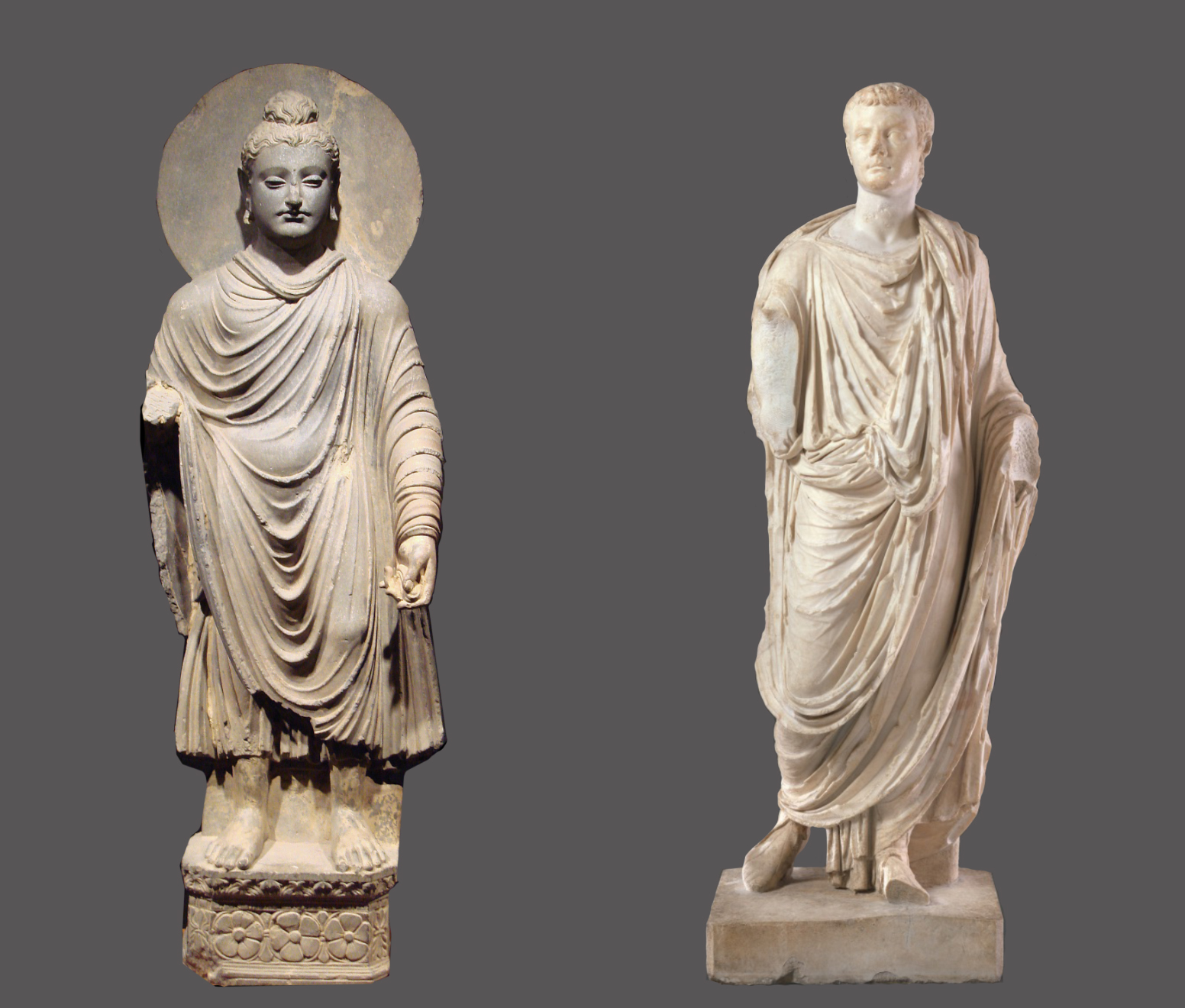
To systematize these observations, let's turn to a more structured breakdown of Gandharan art's defining characteristics.
Gandhara School of Art | Gandhara Art | Art & Culture for UPSC Prelims & Mains 2022-2023
The following video from BYJU'S IAS provides a concise, point-by-point explanation of the key features of Gandhara sculpture, which will help you identify them easily.
Please watch from 04:59 to 13:20. The speaker meticulously identifies the core features of a Gandharan Buddha image. As you watch, make a mental checklist of these elements: Material: Bluish-grey sandstone and stucco. Theme: Primarily Mahayana Buddhist. Iconography: Focus on the 'Greek or Roman influence' such as the halo, wavy hair (like Apollo), stoic facial expression, elongated ears, and the heavy, pleated drapery.
In summary, the Gandhara School is defined by:
- Hellenistic Realism: Anatomically detailed and naturalistic depiction of the human body.
- Specific Features: Wavy hair, toga-like robes with thick pleats, calm and meditative expressions, and sometimes even muscular features.
- Material: Predominantly bluish-grey schist and, especially in later periods, stucco.
- Religious Focus: Overwhelmingly Buddhist, catering to the Mahayana pantheon of Buddhas and Bodhisattvas.
The Mathura School: An Indigenous Ideal
While the Gandhara school was developing in the northwest, a powerful and equally prolific school of art emerged in Mathura, a major city south of modern-day Delhi. Mathura was a bustling commercial hub and the Kushans' eastern capital. Unlike Gandhara, its artistic roots were firmly planted in indigenous Indian traditions, drawing inspiration from the earlier sculptures of yakshas and yakshis (nature deities) seen at sites like Bharhut and Sanchi.
To understand the Mathura style, let's explore its origins and characteristics through a detailed reading.
The following chapter from a UNESCO publication on the Silk Roads provides a comprehensive overview of the art of Mathura during the Kushan period. It contrasts the school with Gandhara and details its unique contributions.
Please read the section titled 'Kushan art in Mathura', starting on page 361. Focus on the following aspects: Material and Technique: The characteristic use of spotted red sandstone. Religious Breadth: Note that unlike Gandhara, Mathura artists produced images for Buddhists, Jains, and Brahmanical Hindus. Style and Aesthetics: The emphasis on sensual, powerful figures representing inner life-force (prana), as opposed to anatomical realism. The Mathura Buddha: Pay special attention to the description of the Buddha image—the smiling expression, the drapery revealing the body, the shaven or curled hair, and the energetic posture.
The Mathura school produced an art that was vibrant, energetic, and earthly. Its aesthetic goals were different from Gandhara's. Rather than anatomical precision, the artists sought to convey a sense of inner vitality and spiritual bliss.
The key features of the Mathura school are:
- Indigenous Idealism: Figures are powerful and energetic, with full, fleshy bodies. The style is less about realism and more about conveying an inner spiritual state.
- Specific Features: Shaven heads or hair arranged in snail-shell curls, thin and translucent drapery that clings to and reveals the body's form, broad shoulders, and a characteristically alert, smiling expression.
- Material: Distinctive mottled or spotted red sandstone.
- Religious Focus: Eclectic, producing icons for Buddhism, Jainism, and various Hindu deities.
A Comparative Analysis
Now that we have examined each school individually, let's bring them together for a direct comparison. The following image places sculptures from both schools side-by-side, making their stylistic differences immediately apparent.

The differences you can see in the image are summarized in the table below. This table synthesizes the key distinctions and directly addresses our learning outcome.
| Feature | Gandhara School | Mathura School |
|---|---|---|
| Main Influence | Greco-Roman / Hellenistic realism | Indigenous Indian traditions (e.g., Yaksha sculptures) |
| Material | Bluish-grey schist, stucco, plaster | Spotted red sandstone |
| Religious Focus | Primarily Mahayana Buddhist | Buddhist, Jain, and Brahmanical (Hindu) |
| Physique | Realistic, anatomical, sometimes muscular | Idealized, powerful, voluminous, energetic |
| Drapery | Thick, heavy, with complex, opaque folds (toga-like) | Thin, translucent, revealing the body's form |
| Hair | Wavy or curly, in a naturalistic style | Shaven head or tight snail-shell curls (kaparda) |
| Facial Expression | Calm, stoic, introverted, meditative | Alert, open-eyed, subtly smiling, blissful |
| Halo | Generally plain or with minimal decoration | Often intricately decorated with motifs |
It is important to remember that while we distinguish between these two "schools," they were not hermetically sealed. As the UNESCO resource mentions, sculptures from Mathura were exported to Gandhara, and Gandharan motifs found their way to Mathura. This created a dynamic interplay, with later Mathura Buddhas sometimes adopting the robe-covering-both-shoulders style from Gandhara. This complex interaction, explored by scholars in works like "The Global Connections of Gandhāran Art", shows a vibrant artistic dialogue across the Kushan empire.
Conclusion
In this lesson, we have compared the two most significant schools of art from the Post-Mauryan/Kushan period. You now have a framework to distinguish between the Hellenistic-inspired realism of Gandhara and the indigenous idealism of Mathura.
Key Takeaways:
- Gandhara Art: Characterized by its use of grey schist, Greco-Roman influences, realistic anatomy, and serene, meditative Buddha figures with wavy hair and heavy robes. It was an outward-looking art form, synthesizing foreign styles to serve Buddhist ideology.
- Mathura Art: Defined by its use of red sandstone, indigenous roots, energetic and powerful figures, and blissful, smiling Buddhas with transparent drapery. It was an inward-looking tradition, evolving existing Indian aesthetics.
- Shared Context, Different Visions: Both schools flourished under the patronage of the Kushans and were instrumental in creating the first anthropomorphic images of the Buddha, but they pursued distinct artistic visions reflecting their unique cultural locations.
Preview of the Next Lesson:
While the Kushans dominated the north, creating a hub for trans-Asian trade and art, another major power was shaping the political and economic landscape of the Deccan plateau. In our next lesson, we will shift our focus south to "Describe the Satavahana administrative structure and their role in facilitating Deccan trade with Rome and Southeast Asia." We will explore how this dynasty created a stable and prosperous empire that served as a crucial link in the maritime trade routes connecting the Roman world to the east.