Introduction
Welcome to your fifth lesson in our module on Post-Mauryan India. In our last session, we delved into the profound doctrinal shift that led to the emergence of Mahayana Buddhism. We explored its core concepts, such as the ideal of the Bodhisattva, the transcendental nature of the Buddha (Trikaya), and the philosophy of Sunyata (emptiness).
Today, we will see how this new, expansive form of Buddhism was propelled across the continent by a powerful political and economic engine: the Kushan Empire. This lesson directly addresses the learning outcome: Analyze the significance of the Kushan Empire under Kanishka, focusing on its control of Silk Road trade and patronage of Mahayana Buddhism.
We will examine how the Kushans, a dynasty of nomadic origin, established a vast empire at the crossroads of major civilizations. You'll find the nexus of economic strategy, political power, and religious ideology here particularly compelling. We will analyze how their control over the burgeoning Silk Road not only generated immense wealth but also created the very channels through which Mahayana Buddhism spread to Central Asia and China, transforming the cultural landscape of Asia forever.
The Rise of a Central Asian Superpower
The Kushans began not as empire-builders but as a nomadic people. Originally one of five tribes of the Yuezhi confederation, they were pushed out of their homeland in Northwest China by the Xiongnu in the 2nd century BCE. After a long migration, they settled in Bactria (modern-day Afghanistan and Central Asia).
To understand how this nomadic group transformed into a formidable imperial power, watch the following video. It charts their consolidation and expansion from their Central Asian heartland into the Indian subcontinent.
Yuezhi Migration and Kushan Empire - Nomads DOCUMENTARY
This documentary from Kings and Generals details the origins of the Kushans, their unification under Kujula Kadphises, and their inexorable expansion south into India under his successors, laying the foundation for the empire Kanishka would inherit.
Please watch the video from 08:39 to 17:17. As you watch, focus on these key stages: Unification (08:39 - 11:13): How Kujula Kadphises united the Yuezhi tribes and established the Kushan kingdom. Expansion into the Indus Valley (13:20 - 14:26): The conquest of wealthy trade ports in the Indus region. Consolidation under Vima Kadphises (14:26 - 17:17): The push into northern India, the establishment of administration, and the immense economic benefits gained from controlling trade.
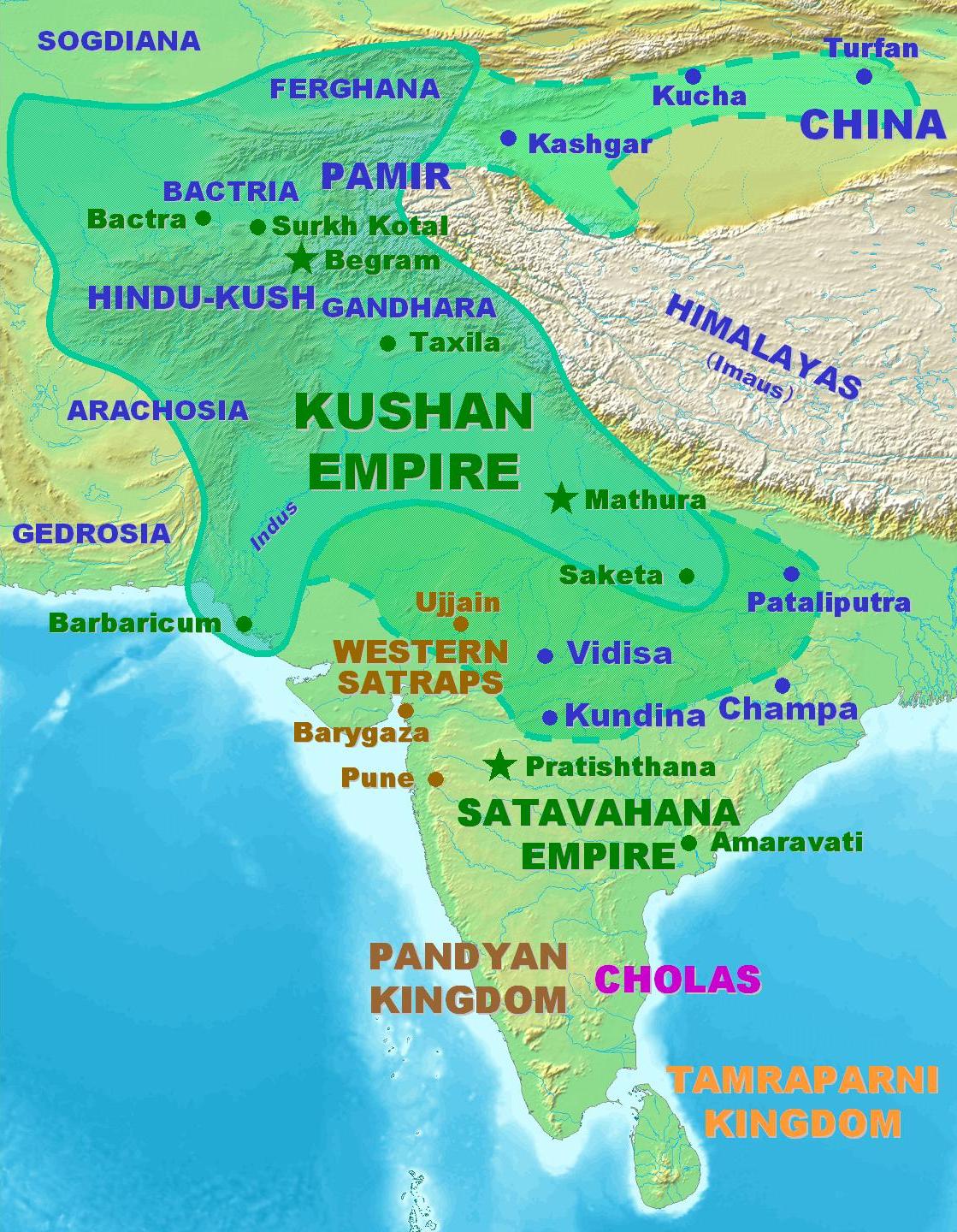
As the video explains, by the time of Emperor Kanishka's accession (c. 127 CE), the Kushans controlled a vast territory stretching from Central Asia to the Gangetic basin. Their empire was a true melting pot of cultures—Iranian, Greek, and Indian.
Masters of the Silk Road: An Economic Analysis
The Kushan Empire's primary significance lay in its unique geographical position. It functioned as the central hub connecting the four great powers of the ancient world: the Roman Empire in the west, the Parthian Empire in Iran, the Han Dynasty in China, and the various kingdoms of India.
Your background in finance and economics provides a valuable lens through which to appreciate the Kushans' economic strategy. They weren't just passive beneficiaries of their location; they were active architects of a thriving commercial network.
To understand the economic mechanics of their empire, please read the "Economy" section in the following research paper.
[PDF] The Kushans and the Emergence of the Early Silk Roads
This excerpt from Paul Wilson's thesis, The Kushans and the Emergence of the Early Silk Roads, offers a detailed analysis of the Kushan economy. It moves beyond a simple description of trade to examine the systemic innovations that fueled their prosperity.
Please read the section titled 'Economy' (which begins on page 40 and ends before 'Extent of Empire' on page 42). Focus on these critical points: The evidence for a sophisticated, high-volume trading system. The 'momentous' switch to gold coinage under Vima Kadphises and its implications for wealth and trade. The standardization and purity of their coinage. Their strategic move to access maritime trade ports to bypass Parthian taxes.
The introduction of a standardized gold coinage was a masterstroke of economic policy. Let's analyze its impact:
- Reduced Transaction Costs: A trusted, high-purity gold coin served as a stable and universally accepted medium of exchange. This is analogous to the role of a global reserve currency today, which simplifies international trade by providing a common denominator of value.
- Facilitation of Long-Distance Trade: For high-value goods like silk and spices, a high-value currency like gold was far more practical than bartering or carrying large amounts of silver or copper coins.
- A Symbol of Sovereignty and Power: Issuing a prestigious gold currency, which rivaled that of Rome, was a powerful statement of imperial authority and economic might. It signaled that the Kushans were not just regional players but a global economic power.
This sophisticated economic system was supported by a network of thriving urban centers that served as production hubs, markets, and administrative centers, as detailed in the UNESCO resource "Cities and urban life in the Kushan kingdom". These cities were the nodes of the Silk Road network.
Kanishka's Patronage of Mahayana Buddhism
The wealth generated from trade provided the resources for another of Kanishka's defining policies: his patronage of Mahayana Buddhism. As we discussed in the last lesson, Mahayana's devotional character, its pantheon of compassionate Bodhisattvas, and its universalist message were well-suited to a cosmopolitan empire composed of diverse peoples.
Kanishka, much like Ashoka Maurya before him, became a great champion of the faith. Let's explore the nature of his patronage.
Yuezhi Migration and Kushan Empire - Nomads DOCUMENTARY
Returning to the Kings and Generals documentary, this segment focuses specifically on Kanishka's reign and his embrace of Buddhism.
Watch from 17:17 to 19:51. Note the key actions Kanishka took as a patron of Buddhism: His reputed conversion experience after a battle. Convening an important Buddhist council in Kashmir. The translation of sutras into accessible forms of Sanskrit. Funding the construction of the monumental Kanishka stupa near Purushapura (Peshawar).
The Fourth Buddhist Council held under Kanishka's patronage was a pivotal event. Its key outcomes were:
- Systematization of Doctrine: The council helped to codify and debate the emerging Mahayana doctrines.
- Linguistic Shift: It marked a formal move away from Pali and towards Sanskrit as the principal language of Buddhist scripture. This "sanskritization" elevated the intellectual prestige of the religion and made it more accessible to the educated elites across northern India and Central Asia.
This patronage was not just an act of personal faith; it was also a shrewd political move. By promoting a universalist religion like Mahayana Buddhism, Kanishka could foster a common cultural identity across his vast and ethnically diverse empire, unifying his subjects under a shared ideological umbrella.
The Great Synthesis: Commerce and Conversion
The true significance of the Kushan empire lies in the synthesis of its two greatest achievements: control of the Silk Road and the patronage of Mahayana Buddhism. The trade routes were not just conduits for silk and gold; they were highways for ideas.

The process worked in a mutually reinforcing cycle:
- Merchants as Missionaries: Kushan merchants traveling to oasis cities in the Tarim Basin (like Khotan) and into China carried their faith with them.
- Monasteries as Hubs: Wealthy traders, in turn, funded the establishment of monasteries along these routes. These monasteries provided safe lodging for caravans, further strengthening the trade network.
- Buddhism's Adaptability: Mahayana Buddhism's new doctrines, as discussed in the thesis
The Kushans and the Emergence of the Early Silk Roads, evolved to embrace commerce. The faith, which had once emphasized asceticism, now found ways to incorporate wealthy patrons and merchants, seeing their success as a means to support the Sangha (monastic community).
The final clip from the documentary provides a concrete example of this process in action.
Yuezhi Migration and Kushan Empire - Nomads DOCUMENTARY
This last segment illustrates how the Kushan empire acted as the primary conduit for Buddhism's transmission to the Far East.
Watch from 19:51 to 21:24. Pay attention to the role of Kushan merchants and missionaries, like Lokaksema from Gandhara, in introducing Buddhist texts and teachings to the Chinese Han court.
Lokaksema, a Kushan monk, is a key historical figure. His work in translating Mahayana sutras into Chinese in the 2nd century CE laid the very foundation for the development of Buddhism in China. Without the political stability and economic connectivity provided by the Kushan Empire, this critical cultural transmission would have been far more difficult, if not impossible.
Conclusion
In this lesson, we have analyzed the multifaceted significance of the Kushan Empire under Kanishka. It was a unique imperial formation that leveraged its nomadic heritage and strategic location to become the lynchpin of the Afro-Eurasian world system.
Key Takeaways:
- The Kushan Empire was a Central Asian superpower that unified a vast territory from the Aral Sea to the Ganges River, placing it at the heart of the Silk Road.
- Their economic acumen, highlighted by the introduction of a standardized gold currency, facilitated unprecedented levels of international trade between Rome, India, and China.
- Emperor Kanishka was a major patron of Mahayana Buddhism, funding councils (like the Fourth Buddhist Council) and monumental architecture (the Kanishka Stupa) that helped codify and propagate the new faith.
- The Kushan Empire's most enduring legacy is the synthesis of commerce and culture: they used their control over the Silk Road's economic network to disseminate Mahayana Buddhism, fundamentally shaping the religious landscape of China and East Asia.
Preview of the Next Lesson:
The new devotional ideals of Mahayana Buddhism, combined with the immense wealth and the diverse cultural influences coursing through the Kushan Empire, created fertile ground for a spectacular artistic efflorescence. In our next lesson, we will "Compare the key features and influences of the Gandhara and Mathura schools of art," exploring how artists gave visual form to the Bodhisattvas and celestial Buddhas that came to dominate the Buddhist imagination.