Introduction
Welcome to the first lesson of our module on the Gupta Empire. In our previous module, we explored the vibrant but politically fragmented landscape of post-Mauryan India, culminating with the powerful regional kingdoms of the Sangam Age in the south. We saw how powers like the Satavahanas and the Tamil kings built their influence on robust trade networks and distinct cultural foundations.
Today, we shift our focus back to the Gangetic heartland to witness the rise of a new imperial power that would once again bring large swathes of the subcontinent under a single authority. This lesson addresses the learning outcome: Describe the political consolidation of the Gupta Empire under Samudragupta and Chandragupta II.
We will analyze the methods—military, diplomatic, and strategic—that transformed a minor principality into a vast empire. We will start with the crucial groundwork laid by the dynasty's founder, Chandragupta I, before diving deep into the expansive conquests of Samudragupta and the peak of territorial consolidation under his son, Chandragupta II. Your interest in systemic analysis will be particularly relevant as we deconstruct the different strategies these rulers applied to different regions.
The Foundation: Chandragupta I
The Gupta dynasty began with minor rulers, Srigupta and Ghatotkacha, who likely held subordinate status. The real architect of the imperial line was Chandragupta I (c. 320 – 335 CE), who elevated the family's political standing significantly.
To understand how he laid the foundation for the empire, please read the following section from the provided text.
This reading from the paper 'Guptas Empire' discusses the rise of Chandragupta I. It explains the two key steps he took to establish the Guptas as a major power.
Please read the text from the beginning of the 'Political History' section to the end of the subsection 'Chandragupta I (320 – 335 CE)'. Focus on: The assumption of the title Maharajadhiraja ('great king of kings'): What does this change in title signify compared to his predecessors' title of Maharaja? The Lichchhavi Alliance: Understand the political and strategic significance of his marriage to the Lichchhavi princess, Kumaradevi.
As you've read, Chandragupta I's reign was pivotal. Through a strategic matrimonial alliance with the powerful Lichchhavi clan, he gained not just prestige but also likely control over their territories and resources in the fertile Gangetic basin. This, combined with his adoption of an imperial title, marked the transition of the Guptas from local chiefs to imperial contenders, setting a solid stage for his successor.
Samudragupta: The Architect of Imperial Expansion (c. 335 – 375 CE)
Chandragupta I's son, Samudragupta, was the true architect of the Gupta Empire. A relentless military commander, his conquests dramatically expanded Gupta authority across the subcontinent. Our primary source for his reign is a remarkable document: the Allahabad Prashasti, an elaborate eulogy composed by his court poet Harisena, inscribed on an Ashokan pillar.

Samudragupta's campaigns were not uniform; he was a pragmatist who applied different policies to different regions. We will explore his major campaigns in two parts.
1. Conquests in Northern India (Aryavarta)
In the north, Samudragupta pursued a policy of complete annihilation and annexation (prashabhoddharana). His goal was to eliminate rival power centers and directly incorporate their territories into the core of the Gupta empire.
The political situation in North India was ripe for such an intervention. To understand the context and the execution of these northern campaigns, please watch the following video.
The Aryavarta wars of Samudragupta | Samudragupta's Conquest Part -1
This video by Jay Vardhan Singh provides an excellent analysis of Samudragupta's northern campaigns, known as the 'Aryavarta wars'. It details the political vacuum he exploited and the key rulers he defeated.
Watch the entire video (around 8 minutes). Pay close attention to: The political instability that provided Samudragupta with an opportunity, specifically the weakening of the Vakataka-Naga alliance. The rulers defeated in his first major campaign (the Nagas, Achyuta, and the Kota family). The concept of 'Aryavarta' and the policy of exterminating the nine kings to gain full control over the resource-rich Ganga valley.
By methodically destroying the Naga confederacy and other monarchies, Samudragupta secured the entire Gangetic valley. This gave him control over an immense agricultural and economic heartland, which would fund his future ambitions.
2. The Southern Expedition (Dakshinapatha) and Strategic Policy
After securing the north, Samudragupta turned his attention south. His objective here was different. Given the vast distances, direct administration was impractical. Instead, he sought to establish his overlordship and extract wealth.
The Southern Campaign of Samudragupta | Samudragupta's Conquest Part -3
This next video from the same channel explains the motivations, route, and unique strategy of Samudragupta's southern campaign.
Please watch from 00:40 to 06:30. Focus on these key points: Economic Motivation: Why was the south an attractive target? Note the discussion on maritime trade and accumulated wealth. The Campaign Route: Trace his likely path down the eastern coast to Kanchi. The Policy of Grahan-moksh-anugraha: Understand this three-stage policy of 'capturing, liberating, and reinstating' the southern kings. What was the strategic purpose of this approach?
Samudragupta's policy in the south was a masterstroke of statesmanship. By defeating the southern kings and then restoring their rule in exchange for tribute and allegiance, he turned them into vassals without overstretching his administrative resources. This approach secured his southern flank and tapped into the region's wealth, all while acknowledging the logistical realities of ruling a vast empire.
To crystallize your understanding of his strategic thinking, the following reading provides a sharp analysis.
This excerpt from a paper by Dr. Dhananjoy Bhattacharjee explicitly analyzes the brilliant pragmatism behind Samudragupta's varied military strategies.
Please read the section titled 'Conquests: Samudragupta’s Strategy'. Note how the author connects his policies to geography, drawing a distinction between the role of a digvijayi (conqueror who annexes) in the north and a dharmavijayi (righteous conqueror who establishes suzerainty) in the south.
Chandragupta II: The Zenith of the Empire (c. 375 – 414 CE)
Samudragupta's son, Chandragupta II (also known as Vikramaditya), inherited a large and powerful empire. His reign is remembered not for dramatic expansion, but for strategic consolidation that brought the empire to its territorial and cultural peak. He achieved this through a calculated mix of military conquest and diplomatic marriages.
The following reading covers the key achievements of Chandragupta II's reign that led to the final consolidation of Gupta power.
Please read the section 'Chandragupta-II (375 – 414 CE)'. As you read, focus on his two primary methods of consolidation: War against the Sakas: Identify the target (the Western Kshatrapas) and the outcome. What were the economic and political benefits of this victory? Diplomatic Matrimonial Alliance: Understand the strategic value of marrying his daughter, Prabhavatigupta, into the Vakataka dynasty. How did this secure the Gupta empire's southern frontier and extend its influence?
By defeating the Western Sakas, Chandragupta II not only eliminated a long-standing rival but also gained control over the prosperous region of Gujarat and its ports (like Broach). This gave the empire direct access to the lucrative maritime trade with the western world, a significant economic boon.
Simultaneously, his Vakataka alliance was a brilliant diplomatic maneuver. It transformed a powerful southern neighbor into a subordinate ally, effectively securing the empire's Deccan frontier and allowing him to project Gupta influence deep into central India without direct conquest.
Visualizing the Consolidated Empire
After examining the contributions of these key rulers, we can now visualize the result of their efforts. The map below illustrates the phased expansion of the Gupta Empire.
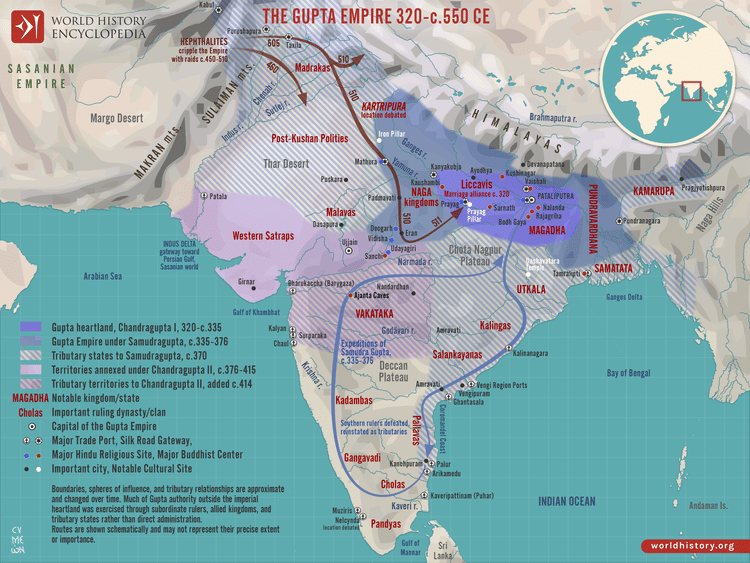
This map clearly shows the political consolidation process:
- Chandragupta I established the core kingdom in the Gangetic plains.
- Samudragupta vastly expanded this core through direct annexation in the north and established a wide sphere of influence over tributary states in the east, south, and west.
- Chandragupta II finished the job by conquering the valuable western territories of the Sakas and securing the Deccan frontier through diplomacy, bringing the empire to its largest and most secure extent.
Conclusion
In this lesson, we have tracked the political consolidation of the Gupta Empire from a small principality to the dominant power of the subcontinent. You can now describe this process, focusing on the pivotal reigns of Samudragupta and Chandragupta II.
Key Takeaways:
- Foundation: Chandragupta I laid the groundwork for empire by securing a strategic alliance with the Lichchhavis and adopting the imperial title of Maharajadhiraja.
- Samudragupta's Pragmatic Conquests: Samudragupta was the primary engine of expansion, employing a dual strategy: direct annexation (prashabhoddharana) in the geographically contiguous north and establishing tributary overlordship (grahan-moksh-anugraha) in the distant south.
- Chandragupta II's Strategic Consolidation: Chandragupta II brought the empire to its zenith by combining conquest and diplomacy. He annexed the wealthy western territories from the Sakas and neutralized the Deccan by forging a powerful matrimonial alliance with the Vakatakas.
- Methods of Consolidation: The Guptas built their empire through a sophisticated blend of overwhelming military force, pragmatic statecraft, and strategic diplomatic alliances.
Preview of the Next Lesson:
Now that we have established the political boundaries and structure of the Gupta Empire, our next step is to look inside. In the next lesson, we will begin to analyze the machinery of the state itself, addressing the learning outcome: "Describe the Gupta administrative structure, differentiating it from the Mauryan model, with a focus on provincial (bhukti) and district (vishaya) governance." We will explore how this vast empire was actually managed.