Introduction
In our last lesson, we traced the decline of the Gupta Empire, a process driven by both external shocks like the Huna invasions and internal decay through emerging feudal tendencies. You'll recall we discussed how the growing independence of feudatory rulers, the samantas, led to the fragmentation of imperial authority. The fall of this centralizing power created a vacuum in North India, setting the stage for a new, protracted contest for supremacy.
This lesson dives straight into that contest. We will address the first learning outcome of our new module on Early Medieval India: Explain the tripartite struggle for Kannauj between the Gurjara-Pratiharas, Palas, and Rashtrakutas. This was not a single war, but a complex, nearly 200-year geopolitical rivalry that defined the subcontinent's political landscape from the late 8th to the 10th century. For someone with your background in finance and strategy, you can think of this as a multi-generational, three-player game for control of a prime asset, where alliances shifted and fortunes changed, but the ultimate prize remained the same.
The Contenders and the Prize
Following the decline of Harsha's empire in the 7th century, no single power immediately replaced him. Instead, three major dynasties emerged in different regions of India, each with imperial ambitions.
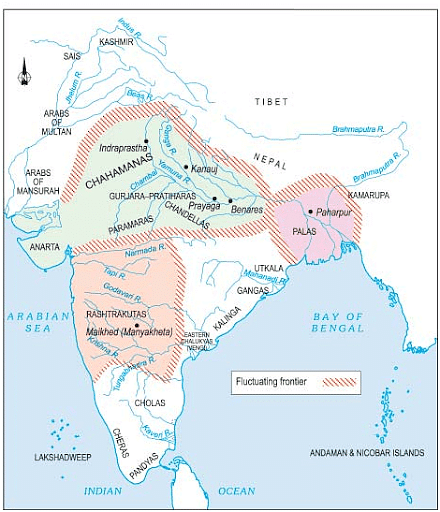
The three main contenders were:
- The Gurjara-Pratiharas, based in western India (Avanti-Jalaor region).
- The Palas, ruling over the eastern regions of Bengal and Bihar.
- The Rashtrakutas, a formidable power from the Deccan plateau.
The focal point of their rivalry was the city of Kannauj. But why was this one city so important?
Tripartite Struggle: History, Cause, & Phases
To understand the context of the struggle, let's start with a foundational text that outlines why Kannauj was the grand prize and introduces the three competing dynasties.
Please read the introductory sections 'Tripartite Struggle', 'Who Were the Parties Involved in the Tripartite Struggle?', and the section 'Causes of Tripartite Struggle'. This will clarify the strategic value of Kannauj and the origins of the three empires.
As you've just read, Kannauj was much more than just a city. It was a potent symbol and a strategic asset for several key reasons:
- Symbol of Sovereignty: Since the time of Harshavardhana, controlling Kannauj was seen as holding the imperial sceptre of North India (Aryavarta). It conferred immense political prestige.
- Economic Hub: Situated in the heart of the fertile and resource-rich Ganga-Yamuna doab, its master controlled immense agricultural wealth.
- Trade Nexus: It was a critical node on the trade routes, including a connection to the Silk Road, making it commercially vital.
- Power Vacuum: After Harsha, Kannauj was ruled by a succession of weak kings, making it a tempting and seemingly easy target for ambitious regional powers.
The Ebb and Flow of Conflict: A Two-Phase Struggle
The struggle for Kannauj was a long and complex affair, marked by shifting fortunes. Historians typically divide its most intense period into two main phases, primarily defined by the reigns of the most ambitious kings from each dynasty.
To get a dynamic sense of these campaigns, particularly from the perspective of the southern power that repeatedly intervened in the north, let's watch a video.
That Time a South Indian Empire Conquered the Heart of North India
This video from Odd Compass provides a concise and engaging narrative of the major military campaigns, focusing on the role of the Rashtrakuta emperors.
Please watch from the beginning to 08:00. As you watch, focus on: The distinct ambitions and geographical positions of the three empires. The actions of the Rashtrakuta king Dhruva in the first phase of the conflict. The even more ambitious northern campaign of his son, Govinda III, in the second phase. The outcome of these southern invasions: successful in battle, but difficult to sustain politically.
As the video highlighted, the Rashtrakutas played a crucial and disruptive role. Let's formalize the sequence of events you saw, integrating them into the two-phase framework.
Phase I (c. 790 – 800 CE)
The conflict began as a duel between the two northern powers.
- The Pratihara king Vatsaraja attacked the Palas and defeated their king, Dharmapala, at Prayaga. Vatsaraja occupied Kannauj.
- Just as the Pratiharas seemed dominant, the Rashtrakuta king Dhruva marched north. In a remarkable campaign, he defeated Vatsaraja, forcing him to flee to the deserts of Rajasthan.
- Dhruva then turned his attention to Dharmapala, also defeating him.
- Crucial Point: Dhruva's victory was a spectacular raid, not a permanent conquest. Having secured immense plunder and prestige, he returned to the Deccan to manage his southern affairs. This left a power vacuum in the north, ready for the next round.
Phase II (c. 800 – 814 CE)
The second phase was essentially a replay of the first, but on a grander scale.
- With the Rashtrakutas gone, the Pala king Dharmapala capitalized on the situation. He captured Kannauj and installed his own nominee, Chakrayudha, on the throne, effectively making Kannauj a Pala protectorate.
- The Pratiharas recovered under Vatsaraja's successor, Nagabhata II. He mounted a new offensive, defeated Chakrayudha, and then defeated his patron Dharmapala in a major battle at Munger.
- History repeated itself. The Rashtrakuta king Govinda III (Dhruva's son) launched an even more formidable invasion. He decisively defeated Nagabhata II and secured the submission of Dharmapala and Chakrayudha without a fight.
- Once again, despite this overwhelming success, Govinda III had to return south. The logistical challenge of controlling North India from a base in the Deccan was simply too great.
Consequences and the Final Outcome
The tripartite struggle was a war of attrition. While the Rashtrakuta invasions were militarily brilliant, their inability to permanently occupy the north meant they acted more as a "balancer" force. By repeatedly weakening the Pratiharas, they inadvertently allowed the Palas to survive and regroup. Likewise, by checking the Palas, they prevented an eastern consolidation of North India.
To understand the long-term consequences, let's turn to a more academic analysis.
[PDF] The tripartite struggle for Kannauj
This scholarly article provides a deeper analysis of the conflict's phases and, most importantly, its structural consequences for the Indian polity.
Please read the two sections starting with 'A reconstruction of the principal phases of the conflict shows...' and 'The Tripartite Struggle’s political consequences were both immediate and structural.' Focus on these key arguments: Why geography and internal politics made it hard for any one power to maintain control. The idea that 'victory' did not mean creating a centralized empire. The structural outcome: the prevention of a single pan-Indian state and the reinforcement of regional powers and 'feudal' characteristics.
As the article argues, the struggle had profound long-term effects:
- Eventual Pratihara 'Victory' in the North: After the final Rashtrakuta withdrawal, the Pratiharas, being geographically closest and most invested, eventually recovered and established firm control over Kannauj. Under powerful rulers like Mihir Bhoja (c. 836-885 CE), they built a large empire in northern India with Kannauj as its capital.
- Mutual Exhaustion: Two centuries of warfare weakened all three dynasties, draining their treasuries and manpower. This exhaustion ultimately contributed to their respective declines and made them vulnerable to new rising powers.
- Entrenchment of Regionalism: The most significant outcome was structural. The struggle effectively prevented the emergence of a new pan-Indian imperial authority like the Mauryas or Guptas. It created a stable, albeit competitive, multi-polar system of powerful regional kingdoms. This pattern of strong regional states vying for supremacy became the defining characteristic of the early medieval period.
- Militarization and Feudalization: The constant need for military readiness reinforced the samanta system. Kings delegated more military and administrative authority to local chieftains in exchange for troops, further decentralizing the state and solidifying the 'feudal' political structure we discussed in the last lesson.
Conclusion
Today, we've dissected the great tripartite struggle, a defining conflict of early medieval India. We saw how the collapse of the Gupta order led not to chaos, but to a new, highly competitive political system.
Key Takeaways:
- The struggle was a nearly 200-year contest between the Gurjara-Pratiharas, Palas, and Rashtrakutas for control of Kannauj, the symbol of North Indian sovereignty.
- The conflict was a dynamic three-way affair, with the Deccan-based Rashtrakutas acting as a powerful intervening force, repeatedly defeating the northern powers but being unable to sustain permanent control due to logistical and political constraints.
- While the Pratiharas eventually emerged as the masters of Kannauj, the larger consequence of the struggle was the exhaustion of all three empires.
- The most enduring legacy was political: the prevention of a single, unified empire and the crystallization of a multi-polar system of strong, competing regional kingdoms that would characterize India for centuries.
Preview of the Next Lesson:
While the great game for Kannauj unfolded in the north, equally significant developments were taking place in the far south. In our next lesson, we will shift our focus to the Tamil country to explore the administrative system and formidable maritime power of the Chola Empire, a dynasty that would come to dominate not just South India, but the entire Indian Ocean commercial network.