Introduction
In our last lesson, we saw the Gupta Empire at its zenith through the eyes of the Chinese traveler Fa-Hien. His account painted a picture of a prosperous, tolerant, and well-governed society in the Gangetic heartland, the Madhyadesha. However, this "Classical Age" was not destined to last. The very structures that defined the empire also contained the seeds of its undoing.
Today, we will examine the process of imperial decline. This lesson addresses the final learning outcome for this module: Discuss the emergence of feudal tendencies during the late Gupta period and the impact of Huna invasions on the empire's decline.
We will approach this not as a single event, but as a complex interplay of internal weaknesses and external shocks. Think of it as analyzing a corporate decline: was it caused by internal mismanagement and structural flaws, or by a disruptive external competitor? As we will see, for the Guptas, it was a devastating combination of both.
The Twin Drivers of Decline
The fall of the Gupta Empire can be attributed to two primary, interconnected forces:
- The Huna Invasions: A severe external shock that drained the empire's military and financial resources.
- Emerging Feudal Tendencies: A gradual internal decay that fragmented political authority and eroded the central government's revenue base.
Let's begin by understanding the external threat.
The External Shock: Huna Invasions
The first major challenge to Gupta stability came from the northwest. A nomadic people from Central Asia, known in India as the Hunas (related to the Hephthalites or "White Huns"), began a series of aggressive incursions.
What Caused the Decline of the Gupta Power? || UPSC 2025 || Ancient History
To get an overview of the Huna invasions and their impact, watch this section from the Sleepy Classes IAS channel. It explains who the Hunas were and how their attacks destabilized the empire.
Watch the segment from 02:37 to 05:11. Focus on: The origins of the Hunas. How Skandagupta initially repelled them, but his weaker successors could not. The key impacts: decline in trade (especially Indo-Roman), breakdown of law and order, and the rise of local chiefs like Yashodharman who challenged Gupta authority after defeating the Hunas.
The early Gupta military, particularly under Emperor Skandagupta (c. 455 – 467 CE), was strong enough to repel the initial Huna attacks. However, these were costly victories. The pressure was relentless, and after Skandagupta, weaker rulers struggled to contain the threat.
The Hunas, under leaders like Toramana and his son Mihirakula, eventually broke through and established their own dominion over parts of northwestern and central India.
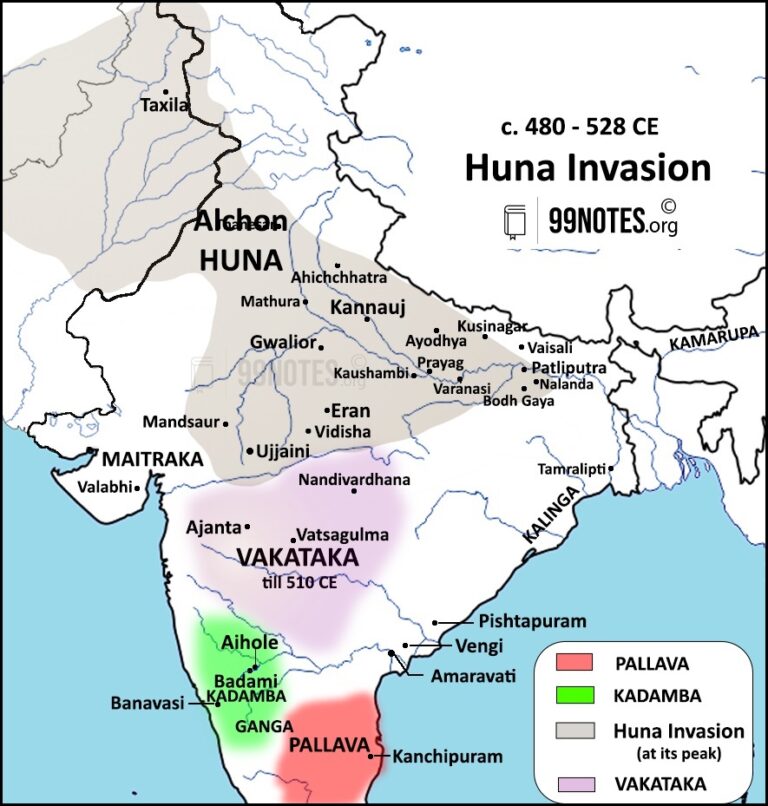
The impact of these invasions was multifaceted:
- Military Exhaustion: Constant warfare against a formidable cavalry-based army drained the imperial treasury and manpower.
- Economic Disruption: The Hunas' occupation of the northwest disrupted the highly profitable overland trade routes connecting India to Central Asia and the West. This was a direct blow to the state's financial health.
- Loss of Prestige: An emperor's legitimacy rested heavily on his ability to protect the realm (dharma of a kshatriya). The inability to prevent the Huna devastation shattered the Gupta's aura of invincibility, emboldening internal rivals.
The Internal Decay: Feudalization of the State
While the Hunas were battering the empire from the outside, it was hollowing out from within. This process is often described as the emergence of feudal tendencies. This wasn't feudalism in the European sense, with manors and serfs, but a distinct Indian pattern of political and economic decentralization. It was driven primarily by two administrative practices.
1. The Land Grant System
As we've seen, Gupta kings made extensive land grants, known as agrahara grants, to Brahmanas and temples for religious merit. Later, they also began granting land to administrative officials, often in lieu of cash salaries.
HUNA Invasion & The Fall of Gupta Empire in English | Ancient History for UPSC
This video from Bookstawa explains the nature of these land grants and their long-term consequences.
Watch the segment from 09:09 to 10:40. Pay close attention to how these grants differed from earlier practices. The Guptas often transferred not just land, but also rights over mines and the authority to administer justice, effectively creating small, autonomous zones.
This practice had profound consequences:
- Economic Impact: Every grant removed land from the direct imperial revenue system. The taxes that would have flowed to the central treasury now went to the grant-holder. Over time, this significantly shrank the state's economic base.
- Administrative Fragmentation: The grant-holders often had administrative and judicial authority over their donated villages. This created pockets of territory that were outside the direct control of the imperial bureaucracy, weakening central authority.
2. The Growing Independence of Samantas
Perhaps the most significant factor was the changing role of provincial governors and subordinate rulers, known as samantas.
Factors Leading to the Decline of the Gupta Empire
The article 'Factors Leading to the Decline of the Gupta Empire' provides an excellent analysis of how the samanta system evolved and undermined the empire.
Please read the section titled 'The growing independence of samantas: Feudalization and imperial weakness'. Focus on the transition of samantas from appointed officials to hereditary rivals and the 'loyalty problem' this created.
Initially, the samanta system was an efficient way to govern a vast empire. The emperor would defeat a local king but allow him to continue ruling his territory in exchange for tribute and military support. However, this system depended entirely on a strong center.
As central authority weakened due to weak successors and the Huna crisis, the dynamic shifted:
- Hereditary Power: Governorships and subordinate positions became hereditary. This meant loyalty was no longer to the emperor who appointed them, but to their own lineage and local power base.
- Withholding Resources: Samantas began to withhold tribute and military levies, claiming they needed the resources to defend their own territories.
- Asserting Independence: The most powerful samantas saw the emperor's weakness as an opportunity. They started issuing their own coins, conducting their own diplomacy, and eventually declared themselves independent kings, carving up the empire from within.
Synthesis: A Vicious Cycle of Decline
It is crucial to understand that these internal and external factors did not operate in isolation. They created a vicious feedback loop that accelerated the empire's collapse.
Factors Leading to the Decline of the Gupta Empire
Let's read one more short section from the same article, which masterfully summarizes how these factors reinforced each other.
Read the final section titled 'The cascade effect: How weaknesses reinforced each other.' This will help you synthesize the information from this lesson.
This "cascade effect" worked as follows:
- Huna invasions placed immense strain on the imperial treasury.
- To pay officials and soldiers, the cash-strapped state resorted to more land grants.
- These grants further reduced state revenue and created powerful, independent landed elites.
- The military defeats against the Hunas shattered imperial prestige.
- This emboldened samantas to assert their independence, withholding tribute and troops.
- The weakened military and empty treasury made the empire even more vulnerable to both external attacks and internal rebellion.
The Gupta Empire did not fall with a single, dramatic crash. Instead, it slowly disintegrated as its economic and political foundations were eroded from within, while being simultaneously battered from without.
Conclusion
Today we have analyzed the complex factors that led to the end of the Gupta "Classical Age." We moved from the prosperous society Fa-Hien witnessed to a period of crisis and fragmentation.
Key Takeaways:
- The decline of the Gupta Empire was driven by a combination of a powerful external shock (Huna invasions) and deep-seated internal structural weaknesses (feudal tendencies).
- The Huna invasions drained the empire's military and financial resources, disrupted trade, and shattered the emperor's prestige.
- Internal decay was characterized by the rise of feudal tendencies, specifically:
- The Land Grant System, which eroded the central revenue base and created autonomous administrative pockets.
- The growing independence of Samantas (feudatory rulers), who evolved from appointed governors into hereditary rivals, leading to political fragmentation.
- These factors created a vicious cycle, where external pressure exacerbated internal weaknesses, which in turn made the empire more vulnerable to external threats.
Preview of the Next Lesson:
The collapse of the Gupta imperial structure did not lead to a lasting political vacuum. Instead, the powerful successor states that emerged from the empire's ruins began to compete for supremacy. In our next lesson, we will enter the early medieval period and explore the tripartite struggle for Kannauj between the Gurjara-Pratiharas, Palas, and Rashtrakutas, a conflict that would define North Indian politics for centuries.