Introduction
In our first lesson, we established the fundamental building blocks of German: the 100 most frequent words, including core pronouns and the verbs sein and haben. You learned to construct basic statements and negations, such as Ich bin ein Kollege and Der Mann hat keine Zeit.
Today, we move from foundational words to your first practical conversations. This lesson is designed to equip you with the exact phrases needed to navigate initial encounters in both social and professional settings. We will cover how to greet people formally and informally, introduce yourself by stating your name, origin, and profession, and master essential "survival phrases" for thanking, apologizing, and asking for help. By the end of this session, you will have a complete, actionable script for making a confident first impression in German.
1. Greetings and Farewells: Setting the Right Tone
First impressions are critical. In German, as in French, choosing the correct level of formality (Sie vs. du) is key. The greeting you use sets this tone immediately.
Master ALL German Greetings in 15 Minutes
The video "Master ALL German Greetings in 15 Minutes" from the GermanPod101.com channel provides a clear, practical overview of the most common greetings and farewells.
Watch the segment from common greetings to learn the essential phrases. Pay attention to the distinction between informal (Hallo, Tschüss) and formal greetings, which often depend on the time of day.
Here is a summary for quick reference:
| Situation | Greeting | Meaning |
|---|---|---|
| Informal (any time) | Hallo | Hello |
| Formal (morning) | Guten Morgen | Good morning |
| Formal (daytime) | Guten Tag | Good day / Good afternoon |
| Formal (evening) | Guten Abend | Good evening |
For farewells, the distinction is just as important:
- Informal: Tschüss (Bye)
- Formal: Auf Wiedersehen (Goodbye)

In professional contexts, such as a business meeting or conference, a formal greeting like "Guten Tag" combined with a firm handshake is the standard.
2. The Introduction Script: Name, Origin, and Profession
Once you've exchanged greetings, the next step is the introduction. We'll build a script covering the three core components: who you are, where you're from, and what you do.
The infographic below provides a high-level overview of the phrases we will now break down.
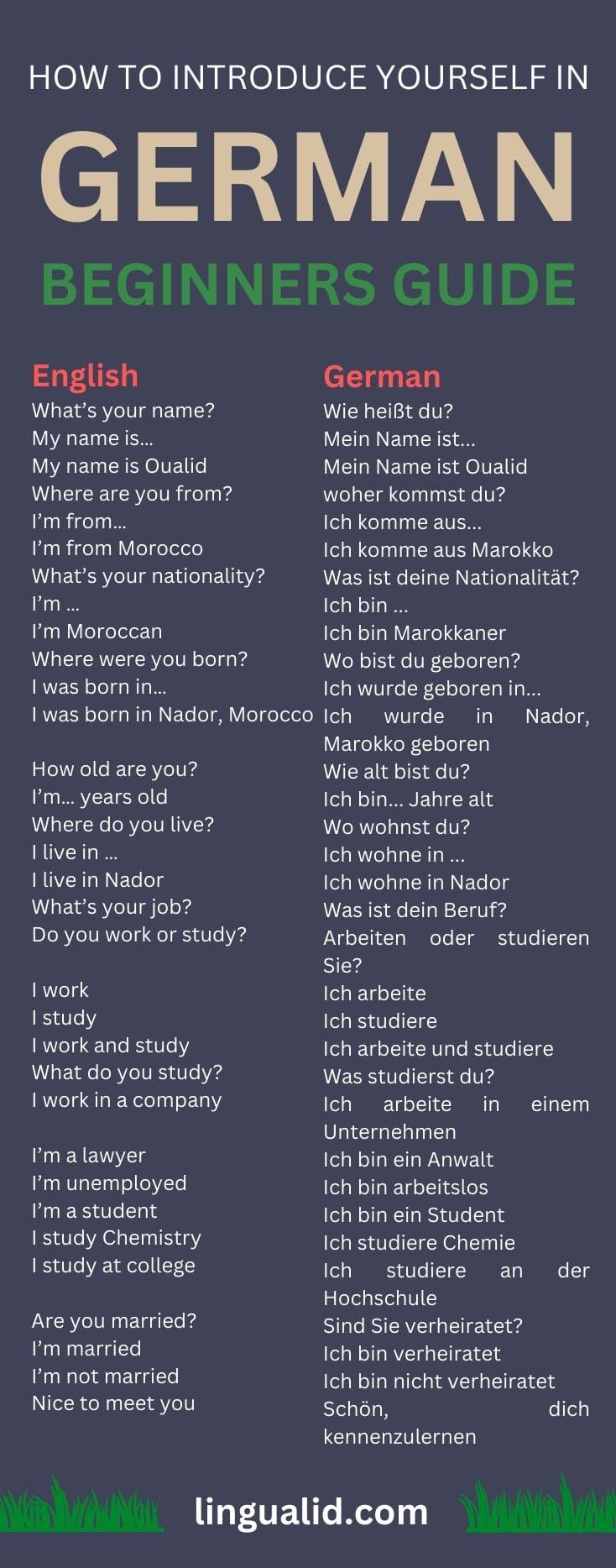
This guide summarizes the key phrases for introducing your name, origin, job, and other personal details in German.
A. Stating Your Name
You have two primary ways to state your name. Their usage depends on the context's formality.
How to introduce yourself in German: A guide
The Lingoda article "How to introduce yourself in German" clearly explains the difference between the two main phrases for stating your name.
Read the sections Say your name and pay attention to the distinction between Ich heiße for general use and Mein Name ist for more formal or business settings.
- General Use: Ich heiße... (I am called...)
- Formal/Business: Mein Name ist... (My name is...)
To ask someone for their name:
- Informal: Wie heißt du?
- Formal: Wie heißen Sie?
B. Stating Your Origin
To state where you are from, you will use the verb kommen (to come), which you learned in the previous lesson.
- Ich komme aus Frankreich. (I come from France.)
To state where you live now, use the verb wohnen (to live/reside):
- Ich wohne in [Stadt/Land]. (I live in [City/Country].)
To ask someone about their origin:
- Informal: Woher kommst du?
- Formal: Woher kommen Sie?
C. Describing Your Profession
This is a critical component for your professional goals. You can state your profession directly using sein (to be) or describe your activity with arbeiten (to work). Given your background, let's focus on IT- and business-specific vocabulary.
SICH VORSTELLEN AUF DEUTSCH🇩🇪(Tipps | Tricks | Redemittel | Deutsch im Beruf)
The video "SICH VORSTELLEN AUF DEUTSCH" by Dein Sprachcoach offers an excellent, in-depth look at describing one's profession. While the video is entirely in German, focus on the written examples on screen, which are clear and highly relevant.
Watch the section on discussing your profession from Beruf. Pay close attention to the sentence structures for stating your job title, your employer, and your area of expertise.
Here are the key structures tailored for you:
-
Stating your role:
- Ich bin Informatiker. (I am an IT specialist.)
- Ich arbeite als IT-Berater. (I work as an IT consultant.)
-
Stating your employer:
- Ich arbeite bei [Firmenname]. (I work at [Company Name].)
-
Describing your field:
- Ich arbeite im Bereich Business Intelligence. (I work in the field of Business Intelligence.)
- Ich habe fünf Jahre Erfahrung im IT-Bereich. (I have five years of experience in the IT field.)
To ask about someone's profession:
- Informal: Was bist du von Beruf?
- Formal: Was machen Sie beruflich?
3. Survival Phrases: Handling Communication Gaps
Even with the best preparation, you will encounter situations where you don't understand or need assistance. These survival phrases are non-negotiable for real-world interaction.
92 Basic German Phrases To Survive Your First ...
This PDF provides a list of direct, actionable phrases for managing difficult communication situations.
Focus on the section titled Getting Out Of Sticky Situations. Internalize these key phrases for clarification and apology. Also, locate the phrases for thanking, such as Vielen Dank.
Here is a consolidated list of the most critical survival phrases:
Thanking and Apologizing:
- Danke. / Vielen Dank. – Thanks / Thank you very much.
- Bitte. / Gern geschehen. – You're welcome.
- Entschuldigung. – Excuse me / Sorry (for getting attention or a minor issue).
- Es tut mir leid. – I'm sorry (to express regret).
Asking for Help and Clarification:
- Können Sie mir bitte helfen? – Can you please help me?
- Ich verstehe nicht. – I don't understand. (You learned
nichtin the last lesson). - Können Sie das bitte wiederholen? – Can you please repeat that?
- Sprechen Sie Englisch? – Do you speak English?
Practice Task: Your First Professional Introduction
Your task is to synthesize what you've learned into a coherent self-introduction. Imagine you are at a tech conference in Munich. An attendee approaches you.
Instructions:
Verbally construct a short monologue (3-5 sentences) in German that includes:
- A formal greeting.
- Your name.
- Your origin (France).
- Your profession (IT specialist) and your field (Business Intelligence).
- A polite closing phrase.
Record yourself speaking, then check your response against the model below. The goal is fluent delivery, not just getting the words right.
Model Answer:
Guten Tag. Mein Name ist [Your Name]. Ich komme aus Frankreich. Ich bin Informatiker und arbeite im Bereich Business Intelligence. Schön, Sie kennenzulernen.
Conclusion
You have now acquired the practical tools for your first complete German conversations. You can confidently greet others, introduce yourself with relevant professional details, and manage communication challenges using key survival phrases. You have moved beyond single words and are now using structured, multi-sentence expressions.
Key Takeaways:
- Always start with the appropriate formal (Guten Tag, Sie) or informal (Hallo, du) greeting.
- Your core introduction script is: Mein Name ist..., Ich komme aus..., Ich bin... von Beruf.
- For professional contexts, use specific phrases like Ich arbeite als... and Ich arbeite im Bereich...
- Master survival phrases like Ich verstehe nicht and Sprechen Sie Englisch? to handle any situation.
In the next lesson, we will continue building your practical skills by learning to use numbers from 1 to 1,000,000. This will unlock your ability to discuss prices, understand phone numbers, and arrange dates and times—all essential data points in both daily life and business.