Introduction
Welcome to the first lesson of your intensive German course. Today, we begin the journey toward conversational fluency by building the absolute foundation of the language. Our goal is to master the 100 most frequent German words. According to linguistic research, these core words account for up to 50% of all daily spoken German. By focusing on them from day one, we are applying a powerful principle: maximizing practical output with minimal initial vocabulary.
We will not be memorizing a random list. Instead, we'll group these words logically by function—pronouns, core verbs, essential nouns, and connectors. You will learn each word within a practical sentence, a method that is far more effective than studying words in isolation. Given your background in French, the concept of grammatical gender and verb conjugation will be familiar territory, allowing us to focus squarely on the unique structures of German.
Your Core Vocabulary Strategy
Before we dive in, it's crucial to understand the strategy. The most effective way to learn vocabulary is not by memorizing lists, but by seeing and using words in context.
Stop Wasting Time: Learn These 100 German Words Instead | 4 Week Plan | Learn German
To understand this principle, watch this short segment from the video "Stop Wasting Time: Learn These 100 German Words Instead" by the Learn German channel.
Watch the instructor explain the correct way to learn new words, from the common mistake learners make to the effective, context-based approach. The core takeaway is to always learn a full, usable sentence, not just an isolated word.
We will apply this principle throughout the entire course. For every new word, your goal is to master at least one sentence that uses it.
1. The Building Blocks: Pronouns and Essential Verbs
The most fundamental words in any language are those that refer to people (pronouns) and the two most common verbs: "to be" and "to have".
Learn German On-the-Go: The TOP 100 Most Important Words
The video "Learn German On-the-Go: The TOP 100 Most Important Words" provides an excellent, structured introduction to these core words.
First, watch the section on subject personal pronouns. This covers the German equivalents of I, you, he, she, we, and they. ich (I) wir (we) du (you, informal singular) Sie (you, formal) ihr (you, informal plural) er (he) and sie (she) sie (they) Next, continue with the two most important verbs, sein (to be) and haben (to have). Pay close attention to how they are conjugated with the pronouns you just learned. sein (to be) and its conjugations (ich bin, du bist, etc.) haben (to have) and its conjugations (ich habe, du hast, etc.)
Here is a summary of these conjugations in the present tense (Präsens). This is your first and most important verb table.
| Pronoun | sein (to be) | haben (to have) |
|---|---|---|
| ich (I) | bin | habe |
| du (you, informal) | bist | hast |
| er/sie/es (he/she/it) | ist | hat |
| wir (we) | sind | haben |
| ihr (you all, informal) | seid | habt |
| sie/Sie (they/you, formal) | sind | haben |
Actionable Examples:
- Ich bin Informatiker. (I am an IT specialist.)
- Du hast eine Frage. (You have a question.)
- Er ist mein Kollege. (He is my colleague.)
- Wir sind hier. (We are here.)
- Sie haben Zeit. (You/They have time.)
2. Naming Things: Essential Nouns & Articles
In German, as in French, all nouns have a grammatical gender, marked by an article. The three articles are der (masculine), die (feminine), and das (neuter).
Learn German On-the-Go: The TOP 100 Most Important Words
Watch this segment of the "Learn German On-the-Go" video to see how these articles work.
Focus on the definite articles der, die, das and the indefinite articles ein, eine.
Let's learn a few of the most frequent nouns, grouped by theme. Notice the article for each one.
People & Work
- der Mann (the man)
- die Frau (the woman)
- das Kind (the child)
- der Freund (the friend)
- der Kollege (the colleague)
- die Leute (the people, plural)
- die Arbeit (the work)
Time & Place
- das Haus (the house)
- die Zeit (the time)
- der Tag (the day)
- die Nacht (the night)
- der Weg (the way, path)
Essential Verbs
Beyond sein and haben, a few key verbs are extremely common. The image below shows a selection of the 100 most used verbs. For now, we will focus on the infinitive form (the base form, e.g., machen).
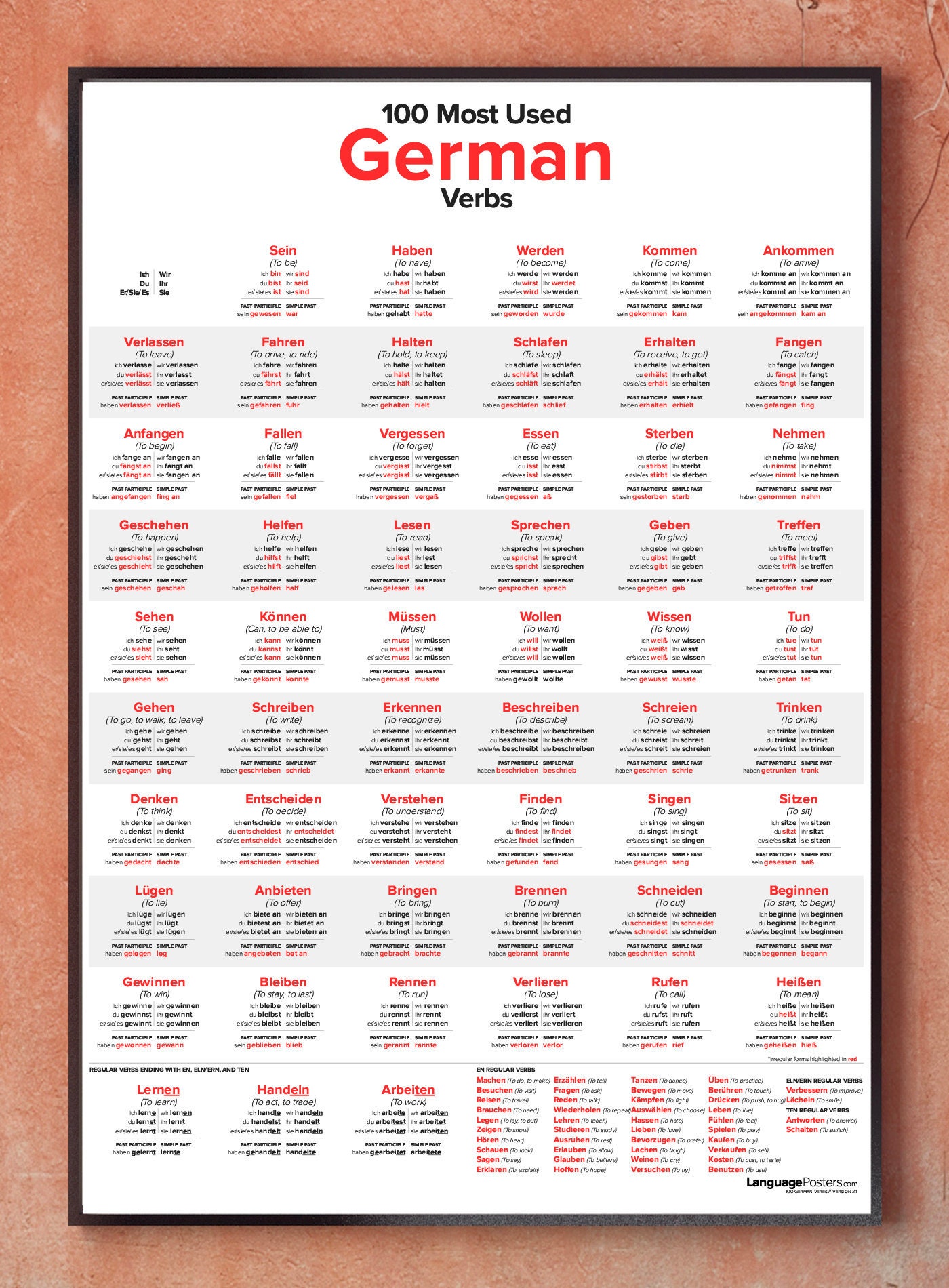
This chart displays 100 of the most frequently used German verbs. For each verb, it shows the infinitive form, present tense conjugation, and past tense forms, which we will cover in later lessons.
Let's focus on these five for now:
- machen (to do/make)
- gehen (to go)
- kommen (to come)
- sehen (to see)
- wissen (to know)
Actionable Examples:
- Der Mann hat Arbeit. (The man has work.)
- Die Frau hat keine Zeit. (The woman has no time.)
- Wir machen das jetzt. (We'll do that now.)
- Ich gehe nach Hause. (I'm going home.)
3. Negation and Connection
To form useful sentences, you need to negate ideas and connect them.
Negation: nicht and kein
German has two primary words for negation. The rule is simple:
keinnegates a noun that has an indefinite article (ein/eine) or no article. It's the equivalent of "not a" or "no".nichtnegates everything else: verbs, adjectives, adverbs, proper names, nouns with definite articles.
Learn German On-the-Go: The TOP 100 Most Important Words
The same video explains this distinction clearly.
Watch the short explanations for kein/keine and nicht. Notice the examples provided for each.
Actionable Examples:
- Ich habe kein Geld. (I have no money.)
- Das ist kein Problem. (That is not a problem.)
- Ich weiß nicht. (I don't know.)
- Er ist nicht mein Kollege. (He is not my colleague.)
Conjunctions: und, aber, oder
These three "coordinating conjunctions" link words or simple sentences without changing the word order.
- und (and)
- aber (but, however)
- oder (or)
Actionable Examples:
- Ich habe Zeit und Geld. (I have time and money.)
- Wir sind hier, aber er ist nicht hier. (We are here, but he is not here.)
- Ist das ein Mann oder eine Frau? (Is that a man or a woman?)
Practice Task: Build Your First Sentences
Now, apply what you've learned. Translate the following sentences into German. The goal is active recall, not perfection.
- I am a colleague.
- The man has no time.
- We see the house.
- You (formal) are here, but I am not here.
- Do you (informal) have a child or a friend?
Self-Correction:
- Ich bin ein Kollege.
- Der Mann hat keine Zeit.
- Wir sehen das Haus.
- Sie sind hier, aber ich bin nicht hier.
- Hast du ein Kind oder einen Freund? (Don't worry about
einenfor now; we'll cover that case soon.einis a perfectly good answer for today.)
Conclusion
In this lesson, you have learned the functional core of the German language: pronouns, the verbs sein and haben, a set of essential nouns with their articles, and the basic tools of negation and connection. Most importantly, you have begun to practice the fundamental skill of building sentences immediately. These words are the keys that will unlock a vast portion of everyday German.
Key Takeaways:
- The 100 most frequent words provide a high-leverage foundation for learning German.
- Learn vocabulary in the context of a complete sentence, never in isolation.
- The core building blocks are pronouns (
ich,du,er...) and the verbssein(to be) andhaben(to have). - Nouns have a gender (
der,die,das), a concept familiar from French. - Use
keinto negate nouns with no/indefinite article andnichtfor everything else.
In our next lesson, we will use these building blocks to engage in your first practical conversation: greeting people, introducing yourself (name, origin, profession), and using essential survival phrases.