Introduction
In our last session, you mastered the essential script for introducing yourself in professional and social settings, covering your name, origin, and field of work. You now have the tools to make a confident first impression.
Today, we will build on that foundation by equipping you with another critical, practical skill: using German numbers from 1 to 1,000,000. Numbers are the language of data, finance, and logistics. This lesson will focus on exactly how to form them and, more importantly, how to apply them in real-world business and daily-life contexts: stating prices, reading phone numbers, and giving dates. Mastering this is a non-negotiable step toward conversational fluency.
1. The System of German Numbers: From 1 to 99
The German number system has a few core rules. Once you grasp them, you can construct any number. The most significant challenge is the "reversed" order for numbers 21-99, which we will focus on.
German Numbers – Learn to Count from 1 to 1,000,000 in German
This article provides a comprehensive and systematic breakdown of the German number system. It clearly explains the rules, exceptions, and the logic behind compound numbers.
Read the first part of the article, covering the sections from 0 to 99. Pay close attention to these three key patterns: Numbers 1-12: These must be memorized. Numbers 13-19: Note the (digit) + zehn structure and the small spelling changes for 16 (sechzehn) and 17 (siebzehn). The 21-99 Pattern: This is the most important rule. The structure is "ones + und + tens". For example, 21 is einundzwanzig (one-and-twenty) and 53 is dreiundfünfzig (three-and-fifty). Notice how they are written as a single, continuous word.
Here's a quick summary of the structure:
| Range | Rule | Example | German |
|---|---|---|---|
| 1-12 | Memorize | 8 | acht |
| 13-19 | Digit + zehn | 14 | vierzehn |
| 20, 30... | Stem + -zig (-ßig for 30) | 40 | vierzig |
| 21-99 | Ones + und + Tens | 42 | zweiundvierzig |
This "backwards" structure for numbers 21-99 is counter-intuitive but fundamental. Practice saying a few out loud to internalize the pattern: 34 (vierunddreißig), 67 (siebenundsechzig), 98 (achtundneunzig).
2. Scaling Up: Hundreds, Thousands, and Millions
Larger numbers are built by simply stacking the smaller components. Unlike the 21-99 range, these follow a more familiar "big to small" order.
Learn German | Numbers (Part 3) | Zahlen | German for beginners | A1 - Lesson 16
This "Learn German" video provides clear audio examples of how to pronounce and combine large numbers. Hearing them spoken is crucial for mastering the rhythm of these long compound words.
Watch the following segments to understand the structure of large numbers: Hundreds: Start with (ein)hundert and see how other hundreds are formed. Thousands: Observe the pattern for tausend and hunderttausend. Combining Numbers: Watch the examples from "mixed numbers". Pay attention to how a number like 634 is constructed as sechshundert + vierunddreißig to become one word: sechshundertvierunddreißig.
Key Rules for Large Numbers:
- Hundreds: zweihundert (200), dreihundert (300), etc.
- Thousands: zweitausend (2,000), zehntausend (10,000), fünfzigtausend (50,000).
- Structure: Numbers are combined from largest to smallest component, with the "reversed" 21-99 rule applied at the end.
- Example: 2,345 = zweitausend + dreihundert + fünfundvierzig → zweitausenddreihundertfünfundvierzig.
The Business Intelligence Alert: Long Scale and Formatting
For your work in IT and business intelligence, two distinctions are critical to avoid costly errors when dealing with international data.
-
The "Billion" Trap:
- English "one billion" (1,000,000,000) is
eine Milliardein German. - German "eine Billion" is English "one trillion" (1,000,000,000,000).
- Rule: When you see Milliarde, think billion. When you see Billion, think trillion.
- English "one billion" (1,000,000,000) is
-
Number Formatting:
- German uses a comma (
,) as the decimal separator and a period (.) as the thousands separator. This is the exact opposite of English conventions. - Example (English):
2,567.89 - Example (German):
2.567,89
- German uses a comma (
Learn German Numbers from 1 to 1000 - Sprachcaffe
This article has a very clear section explaining the comma/period difference.
Read the section titled Writing Numbers the Right Way. The table provides a direct comparison that is easy to remember.
3. Practical Applications
Now, let's apply these rules to the practical contexts you'll encounter daily.
A. Prices
When stating prices, Germans say the Euro amount, the currency name, then the cents.
- €12,50 is spoken as "zwölf Euro fünfzig".
- In casual contexts like shopping, you will often hear it shortened to "zwölf fünfzig".
Shopping in Germany? Learn These 10 German Phrases First!
This video from "Learn German with Anja" demonstrates how prices are discussed in a typical shopping scenario.
Watch the section where she explains how to ask for the price. Then, skip to the segment on bills and coins from Coins and Bills, where she explicitly states that you say fünf Euro, not fünf Euros (the currency name remains singular).
B. Phone Numbers
Phone numbers are typically read as single digits. For clarity, people often group them into pairs or short blocks.
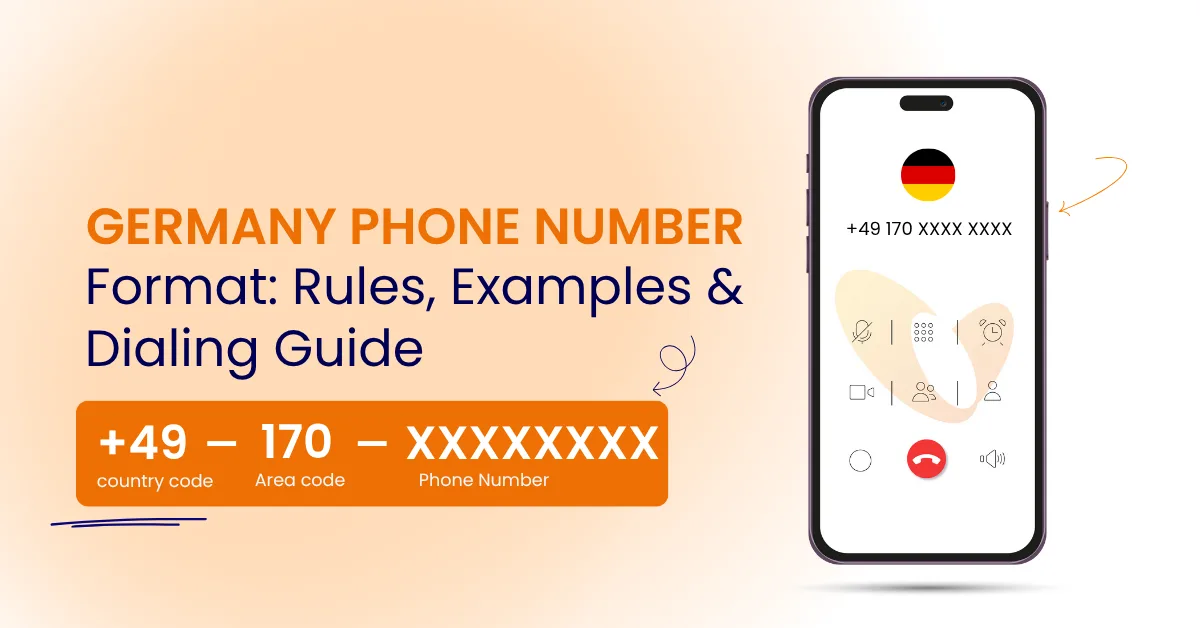
Standard German phone number format, showing country code (+49), area code (e.g., 170 for mobile), and the local number. The leading '0' of the area code is dropped when dialing from abroad.
- A number like 0176 1234567 would be read:
- "null eins sieben sechs, eins zwei drei vier fünf sechs sieben."
C. Dates
Stating the date requires ordinal numbers (first, second, third, etc.).
The Rule for Ordinal Numbers:
- 1-19: Add -te to the number (e.g., zweite, vierte, zehnte).
- 20 and up: Add -ste to the number (e.g., zwanzigste, fünfundzwanzigste).
- Exceptions: erste (1st), dritte (3rd), siebte (7th), achte (8th).
This grammar chart provides a perfect visual summary.

This chart clearly illustrates the rules for forming German ordinal numbers for dates. Note the split between 1-19 (+te) and 20+ (+ste), as well as the highlighted exceptions.
How to say a date:
- The written format is DD.MM.YYYY (e.g., 21.10.2023).
- The spoken format is
der+[ordinal day]+[month]: "der einundzwanzigste Oktober".
How to say the year:
- Before 2000: Split into two parts. 1995 is "neunzehnhundertfünfundneunzig" (nineteen-hundred-ninety-five).
- From 2000 onward: Read as a full number. 2023 is "zweitausenddreiundzwanzig" (two-thousand-twenty-three).
Practice Task: Confirming Business Details
Your task is to consolidate these rules. Imagine you are on a call confirming details for a project meeting in Berlin. Read the following information out loud in German.
- The invoice total: €875,90
- The meeting date: 23.04.2024
- Your colleague's phone number: 0151 68493372
Record yourself and then check your pronunciation against the model answer. The goal is fluent and accurate delivery.
Model Answer:
- achthundertfünfundsiebzig Euro neunzig
- der dreiundzwanzigste April zweitausendvierundzwanzig
- null eins fünf eins, sechs acht vier neun, drei drei sieben zwei
Conclusion
You have now broken down the German number system and learned how to deploy it in three high-frequency contexts: prices, phone numbers, and dates. This is a significant step that moves you from simple introductions to discussing concrete, data-driven information.
Key Takeaways:
- The core rule for numbers 21-99 is "ones-and-tens" (einundzwanzig).
- For business, remember: German
Milliarde= Englishbillion, and the comma/period usage is reversed. - Dates use ordinal numbers (-te for 1-19, -ste for 20+).
- Large numbers are spoken as one continuous word, from largest to smallest component.
In our next lesson, we will continue to build on your knowledge of numbers by learning to tell time using both formal and informal expressions. This will add another layer of precision to your ability to schedule and discuss events.