Hello! Welcome to the next lesson in our final module, Investor and Trader Discipline.
In our last lesson, we built a toolkit of strategies to maintain emotional discipline during the chaos of market downturns. We learned to reframe downturns as normal events, rely on a financial safety cushion, and stick to a pre-written plan rather than giving in to panic.
Today, we're going to tackle a more subtle, but equally important, psychological challenge that affects every single trade or investment you make. The natural human tendency is to judge a decision based on its result. If a trade makes money, we think it was a good decision. If it loses money, we think it was a bad one. This lesson is about breaking that link. Our learning outcome is to differentiate between analyzing a trade's outcome and its decision-making process.
This skill is at the heart of what separates amateurs from professionals. It's the foundation for consistent improvement, helping you refine your strategy based on the quality of your choices, not the randomness of short-term results. Given your interest in psychology and economics, you'll find this intersection of cognitive bias and decision theory particularly fascinating.
The Mental Trap: Confusing Process with Outcome
In psychology and behavioral economics, judging a decision solely by its outcome is known as outcome bias or, in trading and poker circles, "resulting." It's a cognitive shortcut our brains take, but it's incredibly dangerous for an investor or trader. Why? Because it can lead you to repeat bad habits that got lucky, and abandon good strategies that were unlucky.
This video, presented by a clinical psychologist and trading coach, provides an excellent introduction to this concept and why it's so critical to overcome.
Process Versus Outcomes in Trading
Let's watch a couple of clips from 'Process Versus Outcomes in Trading' from Topstep. The speaker explains the cognitive bias of 'resulting' and how it traps traders.
Watch from 05:06 to 10:01. Pay close attention to how he defines 'conflating' process with outcome and the analogy he draws with professional poker. The key idea is that in any activity involving both skill and luck, you must evaluate your decisions separately from the results.
As the video explains, trading is not a deterministic activity like baking a cake where following the recipe guarantees the result. It's a probabilistic one, like poker. You can play a hand perfectly (good process) and still lose to a lucky draw from your opponent (bad outcome). Likewise, you can make a foolish, reckless bet (bad process) and win the pot (good outcome).
Consistently profitable traders understand this. They know that their job is to make high-quality decisions based on their strategy. The market, with its countless participants, will ultimately decide the outcome of any single trade.

The Professional vs. The Amateur Mindset
The difference between a process-focus and an outcome-focus becomes most clear when observing how traders behave during winning and losing streaks.
- An outcome-focused trader who hits a few winning trades in a row feels invincible. They might start taking bigger risks or deviating from their plan, thinking they "have a hot hand." When they hit a losing streak, they go on "tilt," becoming frustrated and making impulsive "revenge trades" to win the money back.
- A process-focused trader who hits a few winning trades will review them to confirm they followed their plan. If they hit a losing streak, they don't panic. Instead, they analyze their decisions. Did they follow their rules? Was their analysis sound? Or does the process itself need a tweak?
This next video illustrates this difference perfectly.
Why Process is More Important Than the Outcome of Individual Trades! ☝️
Watch this segment from 'Why Process is More Important Than the Outcome of Individual Trades!' by UKspreadbetting. It contrasts how an experienced and an inexperienced trader approach the exact same trade and handle a losing streak.
Watch from 04:29 to 10:28. Notice how the outcome-focused trader's emotions lead them to mismanage the trade (cutting winners short, letting losers run). The process-focused trader, however, uses the losing streak as data to evaluate their system, not their self-worth.
This brings us to the practical, "how-to" core of the lesson: If you can't judge a trade by whether it made money, how do you judge it?
A Practical Framework for Trade Analysis
To systematically separate process from outcome, you can categorize every trade you make into a simple 2x2 matrix. Your process is either "Good" (you followed your trading plan) or "Bad" (you broke your rules). The outcome is either "Good" (you made a profit) or "Bad" (you took a loss).
This creates four distinct categories:
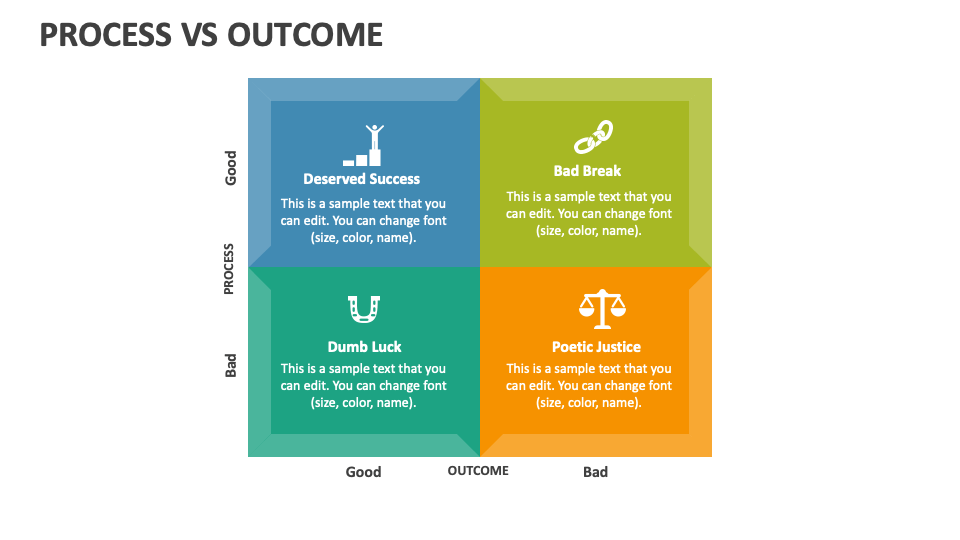
- Good Process, Good Outcome (Deserved Success): This is the ideal scenario. You followed your plan, and the trade worked out. Your goal is to make these trades repeatable. The key here is to reinforce the process that led to the win.
- Good Process, Bad Outcome (Bad Break): This is a normal and expected part of trading. You followed your plan, but the market didn't move in your favor. It's crucial not to change a sound strategy just because of a few "bad breaks." This is simply the cost of doing business in a probabilistic environment.
- Bad Process, Good Outcome (Dumb Luck): This is the most dangerous quadrant. You broke your rules—maybe you chased a stock, didn't set a stop-loss, or took an impulsive trade—and you got lucky. This positive reinforcement of a bad process is how disastrous habits are formed. You must recognize this as a mistake, not a win.
- Bad Process, Bad Outcome (Poetic Justice): This is a clear and valuable learning opportunity. You broke your rules, and you paid the price. The feedback loop is direct. The task is to identify why you broke your rules and avoid it in the future.
The trading psychologist from our first video provides a fantastic walkthrough of this exact framework.
Process Versus Outcomes in Trading
Let's return to the 'Process Versus Outcomes in Trading' video to learn how to apply this four-type framework in practice.
Watch from 14:33 to 20:01. The speaker details the four types of trades (Type 1-4) that map directly onto our matrix. He explains why Type 4 trades ('Dumb Luck') are so psychologically damaging. Listen for his advice to review and categorize your trades at the end of each day.
Test your understanding!
Your trading plan for a stock has the following rules: 1) Buy when the price breaks above its 50-day moving average. 2) Set a stop-loss 5% below the entry price. 3) Take profit at a 10% gain.
Categorize the following trades using the 2x2 matrix (Deserved Success, Bad Break, Dumb Luck, Poetic Justice).
- You see the stock is up 8% on the day but hasn't broken its moving average yet. Fearing you'll miss out (FOMO), you buy it anyway. It keeps running, and you sell for a 15% profit.
- The stock breaks above its 50-day moving average. You buy it, set your stop-loss, and set your profit target. The next day, unexpected bad news hits the company, and the stock gaps down, hitting your stop-loss for a 5% loss.
- The stock breaks above its 50-day moving average. You buy it, set your stop-loss, and set your profit target. Two weeks later, the stock hits your profit target and you sell for a 10% gain.
Show answer
- Dumb Luck (Bad Process, Good Outcome). You broke your entry rule (#1) by chasing the stock out of FOMO. Even though you made money, this reinforces a bad habit that will likely lead to losses in the long run.
- Bad Break (Good Process, Bad Outcome). You followed all your rules perfectly: the entry signal was met, and you managed your risk with a stop-loss. The trade didn't work out due to an unpredictable event, but your decision-making process was sound.
- Deserved Success (Good Process, Good Outcome). You followed your plan from entry to exit, and the trade worked out as intended. This is the goal. Your job is to reinforce this process.
To put this into practice, you need to conduct a post-trade review. The following article provides a simple, effective set of questions to ask yourself.
5 Elements of a Smart Trade Plan
Let's look at the 'After your trade: Routinely evaluate performance' section of the article '5 Elements of a Smart Trade Plan' from Charles Schwab.
Read the section titled 'After your trade: Routinely evaluate performance'. The questions listed here ('What worked with this trade, and what didn't? Why?') are exactly what you should be asking in your post-trade analysis. This is the practical application of separating process from outcome.
Conclusion
Mastering your trading psychology is a journey, and learning to separate your decision-making process from its outcome is a giant leap forward. It frees you from the emotional rollercoaster of short-term results and allows you to focus on the one thing you can truly control: the quality of your decisions.
Key Takeaways:
- Outcome Bias is a Trap: Judging a decision based on its result is a natural cognitive bias ("resulting") that reinforces bad habits and punishes good ones.
- Focus on Process: Professional traders and investors know that trading is probabilistic. They focus on executing a sound, repeatable process, accepting that any single outcome involves an element of luck.
- Use the 4-Quadrant Framework: After a trade, categorize it based on both process and outcome:
- Deserved Success (Good Process, Good Outcome)
- Bad Break (Good Process, Bad Outcome)
- Dumb Luck (Bad Process, Good Outcome) - The most dangerous!
- Poetic Justice (Bad Process, Bad Outcome)
- Analyze Your Decisions: Your goal is not to win every trade, but to consistently follow a good process. Ask "Why?" and analyze what you did right and wrong according to your plan, not your P&L.
A Look Ahead:
We've just learned how to think about analyzing our trades. In our next lesson, we will build the tool to do this consistently: the trading journal. We will learn how to keep a trading journal to track trades, strategies, and our emotional state, turning this analytical framework into a routine for continuous improvement.