Hello! Welcome to the twelfth and final module of your investing course: Investor and Trader Discipline.
In our last lesson, you learned how to rebalance a portfolio. We discussed how rebalancing is a disciplined, systematic process designed to keep your portfolio aligned with your goals. Its most powerful benefit might be that it forces you to act logically—selling what has done well and buying what has lagged—rather than emotionally. This provides a perfect bridge to our new focus: the psychology of investing.
Your interest in psychology and philosophy will be a great asset here. As you'll discover, success in the market is often less about finding a secret formula and more about mastering your own mind. The greatest battle a trader or investor fights is the one against themselves.
This first lesson in our final module is designed to give you the tools to win that battle. Our learning outcome is to recognize common emotional biases that affect investment decisions (e.g., fear, greed, FOMO). By learning to name these psychological traps, you take the first and most crucial step toward avoiding them.
The Real Challenge: You vs. You
Before we dive into specific biases, it's important to frame the problem correctly. For both long-term investors and active traders, the primary source of failure isn't a bad strategy or a volatile market; it's the inability to control one's own emotional impulses.
The following video powerfully introduces this core idea. It's geared toward traders, but the message is universal for anyone putting capital at risk.
26 Years Of Trading Psychology In 30 Minutes
Watch this introductory segment from '26 Years Of Trading Psychology In 30 Minutes' by The Rumers. It sets the stage for why understanding your own psychology is non-negotiable.
Watch from 01:13 to 02:54. Listen for the key argument: that your success or failure will ultimately come down to whether you can control your own impulses like fear, greed, and self-doubt.
As the speaker notes, the market is almost perfectly designed to trigger our deepest-seated emotions. The two most powerful of these are fear and greed.
The Cycle of Fear and Greed
Fear and greed are the emotional currents that drive market manias and panics. They create a predictable psychological cycle that repeats throughout history. Understanding this cycle helps you identify where you (and the market) are emotionally, so you can avoid buying at the peak of greed and selling at the bottom of fear.

The article below explains this emotional cycle and gives powerful historical examples of how collective psychology shaped major market events.
Understanding Investor Psychology: How Emotions Shape ...
The article 'Understanding Investor Psychology' provides an excellent overview of the emotional cycle and its real-world impact.
Read the sections titled 'The Cycle of Market Emotions: A Psychological Perspective' and 'How Investor Psychology Shaped Past Market Events'. Pay close attention to how emotions like euphoria and despair map onto historical events like the Dot-Com Bubble, the 2008 Financial Crisis, and the 2020 COVID-19 dip.
The key insight is that market prices don't just reflect fundamentals; they also reflect the collective emotional state of millions of participants. Being aware of this helps you maintain perspective when the crowd becomes overly euphoric or panicked.
A Field Guide to Your Own Brain: Common Biases
"Fear" and "greed" are broad terms. In psychology, these emotions manifest as specific, well-documented cognitive and emotional biases. Think of these as mental shortcuts that our brains use to make quick decisions. While useful in daily life, they can be disastrous in investing.
The video below provides a fantastic tour of eight of the most common investor biases. We'll use it as our foundation for this section.
8 Common Investor Biases (And How to Overcome Them)
Let's watch '8 Common Investor Biases (And How to Overcome Them)' from Next Level Life. This video breaks down complex psychological concepts into easy-to-understand investing scenarios.
Watch the following segments, which cover six critical biases. For each one, try to think of a time you might have felt or thought something similar, even outside of investing. Anchoring & Confirmation Bias (01:05 - 02:31) Hindsight Bias (02:44 - 03:46) Loss Aversion (03:46 - 05:05) Disposition Effect (05:48 - 06:55) Self-Attribution Bias (08:09 - 09:54) Recency Bias / Trend Chasing (09:54 - 11:15)
Let's organize these and a few other key biases into groups to make them easier to remember.
Group 1: Biases of Overconfidence and Flawed Beliefs
These biases lead us to believe we are smarter or more informed than we really are.
- Overconfidence Bias: The tendency to overestimate your knowledge and ability. This often appears as the Dunning-Kruger Effect, where novices with very little knowledge have the highest levels of confidence because they don't know what they don't know.
- Confirmation Bias: The tendency to seek out and favor information that confirms your existing beliefs, while ignoring contradictory evidence. If you've decided a stock is a "winner," you'll naturally gravitate toward articles and opinions that agree with you.
- Hindsight Bias: The "I knew it all along" effect. After an event occurs, we tend to believe we predicted it, even if we didn't. This can lead to overconfidence in our ability to predict future events.
- Self-Attribution Bias: Attributing successful outcomes to your own skill ("I'm a genius for picking that stock!") but blaming failures on external factors ("The market was just irrational.").
Group 2: Biases Driven by Fear and Pain
These biases stem from our powerful, instinctual drive to avoid loss.
- Loss Aversion: The principle that we feel the pain of a loss about twice as strongly as we feel the pleasure of an equivalent gain. This is why it's so tempting to sell everything during a market crash—the emotional pain is overwhelming.
- Disposition Effect: The direct behavioral result of loss aversion. Investors tend to sell their winners too early (to lock in a gain and feel pleasure) and hold their losers too long (to avoid the pain of realizing a loss).
- Sunk Cost Fallacy: Making a decision based on the amount of resources already invested, rather than the current outlook. For example, holding onto a losing stock just because you've already lost a lot of money in it, thinking, "I have to wait for it to come back to what I paid."
Group 3: Biases from Social Pressure and Shortcuts
These biases arise from our tendency to follow the crowd and rely on simple, but often flawed, rules of thumb.
- Herd Mentality (FOMO - Fear Of Missing Out): A powerful urge to do what everyone else is doing, driven by the fear of being left out of a profitable opportunity. This is what fuels speculative bubbles, as everyone rushes to buy an asset simply because its price is going up.
- Recency Bias: Giving too much importance to recent events and expecting them to continue. If the market has been going up for the last year, we start to believe it will keep going up indefinitely.
- Anchoring Bias: Over-relying on the first piece of information you receive (the "anchor"). A common anchor for investors is the purchase price of a stock, which they use as a reference point for all future decisions, even though the purchase price is irrelevant to the company's future prospects.
This article provides a concise written summary of some of these biases, which can be a helpful reference.
What's the #1 Cognitive Bias That Derails Investors? (With ...
To reinforce what you've learned and add a few more biases to your toolkit, read the key takeaways from this article based on an interview with investor Barry Ritholtz.
Read the short sections on the 'Dunning-Kruger effect', 'Confirmation bias', 'The sunk cost fallacy', and 'The hindsight bias'.
Test your understanding!
For each scenario, identify at least one primary bias at play.
- An investor buys a stock at $50. It falls to $25. They decide to hold on, saying, "I can't sell now and lock in a 50% loss. I'll sell when it gets back to $50 so I can break even."
- Your favorite tech CEO, famous for building a great company, tweets that they are buying a new, obscure biotech stock. You immediately buy some shares without doing any research.
- After reading several articles about a coming recession, you sell all your stocks, even though your long-term plan calls for holding them through downturns. You then only look for news stories that confirm a recession is imminent.
Show answer
- This demonstrates Loss Aversion (the desire to avoid the pain of a realized loss), Anchoring (being mentally stuck on the $50 purchase price), and the Sunk Cost Fallacy (letting the past investment dictate the current decision).
- This is a classic example of the Halo Effect, where you assume someone's skill in one area (building a tech company) translates to skill in another, unrelated area (stock picking). It can also be a form of Herd Mentality.
- This shows Fear driving a decision that goes against a logical plan. It's followed by Confirmation Bias, as you actively seek out information that justifies your emotional decision.
The Practical Consequences: Trading Career Killers
For active traders, these biases aren't just theoretical. They lead to concrete, account-destroying mistakes.
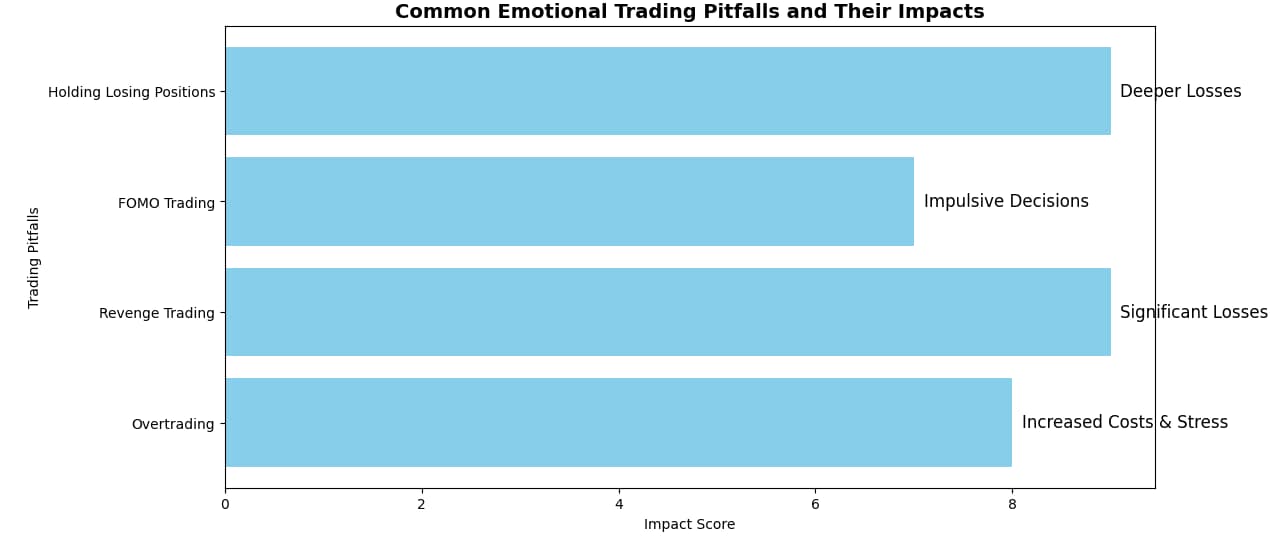
Let's look at a few of the most destructive trading behaviors that stem directly from these biases.
26 Years Of Trading Psychology In 30 Minutes
The '26 Years of Trading Psychology' video offers a blunt, practical look at how biases like impatience, FOMO, and anger manifest in active trading.
Watch the following three segments on trading's biggest psychological pitfalls: Impatience: The number one reason traders fail (10:55 - 12:45) Fear of Missing Out (FOMO): Why traders chase bad opportunities (19:54 - 21:33) Revenge Trading: The single greatest trader killer (21:33 - 24:15)
- Impatience is a form of greed—the desire for profits now. It causes traders to jump into setups that haven't fully formed, violating their own strategy.
- FOMO leads to chasing, which means entering a trade late, at a poor price, with higher risk.
- Revenge Trading is a toxic mix of anger, ego, and loss aversion. After a loss, the trader feels an overwhelming urge to "get the money back" from the market and takes an impulsive, low-quality trade, often leading to an even bigger loss.
Conclusion
In this lesson, we've cataloged the primary psychological enemies you will face as an investor and trader. From the broad emotions of fear and greed to specific biases like loss aversion, overconfidence, confirmation bias, and FOMO, these mental patterns are universal. They are not a sign of weakness; they are a part of being human.
The goal isn't to eliminate these emotions—that's impossible. The goal is to recognize them when they appear so they don't dictate your actions. By learning to name these biases, you've developed the awareness necessary to pause and ask, "Am I making this decision based on my plan, or am I reacting out of fear, greed, or ego?"
Key Takeaways:
- The biggest challenge in investing is managing your own emotions, primarily fear and greed.
- These emotions create a predictable Cycle of Fear and Greed, which drives market bubbles and crashes.
- Common biases like loss aversion, overconfidence, confirmation bias, and FOMO are mental shortcuts that lead to poor financial decisions.
- For active traders, these biases manifest as destructive behaviors like impatience, chasing trades, and revenge trading.
- The first and most important step to mastering your psychology is developing the awareness to recognize and name these biases as they arise.
A Look Ahead:
Recognizing a bias is step one. What do you do next? In our next lesson, we will move from recognition to action. You will learn practical strategies to maintain emotional discipline during market downturns, giving you a concrete toolkit for navigating the moments when your discipline will be tested the most.