Hello! Welcome back to our module on Risk Management and Portfolio Maintenance.
In our last lesson, you learned how to calculate the risk/reward ratio to determine if a trade is worth taking. You now have a complete framework for analyzing and entering a trade with pre-defined risk: you can set your maximum loss, size your position accordingly, and ensure the potential reward justifies the risk.
But what happens once you're in a profitable trade? Your initial stop-loss protects you from downside, but it doesn't help you secure the gains you've made. If you set a fixed profit target, you might exit too early and miss out on a much bigger move. This is a classic trader's dilemma: how to let your winners run while still protecting your profits.
Today, we'll solve this problem. Our learning outcome is to use a trailing stop order to protect profits in an active trade. This dynamic tool is one of the most effective ways to manage a winning position, automate your profit-taking strategy, and reduce emotional decision-making.
What is a Trailing Stop Order?
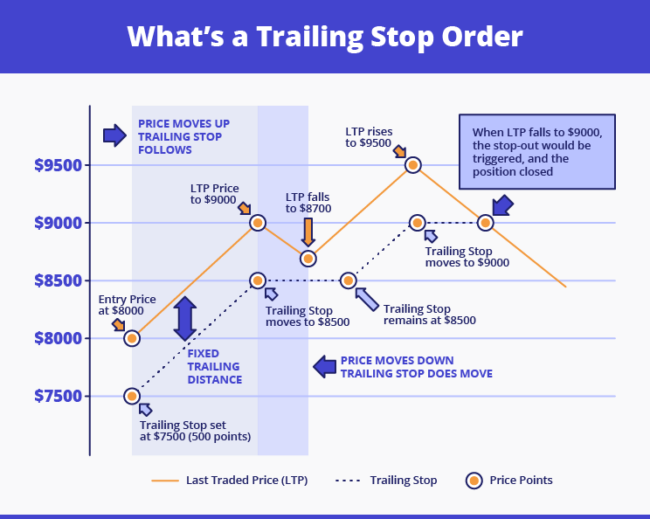
A trailing stop is an advanced order type that functions like a moving stop-loss. For a long position (a stock you've bought), it "trails" the price as it moves up. However, if the price starts to fall, the trailing stop stays fixed at its highest point, acting as a safety net. If the price drops to the stop level, it triggers a sell order, locking in your profit.
Unlike a fixed stop-loss that only protects your initial capital, a trailing stop is designed to protect your unrealized profits.
How to use Trailing Stop Orders: Lock in profits & manage ...
To get a good conceptual overview, please read the first part of the article 'How to use Trailing Stop Orders' from the Traders' Academy.
Read the section titled 'Understanding trailing stops and their role in trading'. It provides a great introduction and highlights why this order type is so important for profit protection and risk management.
The image below illustrates this dynamic. The trailing stop level moves up as the price rises, but it never moves down. When the price eventually reverses and hits the stop level, the position is closed.
How It Works: The Mechanics
A trailing stop is defined by a "trailing amount" or "offset," which is the distance it maintains from the stock's peak price. You can set this amount in two ways:
- A fixed dollar (or point) amount: e.g., trail the price by $5.
- A percentage: e.g., trail the price by 10%.
Let's walk through an example:
- You buy a stock at $100.
- You place a 10% trailing stop sell order.
- Your initial stop-loss is automatically set at $90 ($100 - 10%).
- The stock price rises to $120. Your trailing stop automatically moves up to $108 ($120 - 10%). You have now locked in at least an $8 profit per share.
- The stock then has a small dip to $115. Your stop does not move down. It stays at $108.
- The stock rallies again to a new high of $140. Your stop trails it up to $126 ($140 - 10%).
- Finally, the stock's trend reverses, and the price falls. Once it hits $126, your trailing stop is triggered, and a sell order is sent to your broker to close the position, securing a $26 per share profit.
Stock Market Order Types EXPLAINED ( Limit / Stop / Stop Limit / Trailing Stop )
This short video provides a clear, narrated example of how a trailing stop works in practice.
Watch the segment from 05:58 to 07:32. The speaker explains exactly how the trailing stop moves up with the price, creating a 'safety net' to catch profits.
The Key Benefits of Using a Trailing Stop
Integrating trailing stops into your active trading can significantly improve your discipline and outcomes. It's a powerful tool for addressing common psychological pitfalls.
Trading Secret: How to use TRAILING STOP LOSS like a Pro
Let's watch a brief segment from the video 'Trading Secret: How to use TRAILING STOP LOSS like a Pro' that summarizes the key benefits.
Watch from 05:08 to 06:19. Pay close attention to the three main advantages discussed: automatically locking in profits, reducing emotional decisions, and letting your winners run in trending markets.
To summarize the key benefits:
- Automates Profit Protection: It systematically locks in gains as a trade moves in your favor without you needing to manually adjust your stop-loss.
- Lets Winners Run: It keeps you in a strongly trending stock, preventing you from selling too early out of fear of giving back profits.
- Reduces Emotional Trading: By automating the exit strategy, it removes the guesswork and the influence of fear and greed from your decision-making process.
Practical Application: How to Set the Trailing Amount
Choosing the right trailing amount is the most critical part of using this order type effectively. It's a balance:
- Too Tight: If your stop is too close to the current price (e.g., a 1% trail on a volatile stock), you will likely be "stopped out" by normal daily price fluctuations, even if the stock's overall trend is still up.
- Too Loose: If your stop is too far from the price (e.g., a 30% trail), you will give back a large portion of your profits before the exit is triggered.
The Questrade article on trailing stops offers excellent, practical advice on this topic.
Please read the subsection 'Choosing your trailing or trigger price' within the 'Important to know' section at the end of the article. It clearly explains the trade-off and gives an example of how to think about setting an appropriate percentage.
While there is no single "perfect" number, a good starting point is to analyze the stock's typical volatility. If a stock often has 5% pullbacks within a larger uptrend, setting a 3% trailing stop would be too tight. A setting of 8-10% might be more appropriate, as it would give the stock room to "breathe" without stopping you out prematurely.
Test your understanding!
You buy a stock at $50 per share and place a trailing stop order with a fixed offset of $4.
- The stock price immediately rises to $58. What is your new stop price?
- From $58, the price dips to $55. What is your stop price now?
- The stock then falls to $53. What happens?
Show answer
- When the price is at $58, your new stop price is $54 ($58 - $4).
- When the price dips to $55, your stop price remains at $54. It does not move down.
- When the price falls to $53, it has breached your stop level of $54. Your trailing stop order is triggered, and an order is sent to sell your shares.
An Important Distinction: Trailing Stop vs. Trailing Stop-Limit
When a standard trailing stop order is triggered, it becomes a market order. This tells your broker to sell your shares immediately at the best available price. In most cases, this is fine. However, in a very fast-moving market or if the price "gaps down" overnight, the execution price could be significantly lower than your stop price. This is known as slippage.
To guard against this, brokers offer a trailing stop-limit order. This type adds a second price: a limit price.
Here’s how it works:
- Your trailing stop price is triggered, just like before.
- Instead of a market order, a limit order is sent to the exchange. This limit price specifies the absolute minimum price at which you are willing to sell.
The Trade-off:
- A trailing stop (market) order guarantees your order will execute, but doesn't guarantee the price.
- A trailing stop-limit order guarantees your price (you won't sell for less than your limit), but doesn't guarantee execution. If the stock price gaps below your limit price, your order may not be filled, and you would remain in the falling stock.
This is a crucial concept for practical execution. The Questrade article we looked at earlier explains this difference very well.
Please read the sections 'This is where trailing stop limit orders come in' and the first two parts of 'Important to know' ('Trailing stops come in 2 varieties' and 'Price gaps'). This will solidify your understanding of the difference and the risks involved with price gaps.
For most beginners trading liquid, high-volume stocks, a standard trailing stop order is often sufficient. However, knowing the stop-limit variety exists is essential as you become more experienced.
Conclusion
You've now learned how to manage a trade from start to finish. You can define your risk with a stop-loss, evaluate the opportunity with the risk/reward ratio, and now, protect your profits dynamically with a trailing stop. This order type is a cornerstone of disciplined active trading, allowing you to let your winners run while taking emotion out of the exit decision.
Key Takeaways:
- A trailing stop is a dynamic order that follows a rising stock price to protect unrealized profits.
- It can be set using a fixed dollar amount or a percentage.
- The primary benefits are locking in profits, letting winners run, and removing emotion from trade management.
- Choosing the right trailing distance is a trade-off: too tight risks premature exits, while too loose gives back too much profit.
- A trailing stop-limit order gives you control over the execution price but carries the risk that your order may not be filled in a fast-moving market.
A Look Ahead:
This lesson concludes our deep dive into the risk management tools used for active trading. In our final lesson for this module, we will shift our focus to long-term portfolio management. You will learn how to periodically rebalance a long-term portfolio to maintain its target asset allocation. This is a key discipline for buy-and-hold investors, ensuring your portfolio stays aligned with your goals over many years.