Hello! Welcome to the first lesson in our new module, "Introduction to Fundamental Analysis."
In our last module, we explored the big-picture movements of the market, focusing on market cycles and the investor psychology that drives them. We learned that to be a successful long-term investor, you must look past the market's emotional swings and focus on a company's underlying health. Today, we'll take the first step in doing just that.
The learning outcome for this lesson is to locate a company's quarterly (10-Q) and annual (10-K) reports. These documents are the primary, unfiltered source of financial information that public companies are legally required to file. Think of them as the official report cards on a business. Mastering this simple but crucial skill is the foundation of fundamental analysis and will allow you to base your investment decisions on facts, not just feelings or hype.
What are the 10-K and 10-Q Reports?
Before we find them, let's clarify what they are. Publicly traded companies in the U.S. must regularly report on their financial performance to the Securities and Exchange Commission (SEC), the government agency that regulates the stock market. The two most important reports for investors are the 10-K and the 10-Q.
- Form 10-K (Annual Report): This is a comprehensive, detailed report filed once a year. It provides a complete overview of the company's business, its financial performance over the entire fiscal year, and the risks it faces. Crucially, the financial statements in a 10-K are audited by an independent accounting firm, giving them a high degree of credibility.
- Form 10-Q (Quarterly Report): This is a less detailed report filed at the end of each of the first three fiscal quarters. It provides an update on the company's performance and includes unaudited financial statements. While less comprehensive than the 10-K, it offers more timely insight into a company's recent progress.

For a deeper understanding of why these reports are so important, please read the following brief article.
Where Can I Find a Company's Annual Report and SEC ...
The article 'Where Can I Find a Company's Annual Report and SEC Filings?' from Investopedia explains the purpose of these reports and why they are essential for investors.
Please read the introduction (including 'Key Takeaways') and the section titled 'What Is the Difference Between a 10-K and a 10-Q?'. This will solidify your understanding of these two critical documents.
Now that you know what you're looking for, let's learn how to find them.
Method 1: The Company's Investor Relations Website
The most straightforward method is to go directly to the company's website. Nearly every public company has an "Investor Relations" (IR) section. This is their hub for communicating with shareholders and potential investors.
Here’s how to find it:
- Go to your search engine of choice.
- Type the name of the company you're interested in, followed by "Investor Relations" (e.g., "Apple Investor Relations").
- The first or second result is almost always the correct page.
- Once on the IR page, look for a link labeled "SEC Filings," "Financials," or "Reports."
The following short video demonstrates this process using Texas Roadhouse as an example and also introduces the concept of SEC filings.
How To Read An Annual Report (10-K)
The video 'How To Read An Annual Report (10-K)' by Hamish Hodder quickly shows how to navigate a company's website to find its official filings.
Watch from 1:52 to 2:59. The host demonstrates finding the Investor Relations page and then navigating to the SEC filings to locate the 10-K.
The Investor Relations site is often the best place to start because it's user-friendly and sometimes includes other helpful materials like investor presentations or "glossy" annual reports. However, for serious analysis, always rely on the official SEC filings (the 10-K and 10-Q).
Method 2: The SEC's EDGAR Database
Every report filed with the SEC is stored in a massive public database called EDGAR (Electronic Data Gathering, Analysis, and Retrieval system). This is the ultimate source of truth for all official filings. While its interface can seem a bit dated, it's an essential tool.
First, let's get an official overview of EDGAR from Investor.gov.
Using EDGAR to Research Investments
The article 'Using EDGAR to Research Investments' from Investor.gov provides a clear, authoritative introduction to what EDGAR is and what you can find there.
Read the introduction, the 'Where to begin?' section, and the 'Financial Information and Results of Operations' section. Pay close attention to the table that defines the 10-K, 10-Q, and 8-K form types.
Now, let's see how to use EDGAR in practice. The following video tutorial walks you through searching for a company and filtering for the exact reports you want.
SEC Edgar Search Tutorial: How To Find SEC Filings
The 'SEC Edgar Search Tutorial' video from Dividend Growth Masters provides a practical, step-by-step screen recording on how to use the EDGAR database.
Watch from 0:25 to 1:40 to see how to search for a company using its name or ticker symbol. Then, skip ahead and watch from 3:35 to 4:42 to learn how to filter the results to show only 10-Q or 10-K filings and open the document.
Test your understanding!
Now it's your turn. Go to the SEC EDGAR search page. Using what you learned from the video, find the most recent annual report (10-K) for Microsoft (ticker: MSFT). What is the "Filing Date" listed for this report?
Show answer
After searching for "MSFT" and filtering the filing type for "10-K," you should see the most recent 10-K at the top of the list. As of late 2023, the filing date for Microsoft's most recent 10-K was July 27, 2023. Your answer might differ slightly depending on when you perform the search, but it should be the top result.
A Practical Shortcut: Your Brokerage Platform
Since you prefer a hands-on approach, you'll be happy to know there's often an even faster way. Most modern brokerage platforms integrate tools that pull SEC filings directly into their interface. This means you can find a company's 10-K or 10-Q without ever leaving the platform you use to trade.
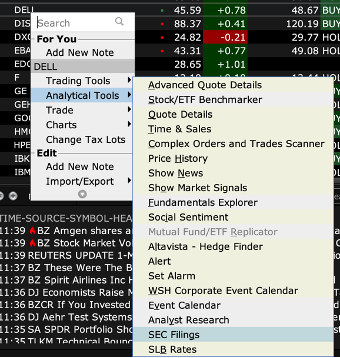
This is incredibly convenient when you are actively researching stocks to buy or sell.
Conclusion
Congratulations! You now know how to locate the most important financial documents a company produces. This is a fundamental skill that separates informed investors from speculators. You've moved beyond simply watching a stock's price and are now equipped to investigate the business behind the ticker symbol.
Key Takeaways:
- 10-K reports are comprehensive, audited annual reports.
- 10-Q reports are unaudited quarterly updates.
- You can find these reports on a company's Investor Relations website, which is usually the most user-friendly option.
- The official, comprehensive database for all filings is the SEC's EDGAR system.
- Most brokerage platforms offer a convenient shortcut to access these filings directly.
A Look Ahead:
Knowing where to find these reports is the first step. The next step is knowing how to read them. In our next lesson, we will open up a 10-K report and begin to analyze its contents. We'll start with one of the three main financial statements: the income statement, which tells you about a company's revenues, expenses, and, most importantly, its profit.