Hello! Welcome to the second lesson in our module on fundamental analysis.
In our last lesson, we learned the crucial skill of locating a company's official financial reports: the annual 10-K and quarterly 10-Q. This was the "where to look." Today, we'll open up those reports and start learning "what to look for."
The learning outcome for this lesson is to identify the key components of an income statement (revenue, expenses, and net income). The income statement is arguably the most important of the financial statements for a new investor because it answers a simple but vital question: "Is this company making money?" Understanding this statement is the first step toward evaluating a company's financial health.
The Core Idea: What is an Income Statement?
At its heart, the income statement is a company's financial report card for a specific period (like a quarter or a year). It tells you how much money the company brought in, how much it spent, and what was left over as profit or loss.
The entire statement can be boiled down to a single, powerful formula:
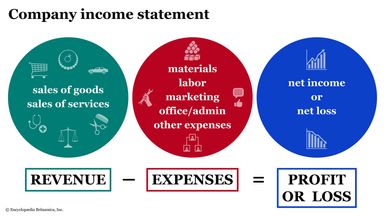
An income statement is also known as a Profit and Loss (P&L) statement. To get a formal introduction, please watch the first minute of this video.
How to Analyze an Income Statement Like a Hedge Fund Analyst
The video 'How to Analyze an Income Statement Like a Hedge Fund Analyst' by Investor Center starts by defining the income statement and its main components.
Watch from 0:39 to 1:10. Focus on the definitions of the income statement, revenue, expenses, and profit.
In the investing world, you'll often hear jargon like the "top line" and the "bottom line."
- Top Line: This simply refers to a company's Revenue, which is the first line item at the top of the income statement.
- Bottom Line: This refers to the company's Net Income, which is the final number at the bottom of the statement after all expenses are accounted for.
The next short clip from a different video explains this common terminology.
How To Analyze an Income Statement
The video 'How To Analyze an Income Statement' by Daniel Pronk provides a quick and clear definition of the 'top line' and 'bottom line'.
First, watch from 0:21 to 0:38 to hear the introduction of these terms. Then, watch from 9:20 to 9:55 where the host explicitly points out the top and bottom lines on an actual statement.
Now, let's break down each of these components in more detail.
The Three Key Components of an Income Statement
We'll use a real-world example to explore these parts. The following video walks through Apple's income statement. We will watch it in sections.
1. Revenue (The Top Line)
Revenue is the total amount of money a company generates from its sales of goods or services. It's the starting point for everything. Companies often break down their revenue so investors can see where the money is coming from.
How to Analyze an Income Statement Like a Hedge Fund Analyst
Let's return to the 'Hedge Fund Analyst' video. This section shows how Apple breaks down its revenue, distinguishing between physical products and services.
Watch from 2:33 to 3:52. Notice how Apple separates 'Products' revenue from 'Services' revenue. This helps investors see which parts of the business are growing fastest.
2. Expenses
Expenses are the costs a company incurs to generate its revenue. An income statement lists several types of expenses, which are subtracted from revenue step-by-step.
The main categories are:
- Cost of Revenue / Cost of Goods Sold (COGS): These are the direct costs tied to creating the product or service. For Apple, this would be the cost of the chips, screens, and labor to assemble an iPhone.
- Operating Expenses: These are the costs of running the business that aren't directly part of the product itself. This includes:
- Research & Development (R&D): Money spent creating new products and improving existing ones.
- Selling, General & Administrative (SG&A): Costs for marketing, salaries of office staff, rent, etc.
- Interest and Taxes: The final costs subtracted before arriving at the bottom line.
This next segment of the video explains these expense categories.
How to Analyze an Income Statement Like a Hedge Fund Analyst
This clip breaks down the major expense categories, from the direct cost of making products to the general costs of running the business.
Watch from 4:28 to 8:34. Pay attention to how the video defines 'Cost of Sales' and then moves down to the operating expenses like R&D and SG&A.
3. Net Income (The Bottom Line)
After subtracting all expenses—the cost of goods, operating expenses, interest, and taxes—from the total revenue, what's left is the net income. This is the company's profit. If the number is negative, it's a net loss.
The final part of the video shows this last calculation.
How to Analyze an Income Statement Like a Hedge Fund Analyst
This last clip shows the final steps to get from pre-tax earnings to the all-important net income figure.
Watch from 8:34 to 9:10. This short section concludes the calculation, arriving at the final 'net income' figure.
Visualizing the Flow
Now that you know the individual components, let's look at how they are presented in a typical income statement. The structure is designed to tell a story. It starts with all the money coming in (Revenue) and progressively subtracts costs to show different levels of profitability.

Let's trace the path for the year 2025 in the image above:
- Net Sales (Revenue): $1,200,000
- Subtract Cost of Sales: $700,000
- This leaves Gross Profit: $500,000
- Subtract Operating Expenses (SG&A): $300,000
- This leaves Operating Income: $200,000
- Subtract Income Tax Expense: $60,000
- This leaves the Net Income (Bottom Line): $140,000
This structure is common across most companies you will analyze.
Test your understanding!
For each item below, identify whether it belongs on the income statement as a Revenue or an Expense.
- Sales of iPhones
- Cost of steel for a car manufacturer
- Marketing budget for a new product
- Salaries for administrative staff
- Money received from consulting services
- Income tax paid to the government
Show answer
- Sales of iPhones: Revenue (money coming in from selling a product)
- Cost of steel for a car manufacturer: Expense (a direct cost of goods sold)
- Marketing budget for a new product: Expense (an operating expense, specifically SG&A)
- Salaries for administrative staff: Expense (an operating expense, specifically SG&A)
- Money received from consulting services: Revenue (money coming in from providing a service)
- Income tax paid to the government: Expense (a specific tax expense)
Conclusion
Great work! You've just dissected one of the most fundamental documents in all of business and investing. By knowing how to identify these key components, you can now look at any company and determine if it's profitable and how that profit is generated.
Key Takeaways:
- The income statement shows a company's profitability over a specific period.
- The basic formula is Revenue - Expenses = Net Income.
- Revenue (the "top line") is the money generated from sales.
- Expenses include direct costs (COGS) and indirect costs (Operating Expenses like R&D and SG&A), as well as interest and taxes.
- Net Income (the "bottom line") is the final profit or loss after all expenses have been paid.
A Look Ahead:
Identifying these numbers is the first step. The real power comes from analyzing them. In our next lesson, we will build on today's knowledge to analyze a company's income statement to extract key metrics like revenue and net income. We'll learn how to see not just what the numbers are, but what they tell us about the company's performance and direction.