Hello and welcome to the final lesson in our module, "Reading Charts and Market Behavior."
In our previous lessons, you learned to read the story of the market through price charts, identifying key levels of support and resistance and using volume to gauge the conviction behind price moves. We noted that extreme spikes in volume often signal moments of intense emotion—widespread panic or euphoria.
Today, we're zooming out to look at the big picture: the recurring long-term cycles of the market. The learning outcome for this lesson is to recognize the characteristics of bull markets, bear markets, and market corrections to manage your psychological biases. This is one of the most important topics for long-term success. Your interest in psychology and economics will be particularly relevant here, as market cycles are driven by the interplay between economic fundamentals and the predictable patterns of human emotion. Understanding this will help you build the emotional resilience needed to navigate your entire investing journey.
What Are Bull and Bear Markets?
First, let's establish some clear definitions. The terms "bull" and "bear" describe the market's overall, long-term direction.
- A bull market is a period of sustained price increases, generally defined as a market index (like the S&P 500) rising 20% or more from its recent lows. It's characterized by economic growth, investor optimism, and strong demand for stocks.
- A bear market is the opposite: a period of sustained price declines, defined as a market index falling 20% or more from its recent highs. It's associated with economic slowdowns, investor pessimism, and a desire to sell.
- A market correction is a less severe drop, typically a decline of 10-20% from a recent high. Corrections are much more common than bear markets and are often seen as healthy "pauses" within a larger bull market.
To give you a practical feel for this, let's look at the history of the S&P 500.
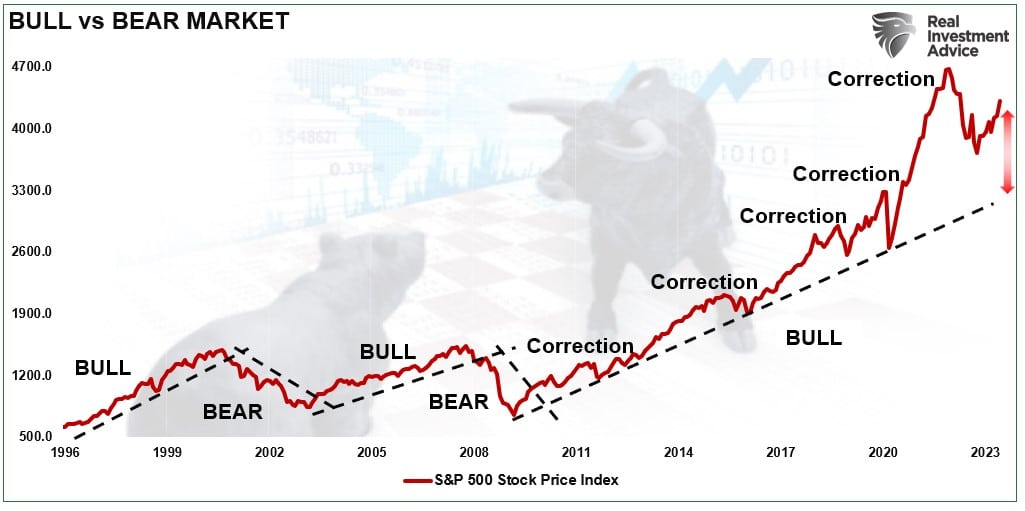
For a concise breakdown of the key differences, please review the first part of this article from Investopedia.
Bull vs. Bear Markets: What's The Difference?
The article 'Bull vs. Bear Markets: What's The Difference?' by Investopedia provides clear, formal definitions and explains the core economic drivers and investor psychology behind these market conditions.
Please read the following sections: 'Bull vs. Bear Markets: An Overview,' 'Bull Markets' (up to 'How to Invest in Bull Markets'), 'Bear Markets' (up to 'How to Invest During Bear Markets'), 'What Causes Bear Markets?,' and the 'Key Differences' section at the end. Focus on how supply/demand, investor psychology, and economic activity differ in each market type.
The Emotional Rollercoaster: The Psychology of a Market Cycle
While economic factors provide the backdrop, the dramatic swings within market cycles are supercharged by human psychology. These emotions follow a remarkably predictable pattern. This pattern is so well-known that it's often visualized in a chart called "The Cycle of Market Emotions."

The following video walks you through each stage of this emotional cycle. As you watch, think about how these feelings could influence your own decisions.
The Psychology of a Market Cycle | #Crypto #NFT #Stocks
The video 'The Psychology of a Market Cycle' from the WhiteBoard Finance channel provides an excellent, step-by-step explanation of the 14 emotional stages investors go through.
First, watch from 1:22 to 3:56, which covers the 'up' phase of the cycle, from Disbelief to Euphoria. Then, watch from 5:20 to 7:41, which covers the 'down' phase, from Complacency to Depression. Notice how the descriptions of investor behavior match the emotions on the chart above.
The two most dangerous emotional states for an investor are:
- Euphoria: At the market top, the feeling of being an "investing genius" leads to ignoring risk and making reckless decisions. This is often driven by FOMO (Fear Of Missing Out).
- Panic/Capitulation: At the market bottom, overwhelming fear causes investors to abandon their long-term strategy and sell everything to "stop the pain," locking in their losses.
Recognizing these emotions in yourself and in the market commentary around you is the first step to mastering them.
Understanding the Mechanics of the Cycle
So, we have these powerful psychological forces. But how do they drive the market? Legendary investor Howard Marks describes the market as a pendulum, swinging between the extremes of greed (euphoria) and fear (despair).
This next video summarizes Marks's framework, explaining that market cycles are oscillations around a long-term fundamental trend. It's a slightly more advanced take that connects psychology to strategy.
MASTERING THE MARKET CYCLE (BY HOWARD MARKS)
The video 'MASTERING THE MARKET CYCLE (BY HOWARD MARKS)' by The Swedish Investor explains why cycles happen and how understanding them can make you a better investor.
Please watch from 3:57 to 10:48. This portion covers two key ideas: first, how markets swing like a pendulum between optimism and pessimism, and second, how investor psychology interacts with other cycles (economic, profit, credit) to create these swings.
The key insight here is that these cycles aren't random. As the video states, "these events aren't just following each other. They are causing each other." Prosperity and optimism lead to excessive risk-taking, which plants the seeds of the next downturn. The ensuing fear and pessimism create opportunities that fuel the next upturn.
Test your understanding!
A friend tells you they've made a 300% return on a little-known tech stock in just two months. They say, "The old rules of valuation don't apply to this company. It's a new paradigm!" They are urging you to invest before you miss out.
Based on the Cycle of Market Emotions, which stage does your friend's sentiment most closely resemble? What is the associated level of financial risk?
Show answer
This sentiment is a textbook example of the Euphoria stage. Phrases like "it's a new paradigm" and the intense fear of missing out are classic signs of a market peak. According to the cycle chart, this is the "Point of Maximum Financial Risk." While the stock could go higher, the odds are increasingly stacked against new investors.
How to Use This Knowledge: Managing Your Biases
The goal is not to perfectly predict the top or bottom of a cycle—even professionals can't do that consistently. The goal is to recognize the dominant sentiment in the market and in yourself, so you can avoid making emotionally-driven mistakes.
Here are some practical strategies, drawn from investing wisdom.
Navigating Bull Markets and Euphoria
- Be Skeptical of Hype: When you hear "this time it's different," it's often a warning sign. The economist Hyman Minsky identified five stages of a speculative bubble, which you can read about in the "Speculative Bubbles" section of the Investopedia article LINK. Recognizing these stages can help you avoid getting caught in the mania.
- Stick to Your Plan: The greatest temptation in a bull market is to abandon your strategy to chase "hot" stocks. Maintain your discipline.
- Rebalance: If a rising market causes one part of your portfolio to become oversized, consider selling some of that position to bring your portfolio back to its target allocation. This is a disciplined way of taking profits.
Navigating Bear Markets and Fear
- Don't Panic: Remember that bear markets are a normal, recurring part of investing. As the S&P 500 chart showed, the market has always recovered and gone on to new highs. Panic selling is the single biggest destroyer of long-term returns.
- Think Like a Buyer: For a long-term investor, a bear market is a sale. It's an opportunity to buy shares in great companies at a discount. If you are still in the wealth-building phase of your life, bear markets are a gift.
- Automate and Diversify: Two of the best defenses against emotional decisions are automation (through strategies like dollar-cost averaging) and diversification.
For more on these strategies, the Scotiabank article provides an excellent, practical summary.
Bull vs. Bear market: The basics explained | Posts
The article 'Bull vs. Bear market: The basics explained' from Scotiabank offers concise, actionable tips for investors in both market environments.
Please read the sections titled 'Strategies for responding to bear markets,' 'Strategies for navigating bull markets,' and the 'Tips on responding to bear and bull markets: Recap.' Focus on the concrete actions you can take to maintain discipline.
Conclusion
You have now explored the large-scale cycles of the market and the psychological forces that drive them. This understanding is not a crystal ball, but a map that helps you orient yourself, manage your emotions, and make rational decisions when others are losing their heads.
Key Takeaways:
- Markets move in cycles of expansion (bull markets) and contraction (bear markets), punctuated by smaller corrections.
- These cycles are driven by a predictable pattern of investor emotions, from optimism and euphoria to fear and despair.
- Your greatest challenge as an investor will be managing your own psychological biases—primarily greed and fear.
- By recognizing the characteristics of each phase of the cycle, you can avoid common mistakes like buying into hype at the top and panic selling at the bottom.
- A disciplined, long-term plan is your best defense against emotional decision-making.
A Look Ahead:
This lesson concludes our module on reading charts and market behavior. You now have a solid foundation for understanding how the market moves. In our next module, "Introduction to Fundamental Analysis," we will shift our focus to what you are actually buying. We'll start by learning how to find and read a company's official financial reports to assess its underlying business performance, a crucial skill for separating a company's true value from the market's emotional swings.