Hello! Welcome to your next lesson.
In our last session, we created a strategic framework for deciding where to invest your money, covering the hierarchy of accounts from 401(k)s to Roth IRAs and taxable brokerage accounts. We also touched on "asset location"—the art of placing investments in the right accounts to maximize tax efficiency.
This lesson drills down into a critical tax rule that you specifically asked about, one that's crucial for both long-term investors and active traders. We will focus on today's learning outcome: to explain the wash sale rule and how it affects the tax treatment of trading losses. Understanding this rule is not just about compliance; it's about avoiding costly and unexpected tax bills that can undermine your trading profits.
What is the Wash Sale Rule?
At its core, the wash sale rule is an IRS regulation designed to prevent investors from creating an artificial tax deduction. It stops you from selling a security at a loss to claim a tax benefit, only to buy back the same or a very similar security immediately afterward.
The rule defines a specific time window: 30 days before the sale, the day of the sale, and 30 days after the sale. This creates a 61-day period you need to be aware of.
This image provides a clear visual of that timeline.

To get a formal introduction, let's start with a short video from Charles Schwab that defines the rule and its purpose.
Understanding the Wash Sale Rule
This video, 'Understanding the Wash Sale Rule,' provides a concise and professional explanation of what the wash sale rule is and why it exists.
Watch the first 40 seconds of the video (0:00 - 0:40). Focus on the core definition of the rule and the 61-day window.
In essence, if you trigger a wash sale, the IRS "disallows" your loss for tax purposes in that moment. But what does that actually mean for your money?
The Consequence: A Disallowed Loss
When a loss is disallowed, it usually isn't gone forever. Instead, the IRS requires you to make two adjustments:
- Cost Basis Adjustment: The disallowed loss is added to the cost basis of the new, replacement shares you bought.
- Holding Period Adjustment: The time you held the original shares is added to the holding period of the new shares.
This might sound complicated, but an example makes it clear. The same Charles Schwab video has an excellent illustration of the cost basis adjustment.
Understanding the Wash Sale Rule
Let's continue with the same video to see a practical example of how a disallowed loss is added to the cost basis of the new shares.
Watch the segment from 0:40 to 1:35. Pay close attention to how the $10 loss is not deducted but instead added to the cost of the repurchased shares, which reduces the taxable gain on a future sale.
Let's break that down with our own numbers:
- Step 1: You buy 10 shares of XYZ stock for $100 per share (Total cost: $1,000).
- Step 2: The stock price drops, and you sell all 10 shares for $90 each (Total sale: $900). You have a loss of $100.
- Step 3: One week later, you repurchase 10 shares of XYZ for $92 each (Total cost: $920).
Because you repurchased the stock within 30 days, the wash sale rule is triggered.
- The Consequence: Your $100 loss is disallowed. You cannot use it to offset other gains on your tax return for this year.
- The Adjustment: The disallowed $100 loss is added to the cost basis of your new purchase. Your new adjusted cost basis is $920 (purchase price) + $100 (disallowed loss) = $1,020.
- The Future: If you later sell these new shares for, say, $1,100, your taxable gain would be $1,100 - $1,020 = $80, not $1,100 - $920 = $180. The tax benefit of the original loss is realized here, just deferred.
Test your understanding!
You buy one share of a stock for $50. You sell it a month later for $45, realizing a $5 loss. Two weeks after the sale, you buy the same stock back for $48. What is the adjusted cost basis of your new share?
Show answer
The $5 loss is disallowed due to the wash sale. This $5 is added to the purchase price of the new share. Your new adjusted cost basis is $48 (purchase price) + $5 (disallowed loss) = $53.
The Trader's "Nightmare Scenario"
For a long-term investor who accidentally triggers a wash sale, the result is usually a minor tax headache. But for an active trader, the consequences can be severe, especially near the end of the year.
A wash sale defers the loss—it doesn't erase it. But if the wash sale happens in December, the loss can be pushed into the next tax year. This can create a situation where a trader has significant realized gains throughout the year, but a large loss in December gets disallowed and deferred, leaving them with a massive tax bill on "phantom profits" they don't actually have.
A CPA who works with traders explains this exact scenario in the following video.
3 Ways to Avoid the Wash Sale Nightmare!
This video, '3 Ways to Avoid the Wash Sale Nightmare!', highlights the real-world financial danger of wash sales for active traders. The example given is a powerful cautionary tale.
Watch the segment from 1:51 to 2:45. The speaker describes a trader who was net-zero for the year but ended up owing taxes on six figures of gains because of a wash sale in December.
This is why understanding the nuances of the wash sale rule is non-negotiable for anyone looking to do swing or day trading.
Critical Nuances: "Substantially Identical" and Multiple Accounts
The rule gets trickier when you go beyond simply buying and selling the exact same stock in the same account.
1. What does "substantially identical" mean?
This is a gray area, but the IRS has provided guidance. It's more than just the same ticker symbol.
- Stocks and Options: A stock and an option contract (like a call option) on that same stock are considered substantially identical.
- ETFs: Two ETFs from different companies that track the exact same index (e.g., two different S&P 500 ETFs) are very likely to be considered substantially identical. However, selling an S&P 500 ETF and buying a Russell 2000 ETF would be fine.
- Bonds: Bonds from the same issuer with similar maturity dates and coupon rates may be considered substantially identical.
This article from TurboTax provides more detail on this topic.
Wash Sale Rule: What Is It, How Does It Work, and More
To understand the subtleties of what the IRS considers 'substantially identical,' let's read a short section from 'Wash Sale Rule: What Is It, How Does It Work, and More' by TurboTax.
Read the section titled 'What does “substantially identical” mean for wash sale rule purposes?'. This will give you a better feel for the facts-and-circumstances test the IRS uses.
2. The Rule Applies Across ALL Your Accounts
This is the most common and costly trap for investors. The wash sale rule is not on a per-account basis. The IRS looks at your activity across:
- All your taxable brokerage accounts, even at different firms.
- Your spouse's accounts. If you sell a stock for a loss and your spouse buys it back within the window, it's a wash sale.
- Your Individual Retirement Accounts (IRAs). This is the most dangerous scenario. If you sell a security for a loss in your taxable account and repurchase it in your Roth or Traditional IRA, it is a wash sale. However, because an IRA is a tax-advantaged account, you can NEVER add the disallowed loss to the cost basis. The tax benefit of that loss is permanently and irrevocably lost.
Let's return to the CPA's video, where he explains this critical point about IRAs.
3 Ways to Avoid the Wash Sale Nightmare!
The speaker in '3 Ways to Avoid the Wash Sale Nightmare!' clearly explains the severe and permanent consequence of triggering a wash sale with an IRA.
Watch the section from 5:51 to 7:00. Focus on his explanation of why a wash sale involving an IRA causes the loss to be 'permanently disallowed.'
How to Avoid a Wash Sale
Now for the practical, "how-to" part. Avoiding a wash sale is straightforward if you're mindful of the rules.
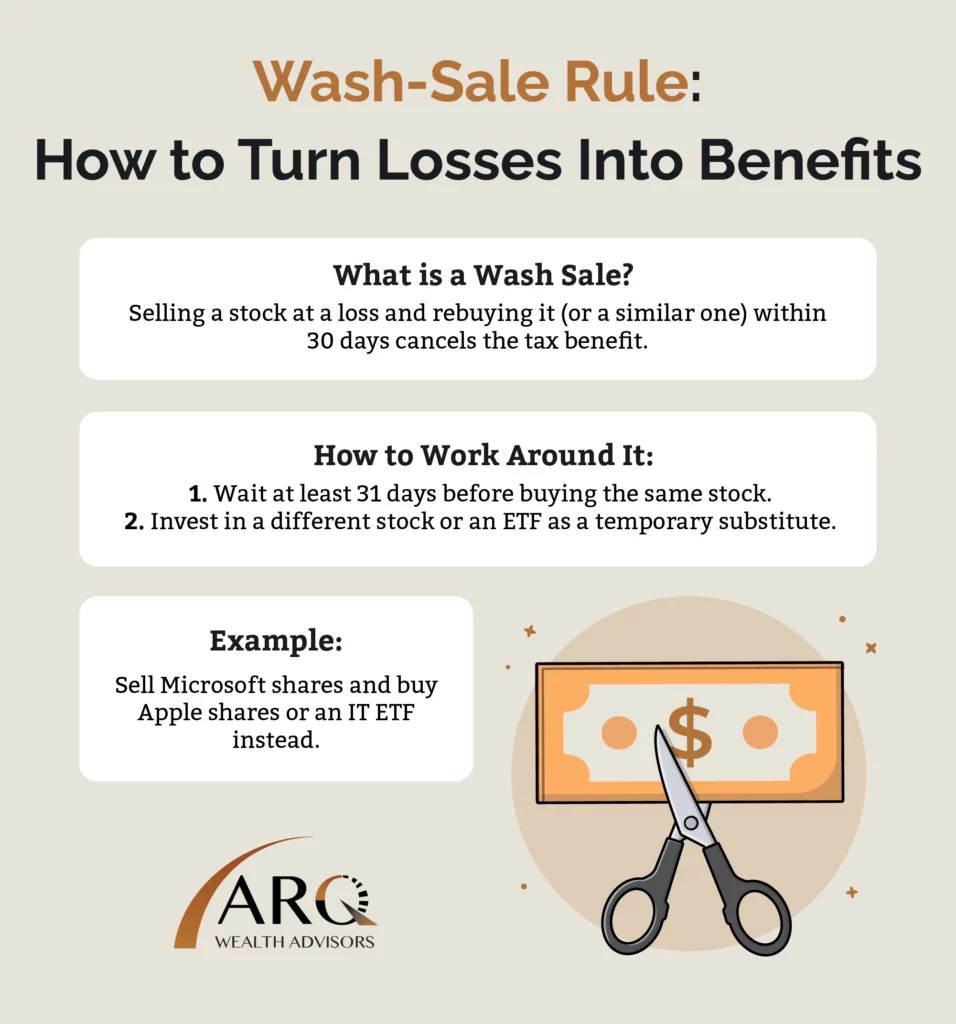
Here are the primary strategies:
- Wait 31 Days: The simplest method. After selling a security for a loss, wait at least 31 days before repurchasing it.
- Buy a Different, Non-Identical Security: If you want to stay invested, you can sell your losing investment and immediately buy a similar, but not substantially identical, one. For example:
- Sell Ford (F) and buy General Motors (GM).
- Sell a Coca-Cola (KO) and buy PepsiCo (PEP).
- Sell an S&P 500 ETF and buy a total stock market ETF or an international stock ETF.
- "Double Up" Then Sell: If you want to harvest a loss but still believe in the stock long-term, you can buy an equal number of new shares, wait 31 days, and then sell the original shares to realize the loss. This maintains your position in the stock while respecting the rule.
Test your understanding!
You sold 100 shares of Microsoft (MSFT) at a loss in your taxable brokerage account. You want to remain invested in the tech sector. Which of the following actions, if taken within 10 days, would likely AVOID a wash sale? Which would likely TRIGGER it?
- Buying 100 shares of Apple (AAPL).
- Buying 100 shares of Microsoft (MSFT) in your Roth IRA.
- Buying call options on Microsoft (MSFT).
- Buying a Nasdaq-100 ETF (like QQQ), which is heavily weighted in tech stocks.
Show answer
- Avoid: Buying Apple (AAPL) is not a wash sale. It's a different company, even though it's in the same sector.
- Trigger: Buying MSFT in your Roth IRA is a classic wash sale. Because the purchase is in an IRA, the tax loss is permanently disallowed. This is the worst-case scenario.
- Trigger: Call options on MSFT are considered "substantially identical" and will trigger the wash sale rule.
- Avoid: Buying a broad-based tech ETF like QQQ is generally considered a safe way to avoid a wash sale. While MSFT is a component of the ETF, the fund itself is not substantially identical to the single stock.
Conclusion
You've now covered one of the most important tax rules for any investor who deals with losses. While it may seem complex, the core idea is simple: the IRS won't let you claim a loss on paper if your economic position hasn't truly changed.
Key Takeaways:
- The wash sale rule disallows a tax loss if you buy a substantially identical security within 30 days before or after selling at a loss.
- In a taxable account, a disallowed loss is added to the cost basis of the new shares, effectively deferring the tax benefit.
- In a transaction involving an IRA, a disallowed loss is permanently lost.
- Active traders must be vigilant, especially at year-end, to avoid deferring losses and creating a large, unexpected tax liability.
- You can avoid wash sales by waiting 31+ days or by purchasing a non-identical asset.
A Look Ahead:
We've now completed our deep dive into the essential tax rules that underpin smart investing. You have the knowledge to structure your accounts and trades in a tax-efficient way. In our next module, we'll shift gears from the "why" and "where" of investing to the "when." We will begin our journey into active trading and technical analysis by learning how to read the most fundamental tool for traders: the candlestick chart.