Hello! Welcome to the final lesson in our module on tax-advantaged investing.
Over the last few lessons, we've built a solid foundation. You've learned about taxable brokerage accounts, the "pay tax later" structure of Traditional IRAs and 401(k)s, and the "pay tax now" power of the Roth IRA.
Now, we'll put it all together. This lesson is about moving from theory to practice. Your goal is to determine which account type is most appropriate for different long-term goals. We will build a practical, step-by-step framework that you can use to decide where to put your investment dollars. This synthesis is a crucial step toward your goal of becoming a savvy long-term investor and an active trader.
The Hierarchy of Investing: Where to Put Your Money First
When you have money to invest, the question isn't just what to invest in, but where. The different tax treatments of each account mean the order in which you fund them matters—a lot. Financial experts often recommend a "waterfall" or hierarchical approach to make this decision simple and effective.
The article "Brokerage Account vs. Roth IRA: Which Is Best?" from The Motley Fool provides an excellent, widely accepted version of this hierarchy.
Brokerage Account vs. Roth IRA: Which Is Best?
Let's read the final section of this article, which lays out a clear, prioritized order for investing your money across different accounts.
Read the section titled 'Choosing between a brokerage account and a Roth IRA'. Focus on the three bullet points that outline the prioritized order of contributions.
Based on that reading and what we've learned, here is the standard investment hierarchy:
-
Contribute to your 401(k) up to the full employer match.
- Why: An employer match is an immediate, guaranteed return on your investment (often 50% or 100%). There is no other investment that can beat this. Not taking advantage of a full match is like turning down free money. This is always the first priority if you have access to it.
-
Max out your Roth IRA.
- Why: After securing the free money from your 401(k) match, the Roth IRA is often the next best place for your funds. As a young investor, you have a long time horizon, making the power of tax-free growth and tax-free withdrawals in retirement incredibly valuable. You also retain the flexibility to withdraw your contributions (not earnings) tax-free and penalty-free at any time, which can serve as an emergency fund of last resort.
-
Go back and max out your 401(k).
- Why: If you've maxed out your Roth IRA and still have money to invest, return to your 401(k) and contribute more until you hit the annual limit ($23,000 for 2024). This allows you to save a significant amount in a tax-advantaged account.
-
Invest in a taxable brokerage account.
- Why: Once all your tax-advantaged retirement accounts are maxed out, a taxable brokerage account is your next stop. This account offers the most flexibility—no contribution limits and no restrictions on when you can withdraw money. This makes it ideal for goals that come before retirement (like a down payment on a house) or for simply investing beyond your retirement account limits.
Test your understanding!
Imagine you're 25 years old, earn $60,000 a year, and have $12,000 to invest annually. Your employer offers a 401(k) and will match 100% of your contributions up to 5% of your salary. How would you allocate your $12,000 according to the hierarchy?
Show answer
- Step 1 (401k Match): 5% of your $60,000 salary is $3,000. You would contribute $3,000 to your 401(k) to get the full employer match of $3,000. You've now invested $3,000 of your money.
- Step 2 (Roth IRA): You have $9,000 left to invest ($12,000 - $3,000). You would contribute the 2024 maximum of $7,000 to a Roth IRA.
- Step 3 & 4 (Remaining Funds): You now have $2,000 left ($9,000 - $7,000). You could either contribute this $2,000 back into your 401(k) or open and fund a taxable brokerage account with it. Both are good options after the first two steps are complete.
The Core Decision: Traditional vs. Roth
Within that hierarchy, you'll often face a choice: Should I use a Traditional (pre-tax) or a Roth (post-tax) account for my 401(k) or IRA?
The decision hinges on one key question: Do you think your marginal tax rate will be higher now or in retirement?
- If you expect your tax rate to be higher in retirement, a Roth is generally better. You pay taxes now at your lower rate and avoid them later at a higher rate.
- If you expect your tax rate to be lower in retirement, a Traditional account may be better. You get a tax deduction now at your higher rate and pay taxes later at a lower rate.
For most young investors starting their careers, income is relatively low. As your career progresses, your income—and thus your tax bracket—is likely to rise. This makes the Roth option the default choice for many people early on.
This article from Fidelity provides a fantastic illustration of this choice, and even adds a psychological angle related to your spending habits.
Traditional or Roth account? 2 tips to help you choose
Let's read 'Traditional or Roth account? 2 tips to help you choose' to explore this decision in more detail.
Please read the sections titled 'Tip 1: Tax rates - higher now or later?', 'Tip 2: Money style - spender or saver?', and the hypothetical example with Sara, Brian, and Sam. This will clarify both the tax logic and the behavioral aspects of the choice.
As the article shows, the Roth IRA can be a powerful tool for "forcing" you to save more. Since you pay taxes upfront, the money in the account is all yours in retirement, removing the temptation to spend the tax savings you would have gotten from a Traditional IRA.
An Advanced Strategy: Asset Location
Once you've decided which accounts to use, you can take your strategy a step further by deciding which investments go into which accounts. This is called asset location.
The goal is simple: shelter your least tax-efficient investments inside tax-advantaged accounts (like IRAs and 401(k)s), while holding your most tax-efficient investments in your taxable brokerage account.
The video below from the "Investing Simplified" channel provides an excellent guide on what to put where.
How to Retire Faster: These Investments Belong in ROTH IRA vs. Best Stocks for Brokerage
This video breaks down exactly which types of investments are best suited for a Roth IRA versus a taxable brokerage account, based on how they are taxed.
Watch the video from 04:54 to 11:38. The host covers five categories of investments: regular dividend stocks, high-yield funds, growth stocks, broad index funds, and REITs. For each one, pay attention to the recommendation of where to hold it and the tax-related reason why.
Here’s a summary of the asset location principles from the video:
| Account Type | Best For... | Why? |
|---|---|---|
| Tax-Advantaged (IRA/401k) | - High-yield funds (like JEPI) - Real Estate Investment Trusts (REITs) - High-dividend stocks - Actively traded stocks |
These investments generate income that is often taxed at your high ordinary income tax rate. Holding them in a tax-advantaged account shelters that income from annual taxes, allowing it to compound more effectively. |
| Taxable Brokerage | - Growth stocks held for the long term - Broad-market index funds (like VOO or VTI) |
These investments tend to be tax-efficient. Growth stocks pay low or no dividends, and you only pay tax when you sell. If held for over a year, you pay the lower long-term capital gains tax rate. |
This decision tree provides a great visual summary of the asset location thought process:
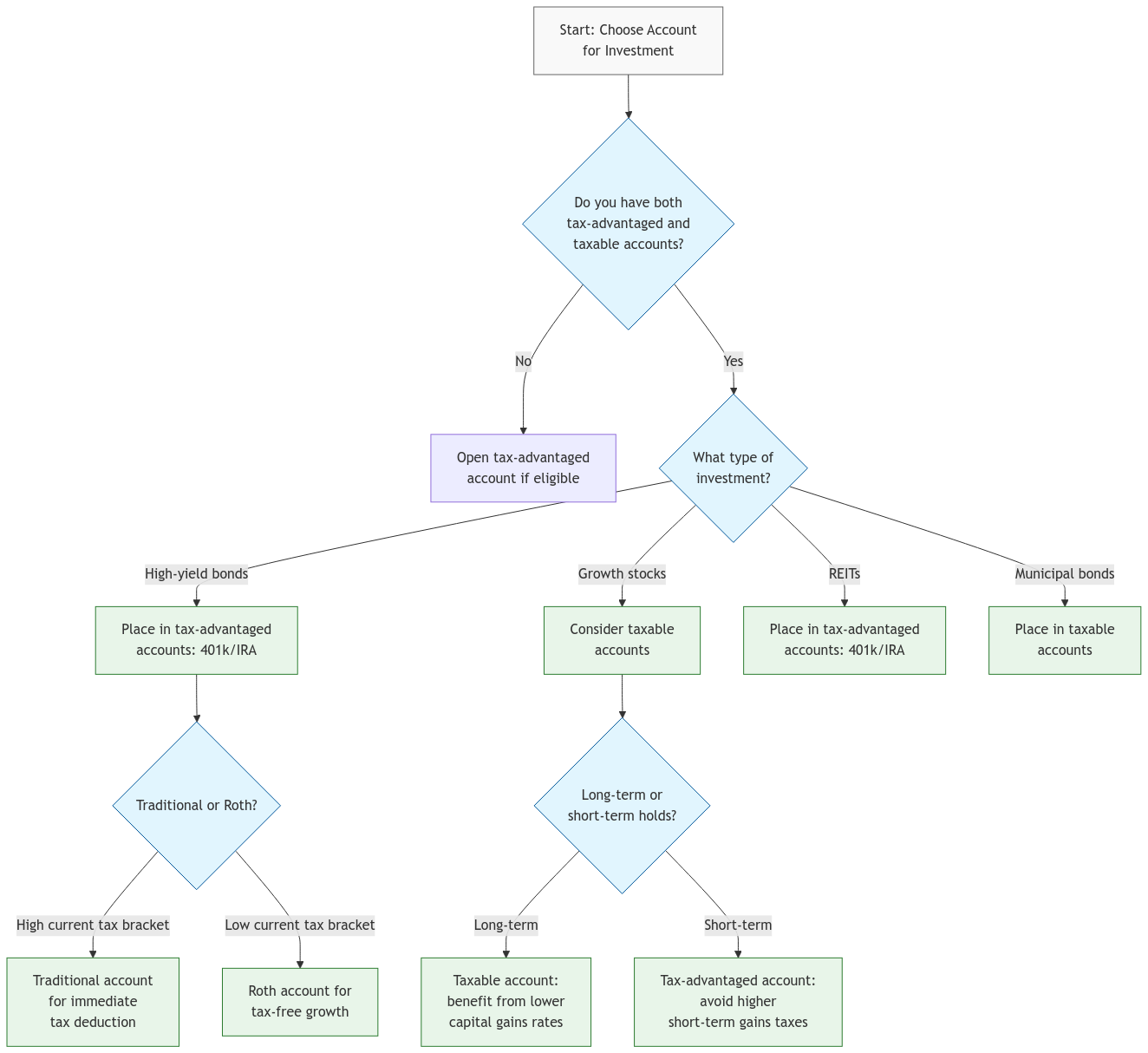
Proper asset location can significantly boost your after-tax returns over the long run, especially as your portfolio grows. It's a key strategy that separates beginner from intermediate investors.
Conclusion
You've now moved from understanding individual accounts to building a cohesive strategy. Deciding where to invest is just as important as deciding what to invest in.
Key Takeaways:
- Follow the Hierarchy: Prioritize your contributions to maximize benefits like employer matches and tax-advantaged growth. The standard order is: 401(k) to match -> Roth IRA max -> 401(k) max -> Taxable brokerage.
- Roth vs. Traditional is a Tax Question: Your choice depends on whether you expect your tax rate to be higher now or in retirement. For most young investors, the Roth option is often preferable.
- Practice Smart Asset Location: Place your most tax-inefficient assets (like high-dividend stocks and REITs) in tax-advantaged accounts. Use your taxable brokerage for tax-efficient assets like long-term growth stocks and broad-market index funds.
A Look Ahead:
As you can see, taxes play a huge role in investing, especially in a taxable brokerage account. In our next lesson, we'll dive into one of the most important tax rules you need to know as an active trader: the wash sale rule. This rule can have a surprising impact on how your trading losses are treated for tax purposes, and understanding it is critical to avoiding costly mistakes.