Hello! Welcome to your final lesson in this module on Tax-Advantaged Investing.
So far, we've explored the "what" and "why" of retirement accounts, comparing taxable brokerage accounts to powerful tax-advantaged vehicles like the Roth and Traditional IRA. You've learned how to choose the right account for your goals and, in our last lesson, you mastered the critical wash sale rule to avoid costly tax mistakes.
Today, we shift from theory to practice. This lesson is all about the "how." Our goal is to walk through the exact process you'll use to fund your retirement account, which directly addresses today's learning outcome: to execute a contribution to a retirement account through a brokerage platform. This is the final, crucial step in setting up your long-term investment engine.
The Universal Steps to Fund Your IRA
While every brokerage platform looks a little different, the process for making a contribution to an IRA (like a Roth or Traditional IRA) is fundamentally the same everywhere. It involves three key stages:
- Link Your Bank Account: Before you can move money in, you must connect your external bank account (like your checking account) to your brokerage account. This is a one-time setup process that securely authorizes transfers.
- Initiate the Transfer: You'll navigate to a section on the brokerage website or app, usually labeled "Transfers," "Move Money," or "Funding."
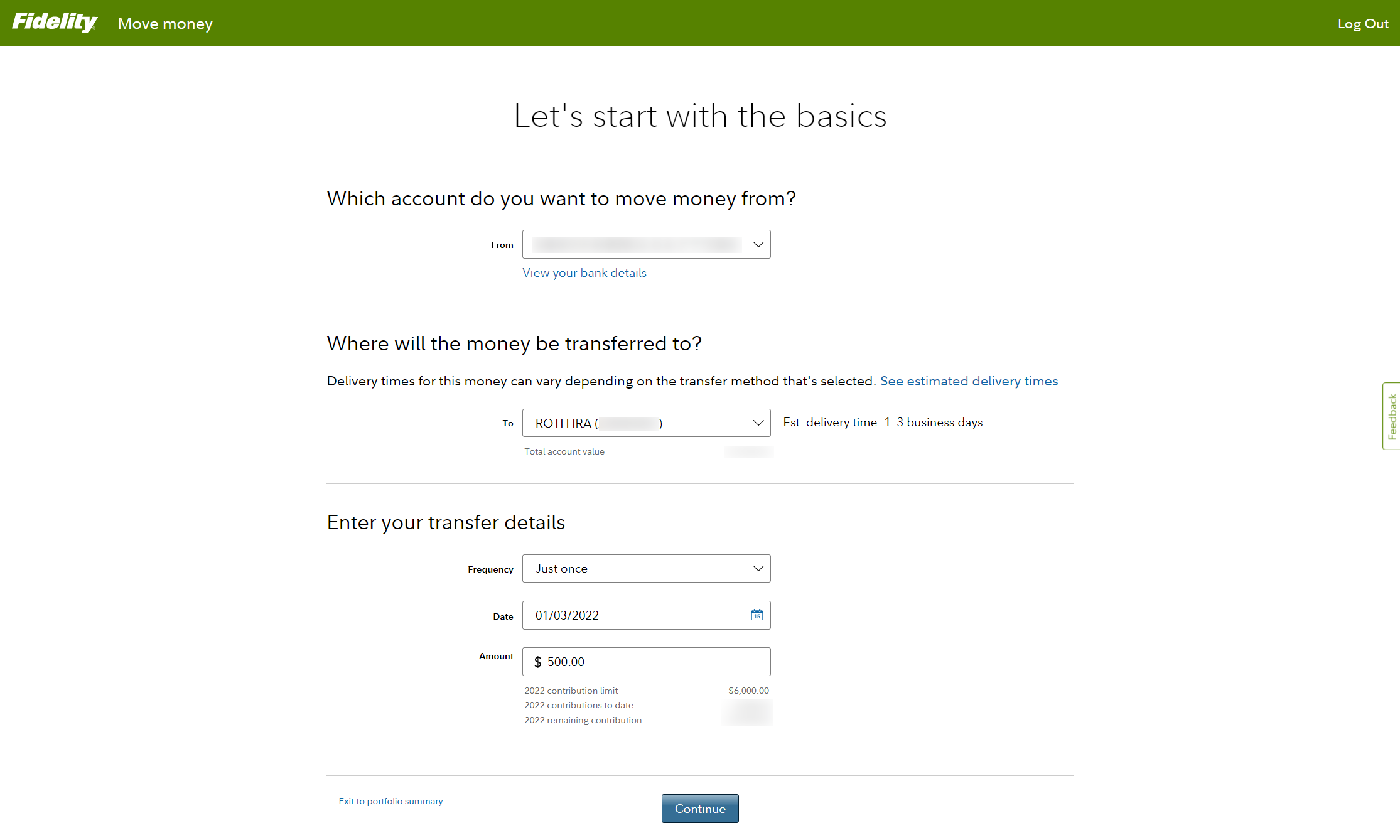
- Specify the Contribution Details: This is the most important part. You will be prompted to provide several key pieces of information:
- From: The source of the funds (your linked bank account).
- To: The destination (your Roth IRA or Traditional IRA).
- Amount: The dollar amount you wish to contribute. Be mindful of the annual contribution limits we discussed previously.
- Contribution Year: This is a critical detail. Between January 1st and the tax filing deadline (usually mid-April), brokerages give you the option to contribute for the current year or the previous tax year. Making a "prior year contribution" is a great way to max out your IRA if you didn't do so before December 31st.
This screenshot from a brokerage platform shows these exact fields. Notice the option to select the contribution year and the display of the contribution limit.

Walkthroughs for Popular Brokerages
Since you prefer a practical approach, let's look at how this process works on some of the major brokerage platforms. The general steps are the same, but seeing the actual interface will be very helpful.
Fidelity
The following video provides a clear, step-by-step guide for making a contribution on the Fidelity platform.
Fidelity Roth IRA For Beginners | Step By Step Tutorial
Let's watch a segment from 'Fidelity Roth IRA For Beginners' by Danny Sully. This will show you exactly where to click to link a bank account and make your first transfer.
Watch the clip from 3:10 to 4:06. Pay attention to how the user navigates to the 'Transfer' page, selects the accounts, and enters the contribution amount. Notice how the platform shows the contribution limit.
This next image from Fidelity also visualizes the one-time transfer process clearly.
Charles Schwab
The process at Charles Schwab is very similar. This next video walks through making a contribution on their platform.
Roth IRA at Charles Schwab: 2024 UPDATED Guide (Open, Contribute, Invest)
Now, let's see how it's done on Charles Schwab. This clip from 'Roth IRA at Charles Schwab' by Alex Quinn covers the same process, highlighting the crucial option to select the contribution year.
Watch from 10:49 to 12:20. Focus on the navigation to 'Transfers and Payments' and the section where you choose which year you want to contribute to.
Vanguard
If you were using Vanguard, the process would be just as straightforward. This guide from The White Coat Investor uses screenshots to show the process.
How to Open a Roth IRA at Vanguard [with Screenshots]
For another example, let's look at this guide for Vanguard. You don't need to read the whole article, just scroll through the screenshots to see the visual steps.
Scroll down to the section titled 'Steps to Open a Roth IRA at Vanguard'. Look at the series of screenshots that show the user selecting how to fund the account, adding a bank, and inputting a dollar amount. This reinforces the universal steps we've discussed.
The Most Important Final Step: Investing the Money
This is a critical point that trips up many beginners. Contributing money to your IRA is not the same as investing it.
When you transfer money from your bank, it lands in your IRA as cash. It sits in a "cash" or "settlement" position, similar to a savings account. It is not invested in the market and therefore cannot grow. You must take the final step of using that cash to purchase investments like ETFs, index funds, or mutual funds.
The same Charles Schwab video has an excellent explanation of this common pitfall.
Roth IRA at Charles Schwab: 2024 UPDATED Guide (Open, Contribute, Invest)
Please watch this next clip very carefully. The speaker explains why simply contributing cash is not enough and that you must actively invest that cash for it to have the opportunity to grow.
Watch the segment from 12:20 to 13:30. This is one of the most important concepts for a new investor to understand.
We will cover the process of choosing and buying those investments in upcoming modules. For now, the crucial takeaway is that funding the account and investing the funds are two separate actions.
Automating Your Success: Recurring Contributions
One of the most powerful features your brokerage offers is the ability to set up automatic, recurring contributions. This aligns perfectly with the "dollar-cost averaging" strategy we'll cover later, where you invest a fixed amount of money at regular intervals.
You can set up a recurring transfer to automatically pull a set amount from your bank account into your IRA every week, two weeks, or month. This "pay yourself first" approach is a cornerstone of disciplined, long-term wealth building. Some platforms even let you set up automatic investments, where the transferred cash is then used to automatically buy a specific fund for you.
Fidelity Roth IRA For Beginners | Step By Step Tutorial
Let's return to the Fidelity video to see how you can set up these automatic schedules. This is a key feature for putting your long-term investing on autopilot.
Watch from 6:46 to 8:20. The video explains the difference between a 'recurring transfer' (moving cash to the IRA) and an 'automatic investment' (using that cash to buy a fund).
Test your understanding!
It's February 2025. You just opened your first Roth IRA and want to make a contribution for the previous tax year (2024). You navigate to your brokerage's transfer page.
What specific option is most critical for you to select to ensure your contribution is applied correctly, and what happens if you forget this step?
Show answer
The most critical option is to select 2024 as the Contribution Year.
If you forget this step, the brokerage's default option will almost certainly be the current year (2025). Your contribution would then count toward your 2025 limit, and you would have missed the opportunity to use your 2024 contribution space.
Conclusion
Congratulations on completing this module! You've moved from understanding the theory of tax-advantaged accounts to knowing the precise, practical steps to fund them. This is a huge step in your investing journey.
Key Takeaways:
- Making a contribution involves linking a bank account, initiating a transfer, and specifying the amount and, crucially, the contribution year.
- The process is very similar across all major brokerages like Fidelity, Schwab, and Vanguard.
- Crucially, contributing cash to an IRA is not the final step. You must use that cash to buy investments for it to grow.
- Setting up automatic, recurring contributions is a powerful tool for disciplined, long-term investing.
A Look Ahead:
You have now built the foundation: you know what stocks are, how to open and fund your accounts, and the tax rules of the road. In our next module, "Reading Charts and Market Behavior," we will begin to explore the tools used in active trading. Our very first lesson will be on how to interpret a basic candlestick chart, the fundamental language of price action for traders and investors alike.