Introduction
In our previous lesson, we established a solid understanding of how to measure the amplitude, or loudness, of a sound wave using the decibel (dB) scale. We saw how this logarithmic unit helps us manage the immense dynamic range of human hearing and is applied differently in acoustic (dBSPL), analog (dBu), and digital (dBFS) domains. Now, we shift our focus from "how loud" to "how high or low."
This lesson addresses the learning outcome of explaining the frequency spectrum and the range of human hearing. We will explore the entire palette of tones available to us, from the deepest rumbles to the highest shimmers. You will learn the standard range of human hearing, why our perception of pitch is not linear, and how audio professionals break this spectrum down into descriptive bands. This knowledge is the absolute foundation for critical listening and for using one of the most powerful tools in audio engineering: the equalizer (EQ).
Defining the Audio Spectrum
Just as white light can be broken down into a spectrum of colors, any complex sound is composed of a spectrum of different frequencies. Frequency refers to the rate at which a sound wave vibrates, measured in cycles per second, or Hertz (Hz). The range of frequencies that a healthy young person can perceive is generally accepted to be from 20 Hz to 20,000 Hz (or 20 kilohertz, abbreviated as 20 kHz). This is known as the audio spectrum.
The following video offers a clear introduction to frequency, the 20 Hz to 20 kHz range, and how all sounds in nature are composed of multiple frequencies.
Frequencies & sound explained #1 - Basic sound theory
This video from wickiemedia provides a great foundation for our topic. Please watch the entire clip. Pay close attention to: The definition of frequency using a sine wave, from the explanation. The statement of the human hearing range, from 20 Hz to 20 kHz. The audio examples of different frequencies, from the sine waves, which will help you start associating numbers with sounds. The crucial concept that natural sounds are made of a fundamental frequency plus harmonics, explained from this section.
The video's final point about fundamental frequencies and harmonics is key: the fundamental determines the note or pitch we hear, while the harmonics (overtones) define the instrument's unique character or timbre. This is why a piano and a guitar playing the same note sound distinctly different.
A Logarithmic Scale for Pitch
Now that we've defined the 20 Hz to 20 kHz range, a logical question might be: what is the middle frequency? A linear mindset would suggest 10,000 Hz (10 kHz). However, just like our perception of loudness, our perception of frequency is logarithmic.
This means we perceive equal ratios of frequency as equal steps in pitch. In music, this ratio is represented by the octave, which is a doubling of frequency. The interval from 100 Hz to 200 Hz sounds like the same pitch jump as the interval from 1000 Hz to 2000 Hz. Both are one octave.
The next video from ProAudioEXP provides an outstanding explanation of this non-linear relationship and its profound practical implications for audio engineers.
Understanding Audio Frequency Spectrum and EQ Charts Hz and KHz
This video is one of the most important in this early stage of the course for building a correct mental model of frequency. Watch the full clip carefully. The section from the pop quiz explains why 10k is not the midpoint and introduces the logarithmic relationship between octaves and hertz. The thought experiment from kick drum vs. vocal sheen demonstrates why a few hundred Hertz makes a huge difference at the low end but very little at the high end. This is a critical insight for mixing.
The key takeaway is that precision matters most at the low end. Being off by 100 Hz when working with a bass instrument is a "football field" difference, whereas being off by 1000 Hz in the high frequencies can be almost negligible. The frequency spectrum is not a uniform ruler; it is exponentially stretched.
The Bands of the Frequency Spectrum
To navigate this logarithmic landscape, audio professionals use a shared vocabulary, dividing the spectrum into distinct bands. While the exact crossover points can vary slightly, the general categories are universal. These bands describe the subjective character of the frequencies within them.
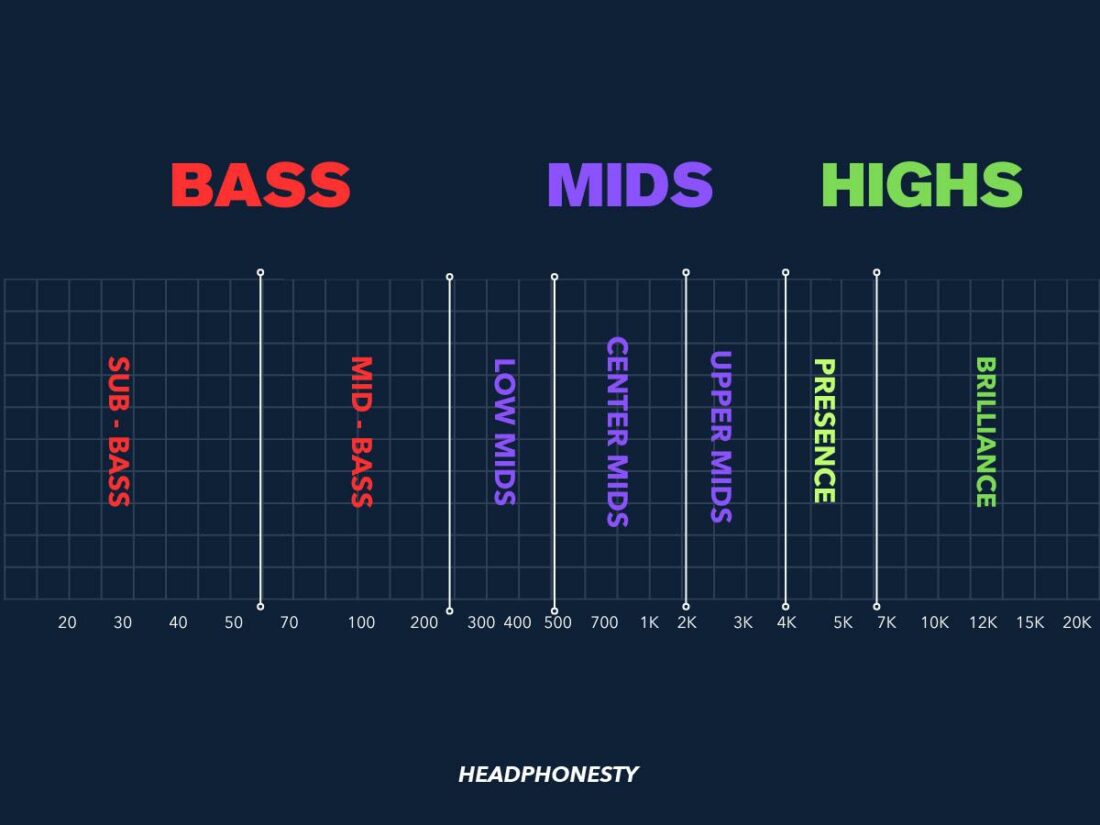
The following reading provides a detailed breakdown of each of these frequency bands, describing their sonic characteristics and their role in a mix.
Audio Spectrum | Teach Me Audio
The article "Audio Spectrum" from Teach Me Audio is an excellent guide to the language engineers use to describe frequency. Read the entire article, from the introduction down to the summary.
As you read, focus on the descriptive words used for each band. You don't need to memorize the exact Hz numbers yet, but begin to associate the names of the bands with their sonic qualities. Pay attention to the descriptions of both the positive contributions and the potential problems (e.g., "boomy," "muffled," "harsh") associated with each range. Read about the lowest frequencies in the Sub-Bass section, which are often felt more than heard. Continue to the Bass section, the foundation of rhythm and weight. Understand the critical and often problematic Low Midrange, often the source of "muddiness." Learn about the Midrange, which determines an instrument's prominence. Discover the ear's sensitivity in the Upper Midrange, which provides attack and presence. Read about the Presence range, responsible for clarity and definition. Finally, explore the highest frequencies in the Brilliance range, which add "sparkle" and "air."
The Ear's Natural EQ
In the reading, you likely noted that the Upper Midrange (2-4 kHz) was described as a range where human hearing is "extremely sensitive." This isn't just a subjective feeling; it's a physiological fact. Due to the physical shape and resonances of the ear canal, our ears naturally amplify frequencies in this region.

This peak sensitivity around 3 kHz is no accident. It corresponds to the frequencies that are most important for understanding human speech, particularly consonant sounds that give speech its clarity. It's also the range where a baby's cry is centered, making it impossible to ignore. For an audio engineer, this means that even tiny adjustments in the 2-4 kHz range will be perceived as significant changes in timbre, presence, and potential harshness.
This phenomenon is also part of a broader concept known as the Fletcher-Munson curves (or equal-loudness contours), which describe how our perception of the frequency spectrum changes at different volume levels. We will revisit this in greater detail when we study mixing.
Conclusion
In this lesson, we have mapped the auditory world, moving from the physical definition of frequency to the practical language engineers use to shape it. You now have a foundational understanding of the sonic territory you will be working in.
The key takeaways are:
- The range of human hearing, or the audio spectrum, spans from approximately 20 Hz to 20 kHz.
- Our perception of frequency is logarithmic, based on octaves (doubling of frequency). This makes small adjustments in low frequencies far more significant than large adjustments in high frequencies.
- Engineers divide the spectrum into descriptive bands: Sub-Bass, Bass, Low-Mids, Mids, Upper-Mids, Presence, and Brilliance/Air.
- The human ear is most sensitive to the Upper-Midrange (around 3 kHz), a critical area for speech clarity, presence, and potential harshness.
We have now examined the two fundamental properties of a sound wave: its amplitude (loudness) and its frequency (pitch). In our next lesson, we will explore the two primary ways these sound waves are captured and stored: as analog and digital signals. This will form the crucial bridge between the physics of sound and the technology in your studio.