Hello! Welcome to the next lesson in our journey through Neural Network Foundations.
In our previous lesson, we explored Dropout, a powerful regularization technique designed to prevent overfitting by randomly deactivating neurons during training. We established that its primary goal is to improve model generalization.
Today, we shift our focus from regularization to optimization and stability. We'll dive into Batch Normalization (BN), a technique that has fundamentally changed how we train deep neural networks. As we previewed, while dropout helps your model generalize better, batch normalization helps it train faster and more reliably. By the end of this lesson, you will be able to apply batch normalization to stabilize and accelerate the training of your neural networks.
1. Why Do We Need Batch Normalization?
Training deep neural networks can be notoriously difficult. As the network learns and the weights in earlier layers change, the distribution of the inputs to later layers also changes with every single training step. This phenomenon is called internal covariate shift.
Imagine a downstream layer trying to learn a specific task. If the statistical properties (like the mean and standard deviation) of its inputs are constantly shifting, it's like trying to hit a moving target. The layer must continuously adapt to these changes, which can slow down learning and make the training process unstable.
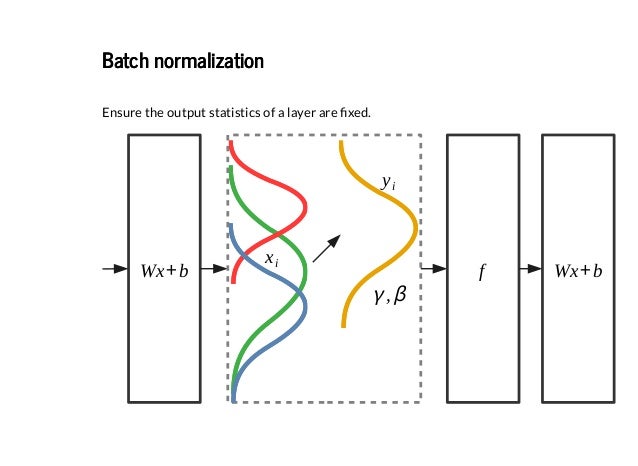
Batch Normalization was introduced to solve this very problem. It normalizes the output of a previous layer before it's fed into the next, ensuring that the input distribution for every layer remains more stable during training.
Let's explore the two main intuitions for why this is so beneficial.
Intuition 1: It's Like Normalizing Your Inputs, but for Every Layer
You already know it's good practice to normalize the input features of your dataset (e.g., scaling them to have zero mean and unit variance). This helps the cost function become more symmetrical and easier for gradient descent to navigate, often allowing for a higher learning rate.
Batch Normalization applies this same logic to the internal activations of the network. By normalizing the inputs to each hidden layer, it helps to smooth out the optimization landscape for that part of the network, leading to faster and more stable training.
Intuition 2: Reducing Internal Covariate Shift
This is the more formal reason. By forcing the activations in each layer to maintain a fixed mean and variance (at least for a given mini-batch), BN reduces the extent to which changes in earlier layers affect the learning of later layers. This "decouples" the layers to some extent, allowing each to learn more independently and speeding up the training of the whole network.
To get a clear visual and verbal explanation of these concepts, let's watch a section of the following video.
Batch Normalization in Deep Learning | Batch Learning in Keras
The video 'Batch Normalization in Deep Learning' starts by explaining the two primary motivations for using this technique. It provides a great analogy to input normalization and then defines internal covariate shift.
Please watch from 03:04 to 14:29. First (03:04 - 06:46), focus on the analogy with input normalization and how it affects the shape of the cost function. Next (06:46 - 14:29), pay attention to the explanation of 'Covariate Shift' and 'Internal Covariate Shift'. The 'Chinese whispers' game analogy at 11:30 is particularly insightful for understanding how information gets distorted as it passes through the network.
2. How Batch Normalization Works: The Mechanics
Now that we understand why we need BN, let's look at how it works during training. The process happens for each mini-batch and is applied to the pre-activation outputs (often called ) of a layer, just before they go into the non-linear activation function (like ReLU).
For each feature in the mini-batch, BN performs two main steps:
-
Normalization:
- Calculate the mean () and variance () of that feature's activations across all examples in the current mini-batch.
- Normalize each activation using this mean and variance:
- Here, is a small constant added for numerical stability to prevent division by zero. After this step, the activations for the mini-batch have a mean of approximately 0 and a variance of 1.
-
Scaling and Shifting:
- The network then learns two new parameters for each feature: a scale parameter (gamma) and a shift parameter (beta).
- The final output of the BN layer is a new set of activations, , produced by scaling and shifting the normalized values:
- These and parameters are learned via backpropagation, just like the network's weights.

Test your understanding!
Why does the network need the learnable and parameters? If the whole point is to normalize the activations to have zero mean and unit variance, why introduce parameters that can change this?
Show answer
Forcing every layer's inputs to have a strict zero mean and unit variance might be too restrictive. Sometimes, the network might need activations with a different mean or variance to learn effectively. The and parameters give the network flexibility. The network can learn to scale () and shift () the distribution to whatever is optimal for that specific layer. In a worst-case scenario, if the network learns and , it can effectively reverse the normalization and recover the original activations. This ensures that BN doesn't hurt the network's representational power.
The following segment of the same video provides a step-by-step walkthrough of these mechanics.
Batch Normalization in Deep Learning | Batch Learning in Keras
This part of the 'Batch Normalization in Deep Learning' video details the step-by-step process of how BN is calculated during training, including the role of gamma and beta.
Please watch from 14:29 to 29:39. This is the core mechanical explanation. Pay close attention to how the mean and variance are calculated over a mini-batch and how the gamma and beta parameters are used to provide flexibility.
3. Training vs. Inference: A Key Difference
A critical question arises: Batch Normalization relies on the mean and variance of a mini-batch. But what happens during inference (testing), when you might want to make a prediction for a single instance and don't have a batch?
The solution is to estimate the population statistics during training. While the model trains, it keeps an exponentially weighted moving average of the means and variances it sees in each mini-batch. By the end of training, these moving averages provide a reliable estimate of the global mean and variance for each feature.
During inference, the model uses these "frozen" moving averages to perform the normalization step, ensuring the process is deterministic and consistent for any single input.
Batch Normalization in Deep Learning | Batch Learning in Keras
This short segment explains the crucial difference between how Batch Normalization operates during training (using batch statistics) and testing (using moving averages).
Watch from 31:39 to 35:41. Focus on understanding why a different approach is needed for testing and how moving averages solve this problem.
4. Advantages and Practical Application
Now that you know the "why" and "how," let's summarize the benefits and see how to use Batch Normalization in practice.
Key Advantages:
- Faster Convergence: BN allows you to use much higher learning rates, as it prevents small changes in parameters from getting amplified into large, problematic shifts in activations.
- Improved Gradient Flow: It helps mitigate the vanishing and exploding gradient problems in very deep networks.
- Regularization Effect: Because the mean and variance are calculated on a mini-batch, they are slightly "noisy" estimates of the true population statistics. This noise adds a subtle regularization effect, similar to dropout, which can reduce overfitting. However, it's a weak effect, and BN is often used alongside dropout.
- Reduced Sensitivity to Weight Initialization: BN makes the network more robust to the choice of initial weights.
Applying Batch Normalization in Code
In modern deep learning frameworks like Keras (TensorFlow) or PyTorch, applying BN is very straightforward. It's simply treated as another layer in your model. The standard practice is to place the BatchNormalization layer after a linear or convolutional layer and before the non-linear activation function.
Adding Batch Normalization to Neural Networks in PyTorch
To understand how BN is implemented, let's first read a quick overview.
Read the sections 'How Batch Normalization Works' and 'Adding Batch Normalization to a PyTorch Model'. This provides a concise summary of the mechanism and shows where the BatchNorm layer is typically placed in a model's architecture.
Now, let's see a practical demonstration of its impact. The final part of the CampusX video shows how to add a BatchNormalization layer in Keras and compares the performance of a model with and without it.
Batch Normalization in Deep Learning | Batch Learning in Keras
This final video segment demonstrates the implementation and powerful effect of Batch Normalization in code.
Watch from 39:53 to 43:09. Notice how simple it is to add the BatchNormalization layer. Most importantly, observe the final graph comparing the accuracy curves. See how much faster and higher the accuracy gets for the model using BN.
The result you just saw is typical: the model with Batch Normalization not only trains faster but also often achieves a better final performance.
Conclusion
You have now added another essential technique to your deep learning toolkit. Batch Normalization is a cornerstone of modern neural network architectures, valued for its ability to make training faster, more stable, and more robust.
Key Takeaways:
- Batch Normalization addresses internal covariate shift by normalizing the inputs to each layer for every mini-batch.
- The process involves normalizing activations to have zero mean and unit variance, then scaling and shifting them using two learnable parameters, and .
- During training, BN uses mini-batch statistics. During inference, it uses "frozen" population statistics calculated via moving averages.
- The main benefits are faster training, stability, a slight regularization effect, and reduced sensitivity to weight initialization.
- It's applied as a layer in your model, typically between the linear transformation and the non-linear activation.
Preview of the Next Lesson:
Techniques like Batch Normalization make our models more robust and often simplify the process of finding good hyperparameters, such as the learning rate. In our next lesson, we will formalize this search process and "Implement a basic hyperparameter tuning process for learning rate and network size," learning systematic ways to find the best settings for our models.