Hello! Welcome to the final lesson in our module on Neural Network Foundations.
In our last session, we delved into Batch Normalization, a technique that stabilizes and accelerates training. We saw that while BN makes training more robust, the ultimate performance of our model still heavily depends on key decisions we make before training even begins.
Today, we'll formalize the process of making those decisions. This lesson is all about hyperparameter tuning. You'll learn how to systematically search for optimal values for critical settings like the learning rate and the size of your network. Your goal is to be able to implement a basic but effective process to find a high-performing configuration for your neural network, giving you a solid, data-driven justification for your model's architecture.
1. What Are Hyperparameters, and Why Do They Matter?
In neural networks, we have two types of parameters:
- Model Parameters: These are the values the model learns during training. The most common examples are the weights and biases in each layer.
- Hyperparameters: These are the configuration settings you, the developer, choose before training starts. They define the model's architecture and how it will learn.
Think of it like building an engine. The model parameters are the fine-tuned adjustments the engine makes to itself as it runs (like fuel-air mixture). The hyperparameters are the design choices you make before you even turn it on (like the number of cylinders or the type of fuel injection system).
Key hyperparameters include:
- Learning Rate: The step size for gradient descent.
- Network Size: The number of hidden layers and the number of neurons in each layer.
- Optimizer: The specific gradient descent algorithm to use (e.g., Adam, SGD).
- Activation Function: The non-linearity to use in hidden layers (e.g., ReLU, Tanh).
- Batch Size: The number of training examples used in one iteration.
- Number of Epochs: The number of times to go through the entire training dataset.
Let's focus on the two most impactful ones for today: learning rate and network size.
The Impact of Learning Rate
As we've discussed, the learning rate controls how much the model's weights are updated in response to the estimated error. Choosing the right value is critical for effective training.
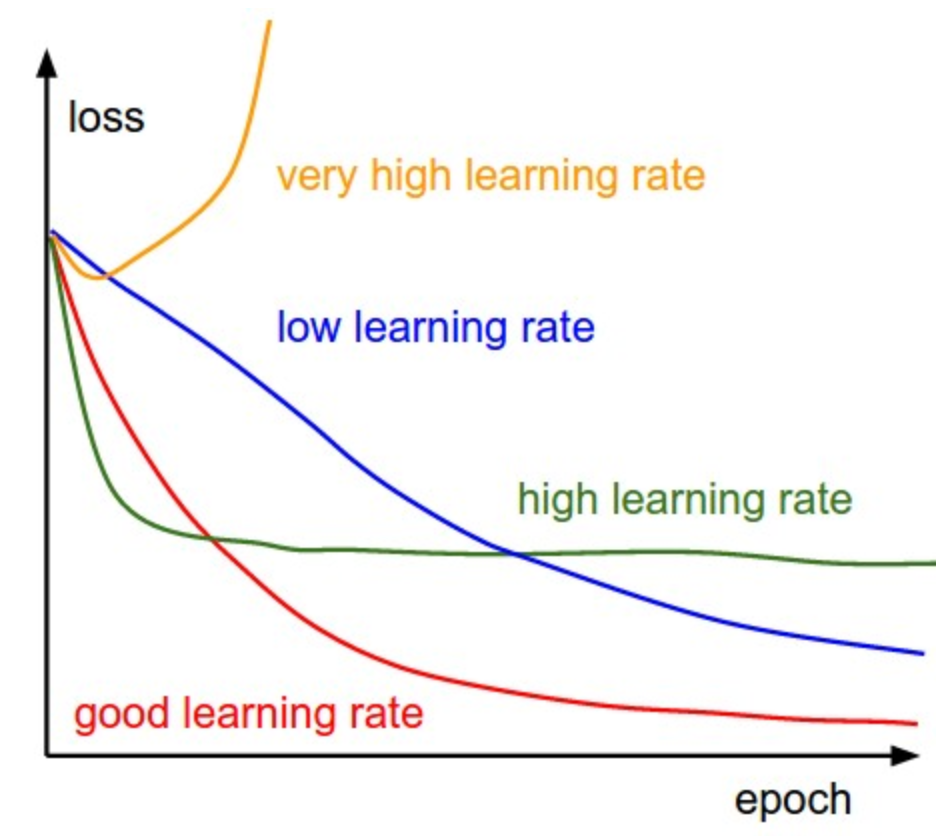
To solidify your intuition on this crucial hyperparameter, let's watch a short explanatory video.
Learning Rate in a Neural Network explained
The video 'Learning Rate in a Neural Network explained' by deeplizard provides a concise and clear explanation of what the learning rate is and the consequences of setting it too high or too low.
Watch the first two minutes of the video (from 00:00 to 02:38). Focus on the conceptual role of the learning rate as a 'step size' and the visual intuition for 'overshooting' the minimum.
The Impact of Network Size
The size and shape of your network—its number of layers and neurons—determine its "capacity" or ability to learn complex patterns.

- Too small a network (underfitting): The model may not have enough capacity to learn the underlying patterns in the data. It will perform poorly on both the training and test sets.
- Too large a network (overfitting): The model may have so much capacity that it simply memorizes the training data, including its noise. It will perform very well on the training set but poorly on unseen test data. It's also computationally more expensive to train.
Finding the right balance is key, and this is where hyperparameter tuning comes in.
2. Automating the Search: The Grid Search Workflow
Trying out different hyperparameter values manually is tedious, prone to error, and simply doesn't scale. A more systematic approach is to automate the search. The most straightforward method is Grid Search.
Grid search works by exhaustively trying every possible combination of hyperparameter values you provide in a predefined "grid". For example, if you want to test:
- Learning rates:
[0.1, 0.01] - Number of hidden layers:
[1, 2] - Neurons per layer:
[32, 64]
Grid search would train and evaluate 2 x 2 x 2 = 8 different models to find the best-performing combination.
Let's walk through how to implement this using Scikit-learn and Keras.
Hyperparameter Tuning For Neural Networks in Python
The video 'Hyperparameter Tuning For Neural Networks in Python' by NeuralNine provides an excellent practical walkthrough. First, we'll watch the segment that sets up the problem and introduces the concept of grid search.
Watch from 00:16 to 01:07 and then from 08:55 to 10:58. This will introduce the difference between parameters and hyperparameters and then explain the core idea of grid search and the 'parameter grid'.
Step 1: Create a Model-Building Function
To allow an automated tool to build models with different architectures, we need to define our model inside a function that accepts the hyperparameters as arguments. This is a fundamental pattern for hyperparameter tuning.
Hyperparameter Tuning For Neural Networks in Python
Now, let's see how to create this flexible model-building function. The video demonstrates this clearly.
Watch from 10:58 to 16:02. Pay close attention to how arguments like n_hidden, n_neurons, and learning_rate are used inside the function to dynamically construct the neural network.
Step 2: Wrap the Keras Model for Scikit-learn
Scikit-learn's GridSearchCV is a powerful and popular tool for this task. However, it's designed for Scikit-learn models. To make our Keras model compatible, we use a special wrapper. In the past, keras.wrappers.scikit_learn was used, but with modern TensorFlow, the scikeras library is the standard. The video uses the older wrapper, but the principle is identical.
This wrapper takes our model-building function and makes it behave like a Scikit-learn classifier.
Step 3: Define the Grid and Run the Search
Now we combine everything: we define our parameter grid, create the wrapped classifier, and pass them to GridSearchCV. The search process uses cross-validation to get a robust performance estimate for each hyperparameter combination.
Hyperparameter Tuning For Neural Networks in Python
This next segment puts all the pieces together: wrapping the model, defining the parameter grid, and launching the grid search.
Watch from 16:02 to 24:49. Notice the Model__ prefix needed for hyperparameters in the grid. Also, observe how the total number of 'fits' is calculated (number of combinations × number of cross-validation folds).
Test your understanding!
If you want to test 3 different learning rates, 4 different network sizes (e.g., number of neurons), and you are using 5-fold cross-validation, how many times will a model be trained in total during the grid search?
Show answer
The total number of trainings will be:
(Number of learning rates) × (Number of network sizes) × (Number of CV folds)
3 × 4 × 5 = 60 times.
This shows how quickly grid search can become computationally expensive!
Step 4: Analyze the Results
Once the search is complete, you can easily retrieve the best-performing model and the set of hyperparameters that produced it.
Hyperparameter Tuning For Neural Networks in Python
Finally, let's see how to extract the results and what to do next.
Watch from 24:49 to 26:55. The key takeaway here is how to interpret the results to inform your next steps. For instance, if the best value is at the edge of your search range, you should probably run another search with a new range that extends further in that direction.
3. Beyond Grid Search: Smarter Tuning Methods
Grid search is simple and exhaustive, but it suffers from the "curse of dimensionality." As you add more hyperparameters, the number of combinations to test explodes, making it computationally infeasible.
Fortunately, more efficient methods exist.
The Ultimate Guide to Deep Learning Hyperparameter ...
This article, 'The Ultimate Guide to Deep Learning Hyperparameter Tuning,' provides excellent, concise summaries of different tuning techniques. Let's read about a few of them.
Please read the section titled 'Techniques for Tuning Hyperparameters'. Focus on the descriptions for Grid Search, Random Search, and Bayesian Optimization. Understand the fundamental difference in their strategies.
Here's a quick summary of the trade-offs:
- Grid Search: Guarantees finding the best combination within the grid, but is very expensive.
- Random Search: More efficient than grid search. Instead of trying every combination, it randomly samples a fixed number of combinations. It's often surprisingly effective because some hyperparameters are much more important than others.
- Bayesian Optimization: The smartest of the three. It builds a probabilistic model of the relationship between hyperparameters and model performance. It uses the results from previous trials to make intelligent choices about what combination to try next, balancing exploration (trying new areas) and exploitation (focusing on promising areas).
For this course, mastering grid search is sufficient, but it's important to know these more advanced options exist for when you tackle more complex problems.
4. Best Practices for Hyperparameter Tuning
Regardless of the method you choose, following some best practices will make your tuning process more effective and efficient.
The Ultimate Guide to Deep Learning Hyperparameter ...
The same article also has a great section on best practices. These are excellent habits to build.
Read the section 'Best Practices for Deep Learning Hyperparameter Tuning'. Pay particular attention to starting with high-impact hyperparameters, using a proper validation split, and defining informed search ranges.
Conclusion
You have now learned a systematic and principled way to optimize your neural network's performance. Hyperparameter tuning is a fundamental skill that separates good models from great ones, and it's essential for justifying your architectural choices.
Key Takeaways:
- Hyperparameters are settings like learning rate and network size that you choose before training. They control the model's architecture and learning process.
- Tuning these parameters is crucial for balancing model capacity and preventing underfitting or overfitting.
- Grid Search is an automated technique that exhaustively tests all combinations in a predefined parameter grid.
- The implementation workflow involves creating a model-building function, wrapping it for use with tools like Scikit-learn's
GridSearchCV, and running the search with cross-validation. - More advanced techniques like Random Search and Bayesian Optimization offer greater efficiency for complex problems.
Preview of the Next Module:
This lesson concludes our module on Neural Network Foundations. You now have a solid understanding of how to build, train, regularize, and optimize a basic neural network.
In our next module, "Advanced Neural Network Architectures," we will move beyond simple dense networks. We'll start by exploring Convolutional Neural Networks (CNNs), a specialized architecture that revolutionized computer vision. You'll see that CNNs have their own unique set of hyperparameters, and the tuning process you learned today will be directly applicable to finding the best architecture for image-based tasks.