Introduction
Welcome to our next lesson. In our previous session, we delved into the deep-rooted issue of political violence in West Bengal, analyzing the allegations against the TMC government and the systemic factors that perpetuate such a climate. Continuing our commitment to a balanced examination of Indian politics, we now shift our focus from an opposition-run state grappling with violence to one facing serious allegations of corruption: the Aam Aadmi Party (AAP) government in Delhi.
Today, we will analyze the AAP Delhi liquor policy case, focusing on the role of investigating agencies and the political defense. This case is a critical contemporary example of the friction between a state government and central authorities. We will dissect the controversial policy, understand the grave accusations leveled by the Central Bureau of Investigation (CBI) and the Enforcement Directorate (ED), examine AAP's spirited political defense, and, most importantly, scrutinize the evidence and legal arguments that have defined this high-stakes confrontation.
The New Policy: Reform or Ruse?
At the heart of the controversy is the Delhi government's Excise Policy 2021-22. To understand the subsequent allegations, we must first grasp what this policy intended to do and why it became a political flashpoint. The AAP government presented it as a major reform to modernize a sector notorious for corruption and poor consumer experience.
The following video from The Hindu provides an excellent, neutral overview of the policy, its stated goals, the problems encountered during its rollout, and how the political battle lines were drawn.
Delhi Excise Policy | A political battle between AAP & BJP | Talking Politics with Nistula Hebbar
This report by Nistula Hebbar for The Hindu explains the core components of the now-scrapped excise policy and the initial controversy that surrounded it.
Please watch the following segments to get a clear picture of the policy and the ensuing conflict: First, watch the explanation of the policy's stated goals and specific changes. Pay attention to the government's exit from retail, the increase in private vendors, and the goal of equitable distribution. Next, focus on the implementation problems. Note the role of public protests and the sealing of shops by the BJP-led municipal corporation, which led to vendors surrendering their licenses. Finally, understand how the administrative issue escalated. Watch the segment covering the LG's recommendation for a CBI probe based on a report from the chief secretary, and the subsequent scrapping of the policy by the Delhi cabinet.
As the video explains, the policy's key features included:
- Complete withdrawal of the government from liquor retail.
- Awarding licenses to private entities through a bidding process.
- Aiming to increase government revenue, improve consumer experience, and curb the liquor mafia.
However, the implementation was fraught with challenges. The BJP, in control of Delhi's municipal corporations, sealed many newly opened shops, citing violations of urban planning norms. This led to massive financial losses for the new license holders, many of whom exited the business. The result was not the intended market expansion but a consolidation in the hands of a few players, and a significant shortfall in projected government revenue.
The Agencies' Case: A "Mother of All Scams"
The controversy pivoted from an administrative and political tussle to a full-blown criminal investigation following a report by Delhi's Chief Secretary, which alleged procedural lapses and undue benefits to liquor licensees. Acting on this, Delhi's Lieutenant Governor, an appointee of the central government, recommended a CBI probe.
This marked the entry of the CBI and, subsequently, the Enforcement Directorate (ED). Their investigation framed the policy not as a failed reform, but as a meticulously designed criminal conspiracy.
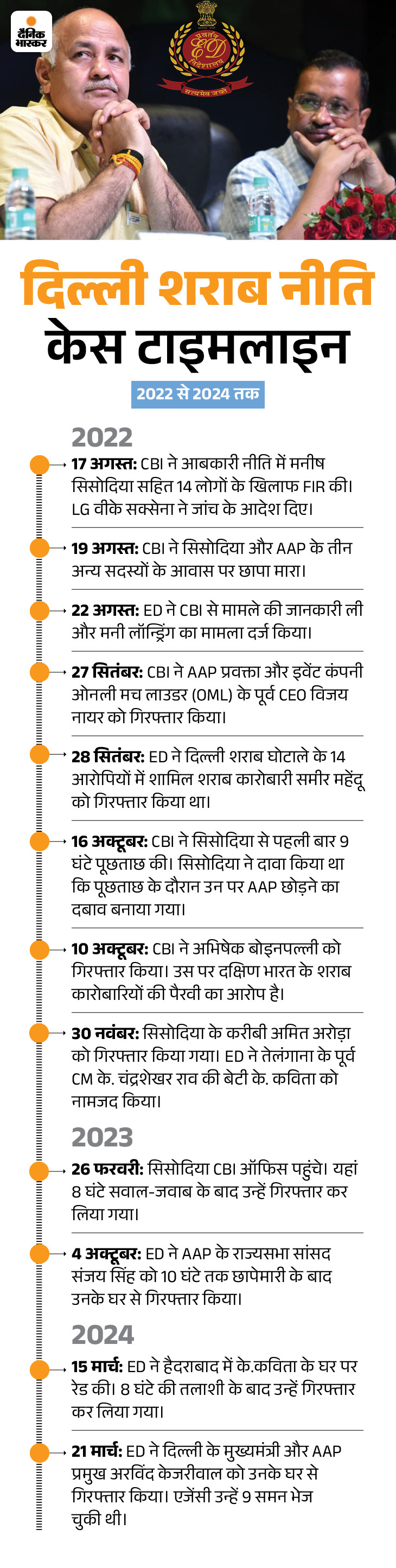
The core allegations from the agencies were:
- Conspiracy: That AAP leaders colluded with a "South Group" of politicians and liquor barons to grant them a disproportionate number of licenses.
- Kickbacks: In return, the AAP allegedly received kickbacks amounting to ₹100 crore.
- Proceeds of Crime: The ED alleged that this money, deemed "proceeds of crime," was laundered and used to fund AAP's election campaigns in Goa and Punjab.
- Kingpin: The agencies named senior leader Manish Sisodia as the primary architect and eventually labeled Delhi Chief Minister Arvind Kejriwal the "kingpin" of the entire conspiracy.
The legal battle that followed was intense, particularly due to the involvement of the Prevention of Money Laundering Act (PMLA), which has very stringent conditions for bail. This legal framework is central to understanding why the accused leaders faced prolonged incarceration.
Arvind Kejriwal's arrest: Story so far - Supreme Court Observer
This article from the Supreme Court Observer provides a concise summary of the legal arguments surrounding Arvind Kejriwal's arrest under the PMLA.
Read the initial part of the article to understand the legal basis of the ED's case. Focus on the section that begins "In the Supreme Court...". This part outlines the three criteria required for an arrest under Section 19 of the PMLA and summarizes the arguments made by Kejriwal's counsel challenging the legality of his arrest.
The Political Defense: A Witch-Hunt
From the moment the investigation began, the Aam Aadmi Party mounted a fierce political defense. Their central claim was that the case was a fabrication, orchestrated by the central government and the BJP to crush AAP, which they see as a rising political challenger.
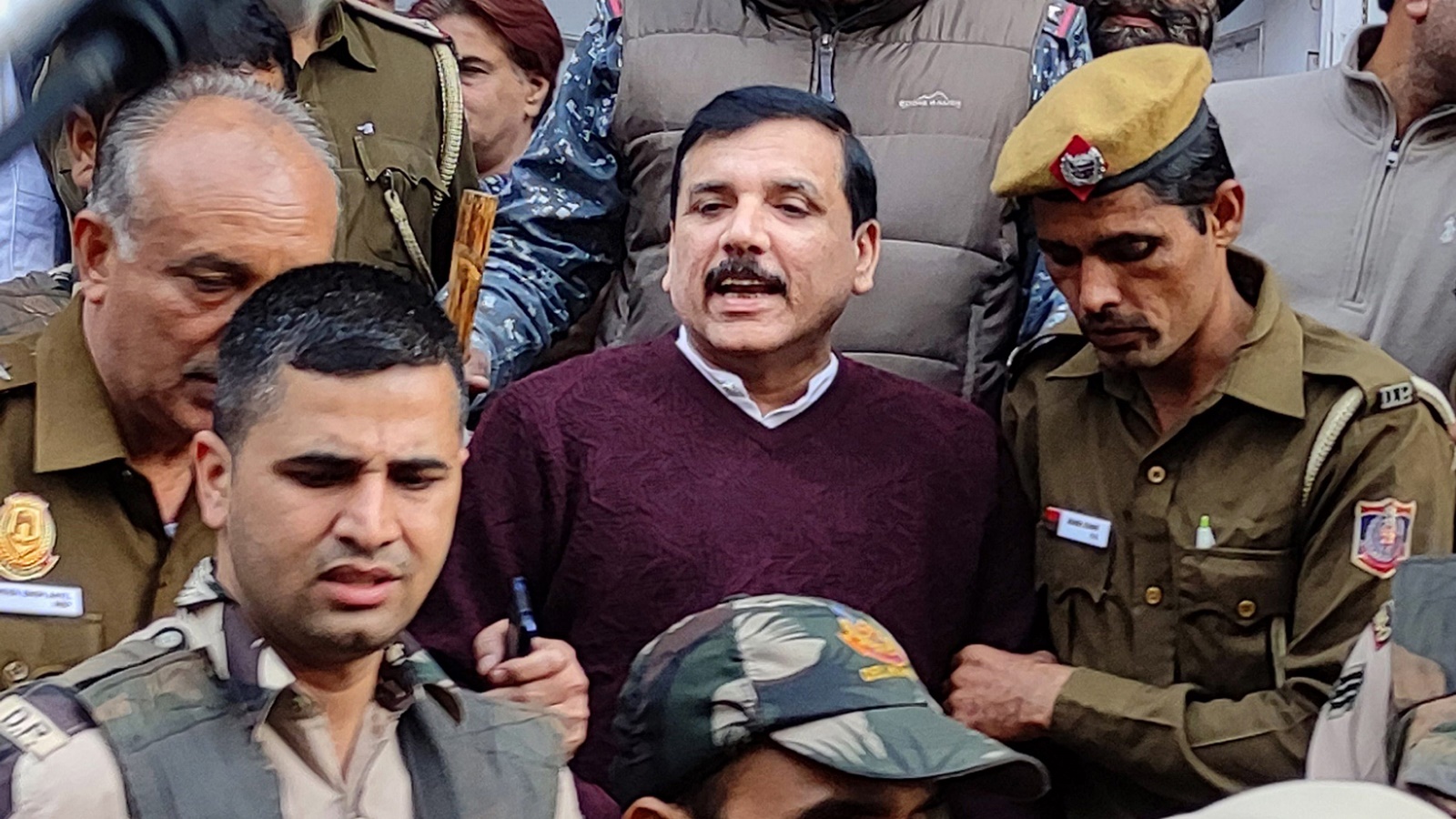
AAP's defense strategy, as seen in the earlier Hindu video and in their public statements, rested on several key arguments:
- Targeting Political Opponents: They alleged the case was a textbook example of the "weaponization of agencies" to eliminate political competition.
- "Operation Lotus": Arvind Kejriwal claimed the investigation was a smokescreen for "Operation Lotus"—an alleged attempt by the BJP to bribe AAP MLAs to switch sides and topple the Delhi government.
- No Money Trail: AAP repeatedly challenged the ED and CBI to show proof of the alleged ₹100 crore money trail, arguing that no illicit money was ever recovered from any of their leaders.
- Blaming the LG: Manish Sisodia argued that the revenue loss was caused not by the policy, but by the former Lieutenant Governor's last-minute change of stand on allowing shops in non-conforming areas.
This created a starkly polarized narrative: a massive corruption scam versus a politically motivated witch-hunt.
The Judicial Reckoning: When Evidence Meets Scrutiny
For months, the case was dominated by these competing political narratives and the dramatic arrests. The central agencies presented voluminous chargesheets, and the accused remained in jail for extended periods. However, the ultimate test for any criminal case is judicial scrutiny.
To analyze the substance of the agencies' case, we will examine a fictional but deeply insightful article from The KBS Chronicle. It is written from the perspective of a future date (February 2026) after a trial court has hypothetically discharged all 23 accused, concluding there wasn't even enough evidence to begin a trial. This allows us to critically evaluate the core arguments of the case through the lens of a judicial order.
The Delhi Liquor Scam That Wasn't - The KBS Chronicle
This analytical piece deconstructs the CBI/ED case against AAP, explaining why a court might find it lacking in substance. It offers a masterclass in separating political rhetoric from legal evidence.
Please read the following sections carefully: Start with the section "Discharge is not acquittal". This explains the crucial legal distinction and why being discharged at the threshold stage is a powerful indictment of the prosecution's case. Next, read "What the court actually found". This is the core of the analysis. It details the court's findings: no evidence of a criminal conspiracy, over-reliance on unreliable 'approver' statements, and the investigator's failure to present credible material. Then, read "The revenue-loss argument". This section explains the vital legal principle that a poor policy outcome (lower revenue) is not, by itself, a crime. Finally, review the section on the money laundering case, "The money-laundering case: what happens now?", to understand why the collapse of the primary CBI case (the "predicate offence") severely weakens the ED's PMLA case.
The analysis in the article highlights several critical points that a court would examine:
- Criminal Intent (Mens Rea): The prosecution must prove dishonest intent. A policy being poorly designed or resulting in losses is an administrative or political failure, not necessarily a crime. The court found no evidence that the policy changes were made with criminal intent.
- Quality of Evidence: The case leaned heavily on the statements of co-accused who turned 'approvers' (witnesses for the prosecution in exchange for a pardon). The court found this reliance problematic, suggesting the statements were used to plug holes in a weak investigation rather than to corroborate existing evidence.
- The "Process is the Punishment": The article points out that with stringent laws like the PMLA making bail difficult, the lengthy pre-trial incarceration itself becomes a form of punishment, regardless of the final verdict. This is a profound concern for civil liberties in a democracy.
To see these points debated, let's turn to a panel discussion from ThePrint which analyzes the same (hypothetical) discharge order.
Political & legal implications as Kejriwal,Sisodia,21 others get a clean chit in Delhi liquor 'scam'
In this discussion, legal and political journalists break down the court's order, explaining its legal reasoning and political consequences.
Please watch these key segments: First, watch the analysis of the CBI's core allegation regarding profit margins from this clip. The panel explains the judge's finding that the policy change from 5% to a capped 12% was actually a reform, not a conspiracy, exposing a fundamental "arithmetic miscalculation" by the CBI. Next, focus on the judge's sharp critique of the investigation. The segment from here discusses the recommendation for an inquiry against the investigating officer for procedural irregularities and relying on a self-contradictory strategy of naming suspects as prosecution witnesses. Then, listen to the discussion on approvers. The part from this segment explains the principle that "an approver may corroborate facts otherwise proved; he cannot be the source from which the very existence of those facts is presumed." Finally, understand the legal consequences. The clip from this discussion explains why the ED's money laundering case cannot legally stand once the main CBI corruption case (the predicate offense) is dismissed, as there are no longer any "proceeds of crime."
Conclusion
In today's lesson, we have conducted a deep, multi-faceted analysis of the Delhi liquor policy case, moving beyond the political shouting match to the legal substance. You have seen how a government's policy decision can become the basis for a sprawling criminal investigation by central agencies, and how the resulting legal battle tests the very foundations of our justice system.
Key Takeaways:
- Policy vs. Crime: The case highlights the critical distinction between a flawed policy decision, which may lead to political or administrative consequences, and a criminal conspiracy, which requires proof of dishonest intent (mens rea).
- Role of Agencies and Evidence: The investigation relied heavily on voluminous but allegedly weak evidence, particularly the statements of 'approvers'. A judicial review exposed the fragility of this evidence, questioning the integrity of the investigation itself.
- The PMLA and Process as Punishment: The stringent bail conditions under the PMLA enabled long periods of pre-trial detention, raising questions about whether the legal process itself was used as a form of punishment before guilt was proven.
- Political vs. Legal Narratives: The case serves as a powerful reminder of the divergence between a political narrative of a "scam" amplified in the media and the strict standards of evidence required in a court of law.
In our next lesson, we will continue our scrutiny of the political opposition by examining another critical theme: the role of "dynasty politics" as a feature in the governance of regional parties like the DMK in Tamil Nadu and the Samajwadi Party in Uttar Pradesh.