Introduction
In our last session, we conducted a rigorous analysis of the Delhi liquor policy case, examining the allegations against the AAP government and dissecting the legal arguments that defined the standoff between the state and central agencies. This continues our module's focus on providing balanced scrutiny of the political opposition in India. Today, we turn our attention to another opposition-run state, Kerala, and a scandal that has shaken its political foundations.
This lesson will address a topic you specifically requested for inclusion: the Kerala gold smuggling case. Our goal is to explain the key details of the case and its political implications for the state government. We will uncover how a routine customs check at an airport unraveled a sophisticated smuggling ring, how the investigation reached the highest office in the state, and how the scandal has become a recurring political battleground, echoing past controversies in Kerala's history.
The Diplomatic Deception
The scandal erupted on July 5, 2020, at the Thiruvananthapuram International Airport. The incident itself reads like a political thriller: a large quantity of gold discovered in a place it should never have been—a diplomatic consignment. To understand the gravity of the case, we first need to understand the mechanics of the crime and the key individuals involved.
The following resource provides a comprehensive overview of how the smuggling operation was executed and the central figures who orchestrated it.
2020 Kerala gold smuggling case - Grokipedia
This encyclopedic entry from Grokipedia offers a clear and factual summary of the incident, the method of smuggling, and the roles of the primary accused.
Please read the following sections to get a firm grasp of the facts: First, read the initial summary paragraph to understand the who, what, and where of the seizure. Next, read the section titled "Diplomatic Baggage Exploitation" in its entirety, starting from its first sentence. This explains the crucial how—the misuse of protections under the Vienna Convention. Finally, read the section under "Primary Accused" to familiarize yourself with the key players: Swapna Suresh, P. S. Sarith, and Sandeep Nair.
As you've read, the smugglers' key innovation was their abuse of diplomatic immunity. Consignments marked as "diplomatic baggage" are typically exempt from customs inspection under international law (the Vienna Convention). The smuggling ring exploited this privilege by addressing packages containing gold to the UAE Consulate in Thiruvananthapuram, knowing they would likely bypass scrutiny. The operation was only foiled due to a specific intelligence tip-off.

The Connection to the Chief Minister's Office
The case exploded from a significant crime into a full-blown political crisis when investigations revealed a direct link between the prime accused and the highest echelons of the state government. This connection was M. Sivasankar, a senior and trusted IAS officer who was, at the time, the Principal Secretary to Kerala's Chief Minister, Pinarayi Vijayan.
Sivasankar's close association with Swapna Suresh—having allegedly facilitated her appointment to a government IT project and maintained frequent contact—placed the Chief Minister's Office (CMO) at the heart of the controversy. His subsequent suspension and arrest by central agencies transformed the narrative.
The following video from NDTV reported on Sivasankar's arrest and the immediate political consequences.
Suspended IAS Officer Arrested As Agencies Probe Gold Smuggling Case
This news report captures the moment the scandal escalated with the arrest of a top bureaucrat from the Chief Minister's office.
Watch these key segments: The introduction announcing the arrest of M. Sivasankar. The explanation of the allegations, from the smuggling details to how Sivasankar allegedly used his official position. The summary of the political fallout, where the opposition demanded the Chief Minister's resignation.
The involvement of the CMO provided the opposition parties—the Congress-led United Democratic Front (UDF) and the Bharatiya Janata Party (BJP)—with powerful ammunition. They immediately launched statewide protests, framing the case not as an isolated crime but as evidence of systemic corruption within the Left Democratic Front (LDF) government.
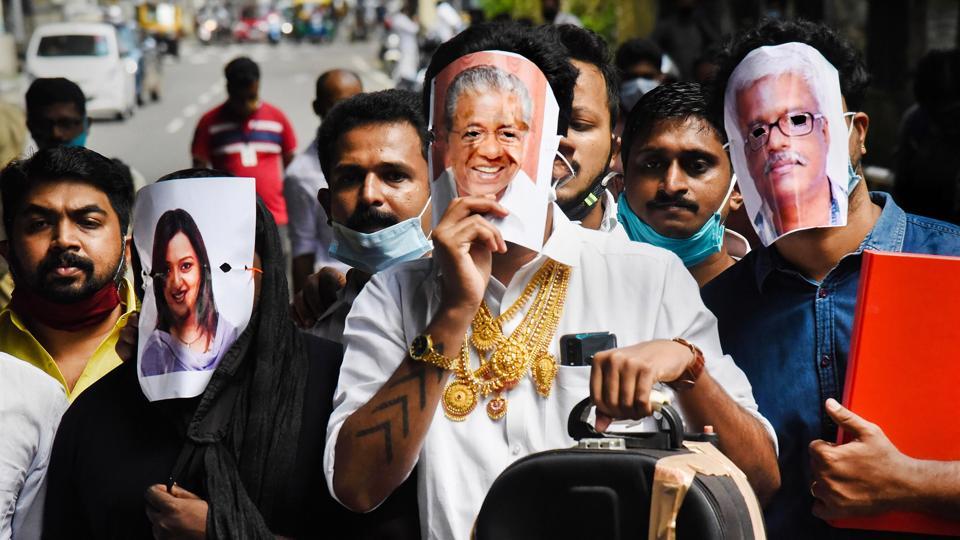
Competing Narratives: Corruption vs. Witch-Hunt
The case quickly settled into two fiercely competing narratives, a pattern we also observed in the Delhi liquor policy case.
-
The Opposition's Narrative: A Government-Sponsored Scam. The UDF and BJP argue that the CMO's proximity to the accused is proof of high-level complicity. Swapna Suresh later made explosive, unproven allegations directly against the Chief Minister and his family, claiming they were aware of, and benefited from, the smuggling. This narrative portrays the LDF government as institutionally corrupt and protecting the smugglers.
-
The Government's Narrative: A Central Agency Witch-Hunt. The LDF government and the CPI(M) mounted a strong counter-offensive. They accused the central investigating agencies (NIA, ED, Customs), which are controlled by the BJP-led central government, of overstepping their jurisdiction. They framed the investigation as a politically motivated attack designed to destabilize an opposition-run state government.
To understand these conflicting viewpoints, let's return to the Grokipedia resource, which documents both sides of the political battle.
2020 Kerala gold smuggling case - Grokipedia
This reading delves into the political war of words that defines the scandal, presenting both the allegations of government complicity and the government's counter-claims of being targeted.
To understand the two competing narratives, please read the following sections: First, read the section "Allegations of State Government Complicity". This details the specific claims made against the Chief Minister's office and the LDF government. Next, read the government's response in the section "Claims of Central Agency Overreach". This outlines their argument that the central agencies were being used as political tools.
A Political Déjà Vu: The "Solar Case" Parallel
To fully grasp the political potency of the gold smuggling case, it is essential to place it within the context of Kerala's recent political history. The structure of the scandal—a woman with high-level connections at the center of a controversy that implicates the Chief Minister's Office—bears a striking resemblance to the infamous "Solar Scam" that rocked the previous UDF government (led by the Congress party) from 2013 onwards.
This historical parallel is not just a coincidence; it is the key to understanding why the LDF's opponents have been so effective in weaponizing this case. They are, in essence, using the same political playbook that the LDF used against them a decade ago. The Frontline article "Crossing the line" offers a brilliant analysis of this dynamic.
Kerala gold smuggling case: Crossing the line - Frontline - The Hindu
This article from Frontline explains the political significance of the gold smuggling case by comparing it to the 'Solar case', revealing a pattern in Kerala's politics.
Please read the section of the article titled "The solar case". As you read, focus on how the author highlights the similarities: A woman with questionable credentials gaining access to the corridors of power. Her connections being linked directly to the Chief Minister's office. The opposition using these links to build a narrative of corruption and demolish the government's credibility, irrespective of the final legal verdict.
This parallel explains why the gold smuggling case has had such a lasting political impact. For the opposition, it's a "godsend" that allows them to "do a ‘Solar-like trick’ on the LDF government, and seek their revenge." It demonstrates that in the political arena, the perception of corruption and cronyism, amplified by a sensational media narrative, can be just as damaging as a legal conviction.
Conclusion
Today, we have dissected the Kerala gold smuggling case, moving from the initial crime to its far-reaching political consequences. We have seen how a sophisticated smuggling operation, which audaciously exploited diplomatic immunity, became a major political crisis due to its links to the Chief Minister's office.
Key Takeaways:
- The Modus Operandi: The case's signature was the use of diplomatic baggage to smuggle large quantities of gold, a method that relies on the abuse of international conventions.
- The Political Nexus: The scandal's political gravity stems directly from the involvement of M. Sivasankar, the Principal Secretary to the Chief Minister, which allowed the opposition to directly target the highest office in the state.
- Competing Narratives: The case is defined by a clash between the opposition's charge of a "government-sponsored scam" and the LDF government's defense that it is a victim of a "political witch-hunt" by central agencies.
- Historical Echoes: The case's political potency is magnified by its strong resemblance to the "Solar Scam," demonstrating a recurring template for political scandals in Kerala where proximity to power is weaponized by the opposition.
In our next lesson, we will continue our examination of the political opposition by analyzing another recurring theme in Indian politics: the role of "dynasty politics" in the structure and governance of major regional parties like the DMK and the Samajwadi Party.