Introduction
In our previous lesson, we examined the Kerala gold smuggling case, providing a detailed look at the allegations against the LDF government and the political battle of narratives it ignited. This analysis is part of our module's commitment to balanced scrutiny of India's political opposition. Today, we continue this theme by shifting our focus from a specific scandal to a deep-seated structural feature that defines many regional parties.
This lesson directly addresses a topic you highlighted as important: the role of family control in opposition parties. Our objective is to analyze the role of 'dynasty politics' as a recurring theme in the governance and structure of regional opposition parties like the DMK and SP. We will move beyond the surface-level critique of nepotism to investigate the underlying political logic. Why does dynasticism persist? How does it shape the internal power structures and governance of these parties? And what are its complex, sometimes paradoxical, effects on political representation?
The Scale of the 'Family Business'
The term "dynasty politics" is most frequently associated with the Congress Party and the Nehru-Gandhi family. However, data reveals a much broader phenomenon that is deeply embedded across the Indian political landscape, especially within regional parties.
To get a sense of the scale and distribution of this trend, the following video from The Indian Express provides an excellent data-driven overview.
Express Investigation: How Family Dynasties Shape Indian Politics and Who Are These Politicians
This investigative report quantifies the prevalence of dynasticism across all Indian legislatures, offering a clear, factual starting point for our analysis.
Please watch the following segments: Begin with the journalist's summary of the investigation's main finding and methodology, from the opening remarks to the definition of a "dynast". Note the overall percentage of legislators who come from political families. Then, watch the specific segment on regional parties, starting from where the discussion begins. Pay close attention to the mention of the Samajwadi Party (SP) and Dravida Munnetra Kazhagam (DMK).
The video establishes two key points: first, that over a fifth of India's legislators are "dynasts," and second, that many regional parties exhibit an even higher proportion of family-based politicians than the national parties.
The dot plot below, from a study on the 2014 Lok Sabha, visually reinforces this point.
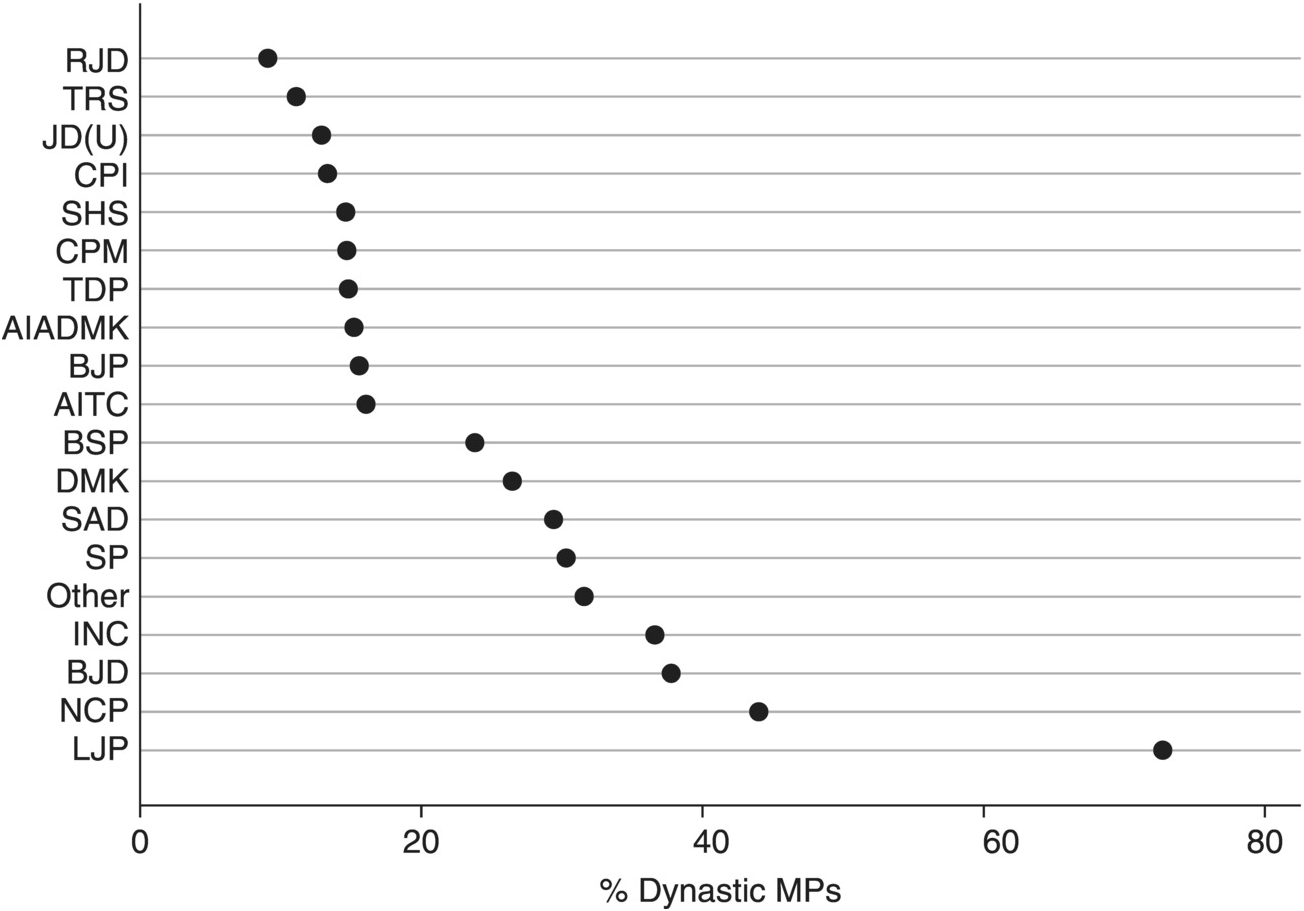
As you can see, parties like the Samajwadi Party (SP), Shiromani Akali Dal (SAD), and Dravida Munnetra Kazhagam (DMK) all feature prominently. This confirms that to understand modern Indian politics, we must analyze dynasty as a widespread structural feature, not just an aberration limited to one or two parties.
The Structural Logic: Why Parties Prefer Dynasties
If dynastic politics is so widely criticized, why is it so pervasive? The answer lies less in voter preference and more in the strategic calculations of political parties themselves. In systems where party organizations are weak and ideological commitment can be fluid, family becomes a proxy for a crucial political commodity: loyalty.
The following article from The Caravan provides a compelling explanation for this phenomenon.
Why political dynasties succeed in India - The Caravan
This article explains the core logic behind why parties, in their own self-interest, often choose to nominate candidates from established political families.
Please read the section that begins with the sentence "The best explanation for the presence of dynasties...". Focus on the central argument: how nominating dynasts is seen as a strategy to reduce the risk of rebellion and ensure cohesion within local party units.
The key insight from this reading is that parties often favor dynastic candidates not because they are necessarily more "winnable," but because they are perceived as more loyal. A family's entire political capital is tied to the party, making them less likely to defect or cause internal disruption. This is a risk-aversion strategy. In essence, the family unit serves as a substitute for strong, institutionalized party structures.
The Family as the Party: Two Models
While many regional parties are dynastic, they don't all follow the same blueprint. The political analyst Ambar Kumar Ghosh proposes a useful distinction between two types of family-run parties. The article "Friendly fire" in Scroll.in elaborates on this.
Friendly fire: How family feuds shape India's 'dynastic' political parties
This piece introduces a helpful framework for categorizing different types of dynasty-led parties.
Please read the section starting from "However, the phenomenon of dynasty-led parties is quite different." In this passage, pay close attention to the distinction between parties that are "dynastic-by-practice" and those that are "dynastic-by-design".
This distinction provides an excellent lens through which to analyze our two case studies, the SP and the DMK.
Samajwadi Party: 'Dynastic-by-Design'
The Samajwadi Party, founded by Mulayam Singh Yadav, is a quintessential example of a party that is "dynastic-by-design." It was structured around the Yadav family from its inception, with political power consolidated and distributed among relatives.
This family tree provides a stark visual representation of the SP's structure.

As you can see, brothers, sons, daughters-in-law, nephews, and cousins all hold or have held significant political office, from Chief Minister and MP to key party posts.
DMK: 'Dynastic-by-Practice'
The DMK, in contrast, is "dynastic-by-practice." It did not begin as a family enterprise. It originated from the powerful, ideology-driven Dravidian movement. However, over decades of leadership by M. Karunanidhi, the party structure gradually morphed to ensure the succession of his son, M.K. Stalin. The party's ideological roots remain, but its leadership structure has become hereditary.
Governance and Accountability: The Role of the Family Feud
A common critique of dynasty-led parties is that they lack internal democracy and accountability. If the leader cannot be challenged from outside the family, who holds them to account?
Paradoxically, a unique form of accountability often emerges from within the family itself. Succession is rarely a smooth, uncontested coronation. It is often the result of intense "intra-dynastic competition"—or, more simply, a family feud.
Let's return to the Scroll.in article to explore this dynamic.
Friendly fire: How family feuds shape India's 'dynastic' political parties
This section argues that competition among family members can serve as an internal check on the leadership of dynasty-led parties.
Please read the section titled "Intra-dynastic competition" in its entirety. As you read, note the examples of leadership challenges within our case-study parties: Samajwadi Party: The power struggle between Akhilesh Yadav (son) and his uncle Shivpal Singh Yadav. DMK: The long-standing rivalry between M.K. Stalin (son) and his brother M.K. Alagiri.
These family conflicts are not mere personal squabbles; they are political power struggles that force the incumbent leader to consolidate their control, prove their electoral mettle, and win the loyalty of the broader party cadre to legitimize their claim over rival family members. In 2016, Akhilesh Yadav effectively staged a coup against his father and uncle to seize control of the SP, recasting the party in his own image. Similarly, M.K. Stalin's rise to undisputed leadership of the DMK was a long process that involved politically sidelining his ambitious elder brother, Alagiri.
This intra-dynastic competition, therefore, acts as a de facto leadership challenge, forcing a dynastic successor to earn their position rather than simply inherit it.
Conclusion
In this lesson, we have moved beyond a simplistic condemnation of dynasty politics to analyze it as a fundamental structural component of the Indian political system, particularly within regional opposition parties. We've seen that its persistence is rooted in the strategic logic of party cohesion in the absence of strong institutions.
Key Takeaways:
- A Widespread Phenomenon: Dynasty politics is not confined to the Congress party; it is a defining characteristic of many regional parties, including the SP and DMK, which often have a higher proportion of dynastic legislators.
- The Logic of Loyalty: Parties often favor dynasts not just for name recognition, but as a strategic tool to ensure loyalty and reduce the risk of rebellion, compensating for weak internal party structures.
- Two Models: We can distinguish between parties 'dynastic-by-design' (like the SP), which were created as family vehicles, and those 'dynastic-by-practice' (like the DMK), which evolved from ideological movements into family-led enterprises.
- Intra-Dynastic Competition as Accountability: Governance and leadership succession in these parties are often shaped by internal family feuds. These power struggles serve as a unique, albeit informal, mechanism of accountability, forcing potential successors to prove their political capabilities to consolidate power.
In our next and final lesson for this module, we will synthesize our findings from the case studies of specific allegations and structural features. We will tackle the broader, evaluative question: do opposition-run states and parties face institutional and media scrutiny that is equivalent to that faced by the central government?