Introduction
Welcome to the capstone module of our course. Over the past ten modules, we have dissected the complex machinery of contemporary Indian politics, from the ideological roots of Hindutva to the intricacies of caste, regionalism, and the functioning of key state institutions. In our last lesson, we concluded our examination of the political opposition by evaluating the significant asymmetry in institutional scrutiny between the central government and its rivals. This finding serves as a critical bridge to our final, summative inquiry.
This lesson marks the beginning of that final analysis. We will now address the central question you wanted this course to explore: Is Indian democracy undergoing a period of consolidation or backsliding? Today, we will tackle the first half of this dichotomy. The learning outcome is to synthesize arguments supporting the 'democratic consolidation' narrative, focusing on electoral mandates, welfare delivery, and national pride.
We will construct this argument by examining three interconnected pillars. First, we will analyze how massive electoral victories are presented as a direct expression of popular will, legitimizing a strong, decisive government. Second, we will explore the "new welfarism," a model of direct benefit delivery that forges a powerful bond between the state and its citizens. Finally, we will consider how a narrative of resurgent national pride, fueled by a rising economy and an assertive foreign policy, works to unify the polity. This lesson will build the case for consolidation, preparing us to critically evaluate the counter-narrative of democratic backsliding in our next session.
The Pillar of Electoral Mandates
The foundation of the democratic consolidation argument rests on the most direct evidence of popular will: election results. Proponents of this narrative argue that the Bharatiya Janata Party's (BJP) successive, overwhelming victories in the 2014 and 2019 general elections are not mere political wins but profound mandates for a new model of governance.
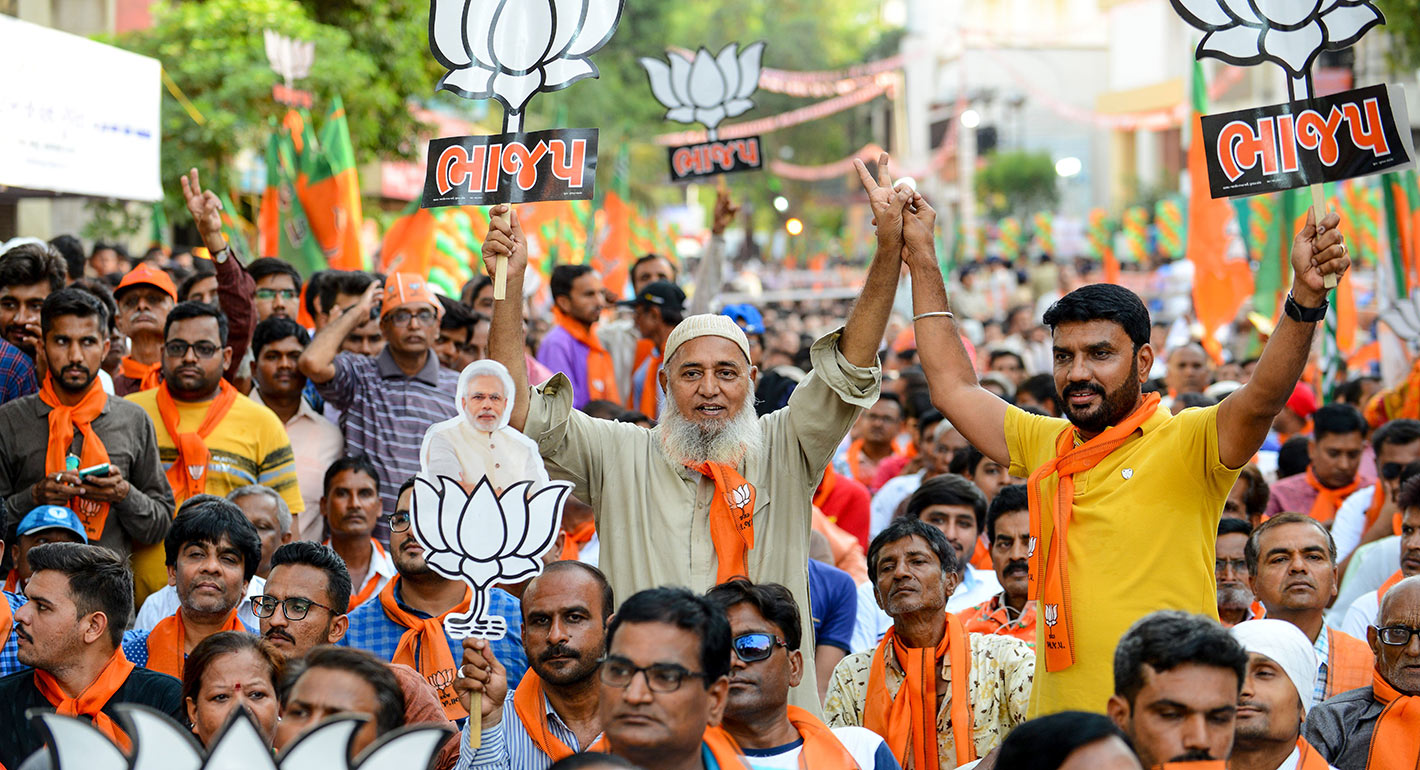
These are not seen as narrow victories in a fragmented system, but as decisive choices made by a large cross-section of the electorate for strong, centralized leadership. This perspective is detailed in a collection of essays from the "Democracy and Autocracy" newsletter.
[PDF] Democracy and Autocracy - APSA Connect
This academic analysis provides context for the BJP's electoral dominance and its transformation into a broad-based party, which are central to the consolidation argument.
Please read the following two sections: First, focus on the paragraph in the "The Looming Challenge" section that details the BJP's electoral performance and the opposition's disarray. It begins with the overview of the BJP's majorities and the weakness of the Indian National Congress. Then, turn to the essay "The State of the Two Major Parties" and read the paragraph under the subheading "The Changing Social Base". Pay attention to how the BJP has expanded its support base beyond its traditional constituencies.
The readings highlight two key points. First, the scale of the BJP's victories, contrasted with the deep disarray of the principal opposition, is interpreted as a clear public preference. Second, the party's success in expanding its social base to include lower castes, rural voters, and new geographical regions signifies its evolution into a true "umbrella party." From this viewpoint, the electoral mandate is broad, deep, and national, giving the government the legitimacy to pursue transformative policies, even if they are contentious.
Furthermore, a key paradox challenges the narrative of a weakening democracy: voter participation remains high. In a podcast from Carnegie India, political scientist Rahul Verma discusses this very issue.
Rahul Verma on the Debate on Democratic Backsliding in India | Interpreting India
In this episode of Interpreting India, titled "Rahul Verma on the Debate on Democratic Backsliding in India," the host and guest question the prevailing "backsliding" narrative by pointing to evidence of robust democratic participation.
Please listen to these key segments: First, listen to the episode summary, which introduces the central question: why is there a disconnect between scholarly claims of backsliding and the ground reality of high political participation? Next, jump to Chapter 2: Paradoxes in Indian Polity. Here, the discussion touches on the high voter turnout and active political engagement as a sign of democratic health. Finally, listen to the introduction of Chapter 5: Conflating Other Phenomena for Backsliding, where Verma begins to argue that what critics label as democratic decline might instead be other political phenomena, such as the emergence of a dominant party system, which the electorate has actively chosen.
The argument presented here is that high voter turnout is a sign of a vibrant, not a failing, democracy. People are actively participating and making decisive choices. In the consolidation narrative, the strong mandate given to the ruling party is not an aberration but the logical outcome of this democratic churn, empowering a government to act decisively on behalf of the people who elected it.
The Pillar of "New Welfarism"
The second pillar of the consolidation argument is the government's reinvention of social welfare. Termed "new welfarism," this strategy moves away from abstract, rights-based entitlements to the direct delivery of tangible, private goods and services to millions of households. This includes everything from cooking gas cylinders and toilets to bank accounts and direct cash transfers.
This approach fundamentally reshapes the relationship between the citizen and the state. By using technology to deliver benefits directly, the government bypasses layers of bureaucracy and local intermediaries, creating a direct, unmediated connection with the voter. The credit for these benefits is often personally associated with the Prime Minister, building a powerful foundation of political support.
The "Democracy and Autocracy" PDF provides a detailed explanation of this strategy.
[PDF] Democracy and Autocracy - APSA Connect
This reading explains the mechanics and political logic of "new welfarism," connecting policy delivery directly to political support.
Please review the following sections in the document: In the section "The Looming Challenge," read the sentence where Shashi Tharoor concedes the Modi government's successes, specifically mentioning the expansion of the social safety net. Next, read the paragraph describing the government's economic policies, paying close attention to the part on the India Stack initiative, which serves as the technological backbone for this direct delivery. Finally, read the paragraph that explicitly defines and analyzes the "new welfarism." It begins with this crucial explanation of how welfare was reinvented to distribute private goods and build political support.
The consolidation narrative posits that this is democracy working at its most effective. The government is responding to the basic needs of the population, and voters, in turn, reward this delivery with their electoral support. It replaces the messy, often corrupt, politics of patronage with a more efficient, technology-driven system of accountability. A report from ABC News In-depth shows just how central this has become to elections across the country.
Can welfare schemes influence voters in Indian elections | India Votes 2024
This news report, "Can welfare schemes influence voters in Indian elections," provides on-the-ground perspectives on how welfare delivery translates into votes.
Please watch these segments: Watch from this section, where a Delhi resident explains how free electricity and bus travel directly influence her vote, providing a clear example of the citizen-state contract. Next, observe the comparison between the welfare promises of the Congress party and "Prime Minister Modi's Guarantees," showing how welfare has become the central language of electoral politics. Finally, listen to the public's views and an expert's concluding analysis from this part of the video, which suggests that welfare politics is a long-standing and integral feature of Indian democracy, aimed at resolving the concerns of the marginalized.
From this perspective, "new welfarism" consolidates democracy by making it more responsive and tangible. It creates a direct feedback loop: the government delivers, and the people endorse.
The Pillar of National Pride
The third and final pillar is the cultivation of national pride, built on the narrative of India's resurgence on the world stage. This argument holds that a strong, confident India, taking its rightful place as a global "leading power," fosters a sense of unity and collective purpose that strengthens the nation's democratic foundations.
This narrative is fueled by several interconnected factors:
- Economic Might: India's status as the world's fastest-growing major economy and its rise to become the fifth-largest economy globally.
- Diplomatic Assertiveness: A foreign policy of "strategic autonomy" that positions India as a crucial "rule shaper," not a mere "rule taker," in a multipolar world.
- Technological Prowess: The success of innovations like the Digital Public Infrastructure (DPI), which are now being exported as models for other developing nations.
A discussion featuring scholars and students from New York University, broadcast on DD India, offers a comprehensive look at this aspect.
Indian Diplomacy: Global Effects of India’s Rise
This program, "Indian Diplomacy: Global Effects of India’s Rise," articulates the narrative of a resurgent India and its positive impact on the world, a key component of the national pride argument.
As you watch, focus on how the speakers build the case for India's rising status: Begin with Professor Sidhu's opening remarks from this timestamp, where he frames India's journey from a "rule taker" to a "rule shaper." Listen to the students' observations on India's economic growth and digital development, and how India serves as a model for the developing world. Pay attention to the discussion on democracy as a strength from this segment, which contrasts the Indian model with the Chinese one. Note the explanation of India's low-cost innovation and its role in creating "global public goods" like the India Stack. Finally, absorb the concluding thoughts from this timestamp, which summarize the idea that India's rise is responsible and beneficial for the global good.
The consolidation argument connects this rising global stature directly to domestic politics. It posits that a population that feels proud of its nation's place in the world is more likely to be unified and supportive of the leadership steering that rise. Success on the world stage validates the government's policies and strengthens its domestic standing, creating a virtuous cycle that reinforces democratic stability.
Conclusion
Today, we have constructed the case for the "democratic consolidation" narrative. This perspective argues that far from backsliding, Indian democracy is being fortified through a powerful combination of popular will, responsive governance, and national purpose.
Key Takeaways:
- Electoral Mandates: The BJP's massive and repeated electoral victories are seen as a clear and legitimate mandate from the people for a strong, decisive government. High voter turnout is interpreted as a sign of democratic vitality.
- New Welfarism: The direct delivery of tangible benefits to millions has created a new, unmediated social contract, making democracy more responsive and building a strong bond between the leader and the electorate.
- National Pride: India's rising economic and diplomatic stature on the world stage fosters a sense of collective purpose and national unity, which reinforces the legitimacy of the government and strengthens the democratic fabric.
Taken together, these three pillars form a coherent and powerful argument that the current political era represents a consolidation of Indian democracy around a new center of gravity.
In our next and final lesson, we will pivot to address the other side of this debate. We will synthesize the arguments for the "democratic backsliding" narrative, focusing on claims of institutional erosion, the marginalization of minorities, and a shrinking space for dissent. This will set the stage for your final task: to weigh these two competing narratives and formulate your own analysis of the state of Indian democracy today.