Welcome back. In our previous lesson, we examined the powerful critique that Indian secularism has been applied inconsistently, giving rise to the political charge of "pseudo-secularism." We explored how the reform of Hindu personal laws, contrasted with a hands-off approach to minority personal laws, created a narrative of minority appeasement.
Today, we will dissect the single most significant event that brought this entire debate to a boiling point: the Shah Bano case. This lesson focuses on how the political handling of this case provided the Bharatiya Janata Party (BJP) with its most potent example to argue that the secularism practiced by its rivals was a sham. By the end of this lesson, you will be able to explain the BJP's 'pseudo-secularism' charge by using the Shah Bano case as the primary case study.
The Spark: A Woman's Plea for Maintenance
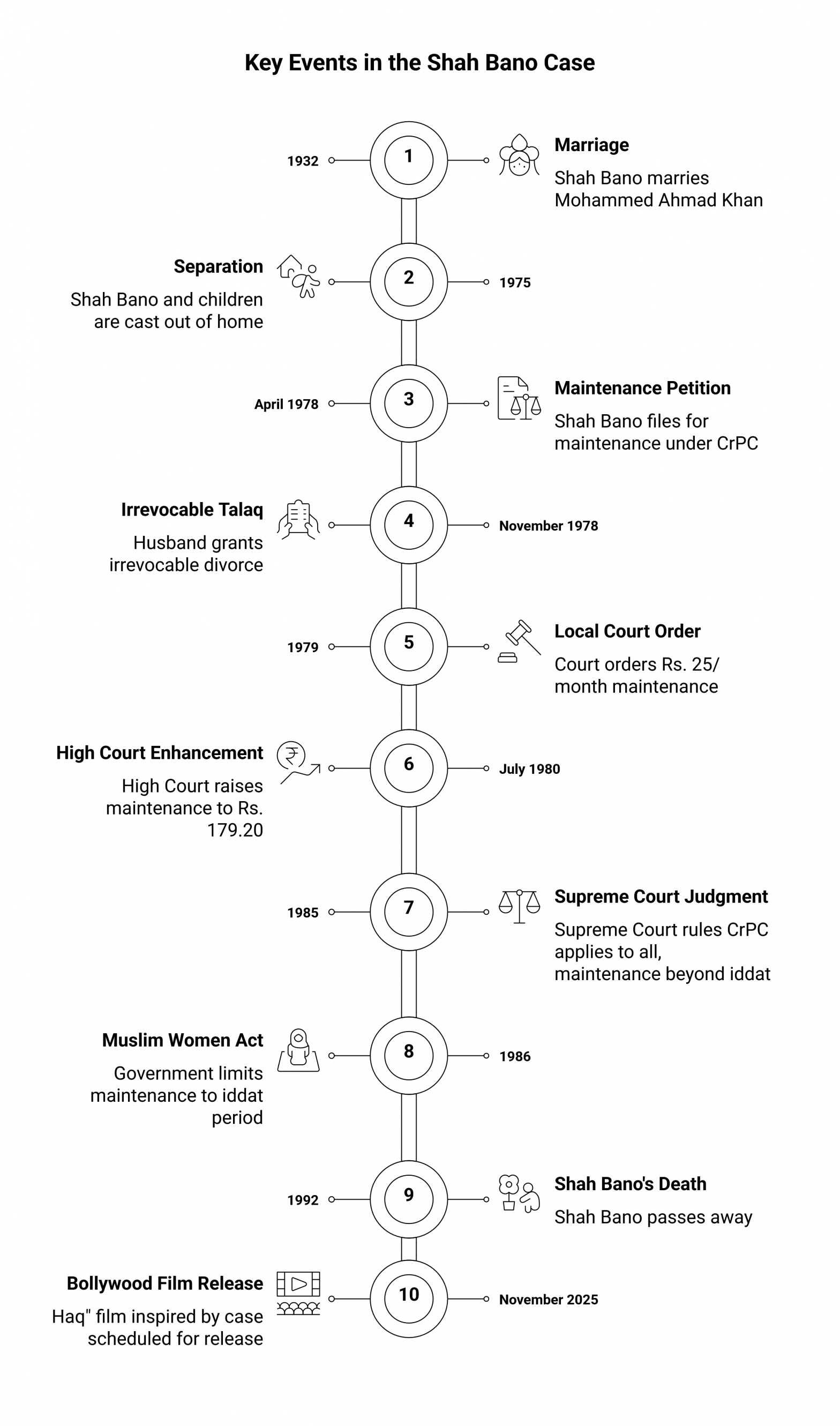
The story begins not as a grand political battle, but as a personal legal struggle. In 1978, a 62-year-old Muslim woman named Shah Bano was divorced by her husband, a prosperous lawyer. After being cast out of her marital home with her five children, and with the initial maintenance payments stopping, she filed a petition in court.
She did not seek recourse under religious law. Instead, she used a secular provision available to every Indian citizen: Section 125 of the Code of Criminal Procedure (CrPC). This law requires a man with sufficient means to provide maintenance to those he is responsible for, including an ex-wife who is unable to support herself. Her husband contested the claim, arguing that under Muslim Personal Law, his only obligation was to pay maintenance for the iddat period (a waiting period of about three months after divorce) and return her dower (mehr), both of which he had done.
The case progressed through the lower courts until it reached the Supreme Court of India. The following timeline provides a clear visual overview of these key events.
The Supreme Court's Verdict and the Backlash
In 1985, the Supreme Court delivered a landmark judgment. It upheld Shah Bano's right to maintenance, ruling that the secular CrPC Section 125 applied to all citizens, irrespective of their religion. The court declared that if there was a conflict between a secular law and a personal law, the secular law meant to prevent poverty and destitution would prevail. The judgment was hailed by progressives and women's rights advocates as a victory for gender justice.
To understand the core facts of the case and the court's reasoning, the following video provides an excellent summary.
Shah Bano Case: How One Woman’s Battle Rewrote Indian Law! | StudyIQ IAS English
This video from StudyIQ IAS offers a clear and structured explanation of the case, the verdict, and the immediate political fallout.
Watch the segment from 01:21 to 09:18. Focus on understanding four key elements: Who Shah Bano was and the basis of her legal claim under Section 125 CrPC. The Supreme Court's reasoning for upholding her claim and prioritizing the secular law. The immediate, large-scale protests organized by conservative Muslim groups like the All India Muslim Personal Law Board (AIMPLB). The response of the Rajiv Gandhi government, which, despite a huge majority, felt pressured by the protests.
As the video explains, the verdict triggered a massive political firestorm. Conservative Muslim organizations, led by the AIMPLB, framed the judgment not as a matter of gender justice but as a direct assault on Muslim identity and an infringement on their personal law. They organized massive protests across the country, portraying Islam as being "in danger."
The Government's Capitulation and the "Pseudo-Secularism" Charge
The Rajiv Gandhi government, which had won a historic 400+ seat majority in the 1984 election, found itself in a political bind. The Congress party began losing crucial by-elections in Muslim-majority constituencies, and a panic set in that the party was losing its traditional "Muslim vote bank."
Instead of defending the Supreme Court's progressive verdict, the government chose a path of political expediency. In 1986, it used its brute majority in Parliament to pass the Muslim Women (Protection of Rights on Divorce) Act. This law effectively overturned the Supreme Court's judgment, stipulating that a Muslim woman's right to maintenance from her ex-husband was limited to the iddat period only. After that, the responsibility to support her fell to her own relatives or, failing that, the state's Waqf Board.
This decision to legislate away a right granted by the nation's highest court, purely in response to pressure from a conservative religious lobby, was the moment the "pseudo-secularism" charge became a devastatingly effective political weapon.
The following video, featuring analysis from journalist Shekhar Gupta who covered the story in 1986, captures the political panic that led to this decision.
How SC order blunts Rajiv Gandhi’s '86 'ShahBano' Act denying Muslim women alimony under secular law
Journalist Shekhar Gupta provides a sharp political analysis of the Rajiv Gandhi government's response and the motivations behind it.
Watch two key segments: First, from 03:11 to 04:49, where he explains the 1986 Muslim Women Act and how it effectively nullified the Supreme Court's order. Then, watch the section from 14:50 to 17:38, which details the political panic inside the Congress party after losing by-elections and the fear of losing its Muslim support base. This is the core of the "appeasement" narrative.
The BJP's Narrative: A Textbook Case of Appeasement
For the BJP and its ideological allies, the Shah Bano affair was a political gift. It provided concrete, undeniable proof for the argument they had been building for years. The narrative they constructed was simple and powerful:
- The Supreme Court upheld a fundamental principle: equality before the law for all citizens, in this case, a poor, elderly woman.
- Conservative Muslim leaders protested to protect their patriarchal control, framing it as an attack on their religion.
- The Congress party, terrified of losing a "vote bank," capitulated to this regressive demand.
- In doing so, they sacrificed the constitutional rights of Muslim women, betrayed the principle of gender justice, and placed religious law above the law of the land.
This, the BJP argued, was the very definition of pseudo-secularism: not a principled protection of minorities, but a cynical and selective "appeasement" of the most orthodox and vocal elements within minority communities for electoral gain. The following readings show how this charge was articulated and how it became central to the political discourse.
Origins of Pseudosecularism in Nehru-Patel Rift - Indiafacts
This article from Indiafacts directly credits BJP leader L.K. Advani with popularizing the term "pseudo-secularism" in the wake of the Shah Bano controversy.
Please read the section starting with "This was possibly the first usage...". It explicitly details how the Rajiv Gandhi government's reversal of the Supreme Court decision prompted Advani to highlight the "pseudo-secularism" of the Congress party.
Nehru to Modi: The evolution of secular thought in Indian ...
This academic paper analyzes the Shah Bano case as a critical turning point that led to a "crisis of secular credibility" for the Congress party.
Focus on these key sections which formalize the political critique: Read the paragraph on the Shah Bano case, which calls the government's action an "attempt to placate a small group." Read the next section, "Shah Bano, Babri Masjid and the Rise of Communal Mobilization," which explains how the Sangh Parivar "took advantage of these changes by dubbing secularism 'pseudo-secularism'." Finally, read the section on "Pseudo-Secularism," which shows how the BJP's ideological argument used the Shah Bano case as prime evidence of appeasement.
By framing the issue this way, the BJP successfully portrayed the Congress and other secular parties as unprincipled and willing to compromise core national values for votes. The Shah Bano case ceased to be just about one woman's maintenance; it became a national symbol of the alleged failures and hypocrisy of Indian secularism.
Conclusion
Today we have explored how the Shah Bano case became the prime exhibit in the BJP's critique of "pseudo-secularism." We traced the sequence of events from a legal plea for maintenance to a full-blown political crisis that fundamentally altered the debate on secularism in India.
Key Takeaways:
- The Shah Bano case pitted a secular law (Section 125 CrPC) against the provisions of Muslim Personal Law.
- The Supreme Court (1985) upheld the secular law, prioritizing gender justice and equality for all citizens.
- Facing backlash from conservative Muslim groups and fearing electoral losses, the Rajiv Gandhi government passed the Muslim Women Act (1986), overturning the court's verdict.
- This act of legislative reversal was seized upon by the BJP as definitive proof of "pseudo-secularism"—a policy of "minority appeasement" that sacrificed constitutional principles for vote-bank politics.
The handling of this case created a deep "crisis of credibility" for Indian secularism and provided a powerful, easily understood narrative that fueled the rise of Hindu nationalist politics. In the upcoming lessons, we will delve deeper into the specific legal conflicts at play in the judgment, the political calculations behind the 1986 Act, and the long-term legacy of this defining case.