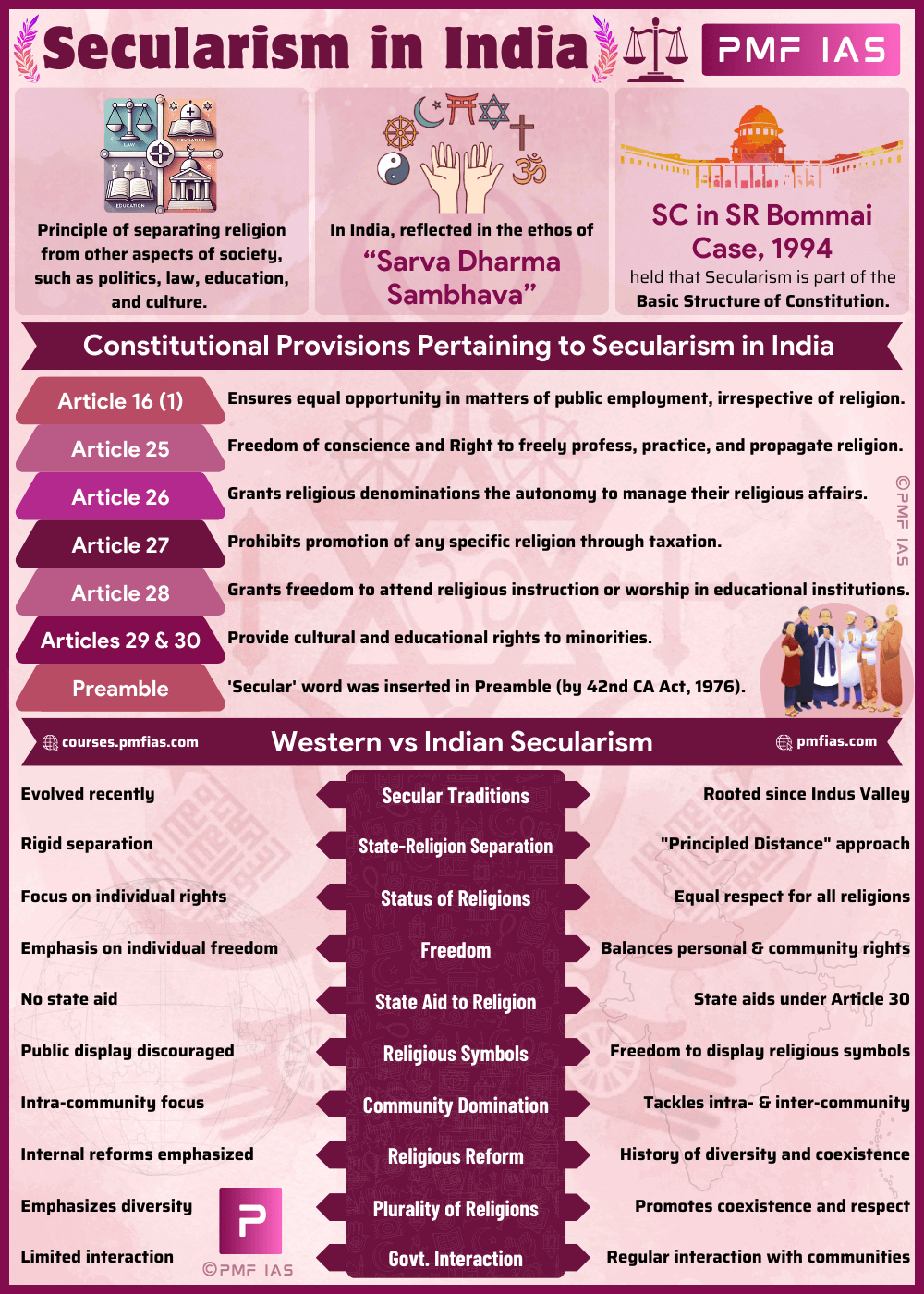
In our previous lesson, we established the unique architecture of Indian secularism—the model of "Principled Distance." We saw how, unlike the rigid "wall of separation" in the West, the Indian state reserves the right to intervene in religious affairs to uphold constitutional values like equality and justice. This flexibility is its defining feature, but as we concluded, it is also its greatest point of contention.
Today, we will analyze the powerful critique that this principle of intervention has been applied inconsistently. This lesson directly addresses the heart of the debate over secularism in India: the charge that the state has treated different religious communities differently, particularly in the sensitive domain of personal laws. This critique is not merely academic; it has fueled decades of political conflict and given rise to the potent accusation of "pseudo-secularism."
The Theory of Principled Distance vs. The Practice of Selective Intervention
The theoretical promise of "Principled Distance" is that the state can act as a reformer, stepping in to correct social evils that hide behind religious sanction. A prime example of this was the passage of the Hindu Code Bills in the 1950s. Pushed forward by Nehru's government against significant opposition from conservative Hindu groups, these laws reformed Hindu personal law on matters of marriage, divorce, succession, and adoption, significantly expanding the rights of Hindu women. This was a clear instance of the state prioritizing the constitutional value of gender equality over religious tradition within the majority community.
The critique of inconsistent application arises when this reformist zeal appears to halt at the boundaries of minority communities. The central argument is that while the state was willing to reform Hindu personal law, it has historically been reluctant to touch the personal laws of minorities, particularly Muslim personal law. This differential treatment forms the basis of the charge that Indian secularism has not been applied neutrally.
The following short video provides a concise overview of this criticism.
Secularism in India. Secular Indian state. (Rajeev Bhargava VS Sumantra Bose & Tariq Modood)
This video from the channel Religiolog summarizes the core arguments against the Indian model of secularism.
Please watch the segments from 01:38 to 02:14 and 04:51 to 05:55. The speaker explains how allowing separate personal laws is seen by critics as a violation of equality and an example of the state's inconsistent approach—intervening in some areas (like caste) while permitting unequal rights in others (like divorce).
The Birth of "Pseudo-Secularism"
This perceived inconsistency gave rise to a powerful political charge, primarily from the Hindu right: "pseudo-secularism." This term argues that the secularism practiced by parties like the Indian National Congress was not genuine (i.e., treating all religions equally) but was a form of political opportunism.
According to this critique, the hands-off approach towards minority personal laws was not about protecting pluralism but about "appeasing" minorities for their votes—a practice often referred to as "vote-bank politics." The active reform of Hindu laws, when contrasted with the preservation of minority personal laws, was presented as evidence that the secular state was biased against the majority community while "pampering" minorities.
The following academic paper traces how this critique developed over time, especially during the tenures of Prime Ministers Indira Gandhi and Rajiv Gandhi, when secularism became less of a guiding philosophy and more of a strategic political tool.
Nehru to Modi: The evolution of secular thought in Indian ...
This paper provides a historical analysis of how Indian secularism became politicized, leading to the critiques we are discussing.
Please read the following sections to understand the context and substance of the "pseudo-secularism" charge: Start with the "Problem Statement," which lays out how secularism became a source of political conflict, and the introduction of terms like "pseudo-secularism." You can find this starting from the second paragraph of the paper. Then, read the section on Congress politics, which notes how secularism became associated with identity politics and electoral calculations. Continue to the section on the "Politicization of Secularism," which explains how it shifted from a moral guideline to a strategic tool. Finally, read the section on Rajiv Gandhi. This part is crucial as it details how his government's actions, particularly in the Shah Bano case, were seen as definitive proof of appeasement and gave immense credibility to the "pseudo-secularism" critique.
A Deeper Critique: The Structural Flaws of Personal Laws
While the "pseudo-secularism" debate is politically charged, there is a deeper, more analytical critique of the very existence of separate personal laws in a modern republic. The philosopher Martha Nussbaum provides a powerful framework for this analysis, focusing on the inherent conflict between personal laws and the constitutional guarantee of individual rights, especially for women.
Nussbaum argues that while personal laws may have been intended to protect minority identity, they create a system of "fragmented sovereignty" where the fundamental rights of a citizen, particularly a woman, depend on the community she is born into. This can effectively trap individuals within systems that deny them the equality guaranteed by the Constitution.
Her analysis moves the debate beyond political accusations of "appeasement" to fundamental questions of justice and equality.
Martha Nussbaum, "Personal Laws and Equality: The Case of India"
This transcript of a lecture by Martha Nussbaum offers a rigorous philosophical and feminist critique of India's personal law system. It will provide you with a robust analytical lens that goes beyond the political rhetoric.
Please read the following excerpts from the transcript: First, read Nussbaum's introduction, where she outlines the defense for personal laws as a form of religious accommodation but also hints at their "more sinister effects." Next, focus on the core of her argument, where she details her six objections. Pay close attention to her third point ("discrimination on grounds of religion") and her fifth point, where she draws a critical distinction between how the Constitution tackled caste discrimination (by abolishing it) and how it allowed gender discrimination to persist within personal laws. Finally, to add nuance, read the response from Rajmohan Gandhi. He gives a concrete example of how personal law creates differential treatment that doesn't fit the simple "minority appeasement" narrative: the Hindu Undivided Family (HUF) tax status, a legal provision that offers significant financial advantages primarily to Hindu males.
Nussbaum's and Gandhi's points together reveal a complex picture. The critique of inconsistent application is not just a political slogan. It points to a genuine structural problem in the Indian state's architecture. The state has intervened, but selectively. This has created legal and economic inequalities based on religion and gender, making citizens' rights contingent on their community identity. The HUF example further complicates the narrative, showing that the inconsistencies do not always favor minorities.
Conclusion
Today we have dissected the central critique leveled against Indian secularism: that its application has been inconsistent and politically motivated, particularly regarding personal laws.
Key Takeaways:
- The critique of inconsistent application stems from the state's willingness to reform Hindu personal law (e.g., the Hindu Code Bills) while being reluctant to intervene in the personal laws of minority communities.
- This differential treatment gave rise to the political charge of "pseudo-secularism," which accuses secular parties of "minority appeasement" for electoral gain.
- Beyond the political debate, a deeper philosophical critique (articulated by Martha Nussbaum) argues that the very system of personal laws is structurally flawed. It creates multiple legal standards for citizens and can trap individuals, especially women, in patriarchal systems that deny them their fundamental constitutional rights.
- The issue is more complex than simple "appeasement," as demonstrated by legal provisions like the Hindu Undivided Family (HUF), which create religion-based advantages for the majority community.
The tension between secular law, religious personal law, minority rights, and gender justice is one of the most enduring fault lines in Indian politics. No single event brought this conflict to a head more dramatically than the 1985 Shah Bano case. In our next lesson, we will perform a deep dive into this landmark case, examining the legal judgment, the political firestorm it ignited, and why it remains a defining moment in the battle for Indian secularism.