Welcome to the first lesson of our third module. In our previous discussions, we traced the BJP's strategic evolution from the coalition-dependent Vajpayee era to the majoritarian dominance under Narendra Modi. This shift in political power has not only changed how India is governed but has also intensified the debates around the core ideas that define the Indian republic. One of the most central and contested of these ideas is secularism.
Today, we will delve into the philosophical foundations of this debate. Our goal is to compare the original, Nehruvian concept of Indian secularism with the dominant Western model of church-state separation. Understanding this fundamental difference is not just an academic exercise; it is the key to deciphering many of the most contentious political arguments in India today, from debates on personal law to the very definition of national identity.
The Western Model: A "Wall of Separation"
When many people hear the word "secularism," they often think of the Western model, which advocates for a strict separation between religion and the state. This idea has deep historical roots in the European experience.
To get a clear overview of this concept, let's start with a short video.
Is Indian secularism the same as Western secularism?
This video from Vajiram and Ravi Official provides a concise explanation of the two dominant models of secularism.
Please watch the segment explaining the Western model, from 01:36 to 03:51. Pay close attention to the core idea of a "wall" that separates church and state and the historical reasons for its development in countries like the US and France.
As the video explains, this model is a direct response to centuries of religious wars and the oppressive power of state-mandated churches in Europe. Thinkers of the Enlightenment, such as John Locke and Thomas Jefferson, argued that the state's domain was civil life (law, order, property), while the soul was a private matter for the individual and their conscience.
This philosophy manifests in two primary forms:
- In the United States, the First Amendment's "Establishment Clause" prevents the government from establishing a national religion or favouring one over another.
- In France, the concept of laïcité goes further, actively seeking to remove religious symbols and influence from the public sphere to ensure the neutrality of the Republic.
The following article provides more detail on the historical and philosophical underpinnings of this model.
A comparative analysis of principled distance versus western strict ...
This article offers a clear analysis of the two secularism paradigms.
Please read the introductory section and the section titled "The Enlightenment Roots...". This will ground your understanding of the Western model in its specific historical context.
The core tenets of this "Strict Separation" model are straightforward: the state must be neutral by being non-involved. Religion is largely relegated to the private sphere, and the "wall of separation" is meant to protect the state from religious conflict and, just as importantly, to protect religion from state control.
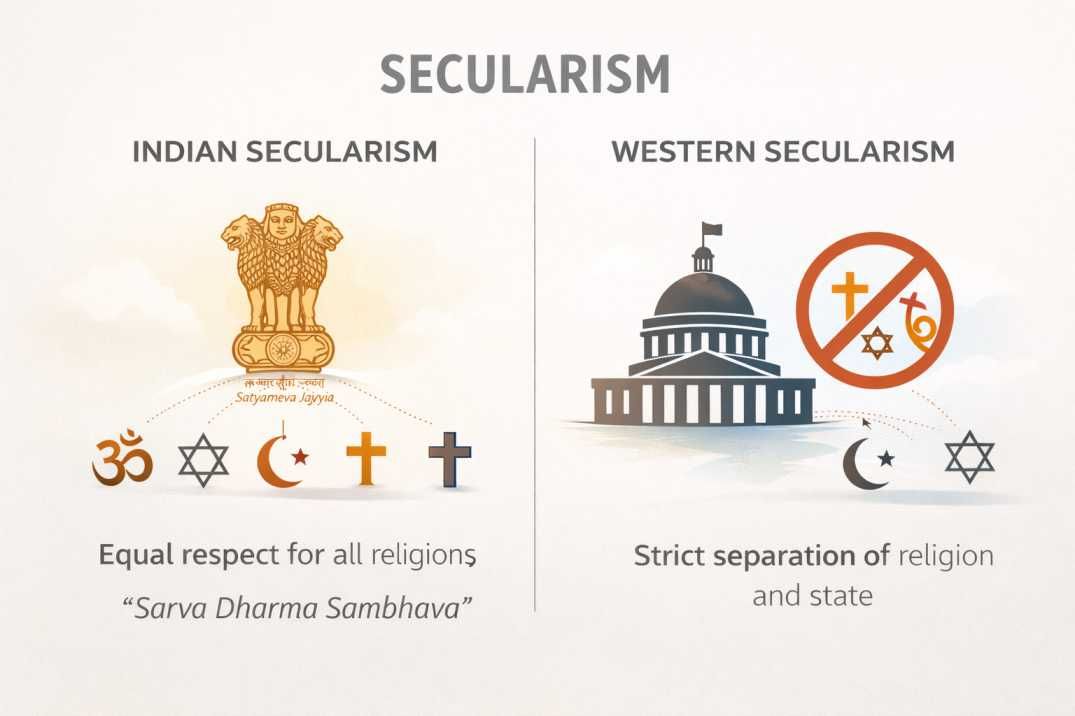
However, this model was built to solve a specific problem: the dominance of a single, powerful church. The question for India's founders was whether this model was suitable for a profoundly different social and religious landscape.
The Indian Model: Sarva Dharma Sambhava and "Principled Distance"
The architects of the Indian Constitution, led by Jawaharlal Nehru, recognized that India's reality was one of "deep diversity"—not just one or two religions, but a vast spectrum of faiths and practices deeply woven into the social fabric. A simple wall of separation seemed not only impractical but also potentially unjust.
Instead of strict separation, India adopted a unique model. Its philosophical soul can be captured by the ancient concept of Sarva Dharma Sambhava—equal respect for all religions. The state was not to be hostile to or equidistant from religion, but was to treat all faiths with equal honour.
The video we watched earlier explains why the Western model was deemed unsuitable for India.
Is Indian secularism the same as Western secularism?
Let's return to the same video to understand the rationale for India's distinct path.
Please watch the section from 10:04 to 11:21, which explains the historical, social, and demographic reasons why a strict separation model would not work in the Indian context.
The political theorist Rajeev Bhargava has given this unique Indian approach a modern name: "Principled Distance." This framework is more complex than simple separation. It implies that the state maintains a respectful distance from religions but reserves the right to engage with or intervene in them based on a set of universal principles, such as liberty, equality, and justice.
To truly understand this idea, we must go to its source: Nehru's own thinking. Nehru was not anti-religious, but he was profoundly opposed to the oppressive, hierarchical, and conflict-ridden aspects of organized religion. Bhargava captures this by distinguishing between two senses of religion:
- Religion A: The personal, spiritual quest for self-development and meaning. Nehru respected this as a fundamental human endeavor.
- Religion B: Institutionalized, power-laden religion, with its hierarchies, doctrines, and potential for conflict and domination. Nehru saw this as a threat to a modern, democratic society.
The following reading from Bhargava is dense but crucial for grasping this distinction.
[PDF] Nehru against Nehruvians | CSDS
This academic paper by Rajeev Bhargava provides a deep dive into Nehru's complex views on religion and the state.
Please read the section titled "On Religion and Plurality." Focus on how Bhargava explains Nehru's distinction between "Religion A" (the inner development of the individual) and "Religion B" (institutionalised, power-laden systems). This is the intellectual key to understanding the Indian model.
Because the Indian state must respect "Religion A" for all citizens, it cannot be anti-religious. But because it must combat the social evils often embedded in "Religion B"—such as caste discrimination or patriarchy—it cannot remain strictly separate. This leads to the core of "Principled Distance": the state can intervene in religious practices to uphold constitutional values.
This is why the Indian Constitution, for example, could simultaneously protect religious freedom (Article 25) and also abolish untouchability (Article 17), a practice that had religious sanction. This is also why the state can provide subsidies for pilgrimages while also passing laws to reform temple administration.

A Head-to-Head Comparison
Let's consolidate the key differences between the two models. The core distinction lies not in whether the state is secular, but how it achieves secularism.
| Feature | Western "Strict Separation" Model | Indian "Principled Distance" Model |
|---|---|---|
| State-Religion Link | A rigid "wall of separation." Mutual non-interference. | A "flexible boundary." The state can engage with and intervene in religion. |
| Concept of Neutrality | Passive: The state is neutral by staying out of religion. | Active: The state may intervene to ensure fairness between communities. |
| Public Sphere | Religion is relegated to the private sphere. | Religion is acknowledged and accommodated in the public sphere. |
| Goal of State Action | To protect the state from religion and religion from the state. | To protect individual rights and promote social justice, even from religion. |
| Handling of Diversity | Assumes individual religious choice in a homogenous public square. | Designed to manage "deep diversity" where identity is communal and public. |
To cement this comparison, let's return to the Bhargava text, where he explicitly contrasts the Nehruvian framework with its Western counterparts.
[PDF] Nehru against Nehruvians | CSDS
This reading will synthesize the entire lesson by directly comparing the models.
First, read the section "On Secular States and Secularism." This part details Nehru's vision for the state's role. Then, read the following section, "Nehru's Secular Framework," which directly contrasts his model with the French, American, and other European variants.
Conclusion
The debate over secularism in India is often clouded by the mistaken assumption that all secularism is the same. As we've seen today, the Western and Indian models are born of different histories and designed for different social realities.
Key Takeaways:
- Western Secularism is defined by a "wall of separation" between church and state. It is rooted in European history and aims for state neutrality through non-interference, largely privatizing religion.
- Indian Secularism, or "Principled Distance," is based on the philosophy of Sarva Dharma Sambhava (equal respect for all religions). It was designed for a context of deep religious diversity.
- The most crucial difference is that the Indian state can and does intervene in religious affairs. This intervention is not arbitrary but is meant to be "principled"—guided by the constitutional values of equality, liberty, and social justice.
This Indian model is, in theory, a sophisticated tool for balancing religious freedom with social reform. However, its flexibility is also its greatest vulnerability. The principle of "principled intervention" can be, and has been, accused of being applied inconsistently.
In our next lesson, we will explore this very critique. We will analyze the argument that Indian secularism has often devolved into "pseudo-secularism," a charge that gained enormous political traction through controversies like the Shah Bano case, a landmark event that we will examine in detail.