In our previous lesson, we examined how the Shah Bano controversy was politically framed, becoming the BJP's primary example for its "pseudo-secularism" charge against the Congress. We saw how a personal legal case escalated into a national political firestorm. Now, we will move from the political arena into the courtroom to understand the legal heart of the matter.
This lesson is dedicated to dissecting the landmark 1985 Supreme Court judgment itself. Our goal is to explain the precise facts and legal arguments that defined the verdict, focusing on the fundamental conflict it addressed: the clash between a uniform, secular criminal procedure and religious personal law. By the end, you'll have a firm grasp on the court's specific reasoning, which is essential to understanding why the subsequent political reaction was so intense.
The Collision of Laws: Section 125 vs. Personal Law
At the core of the Shah Bano case were two competing legal frameworks.
-
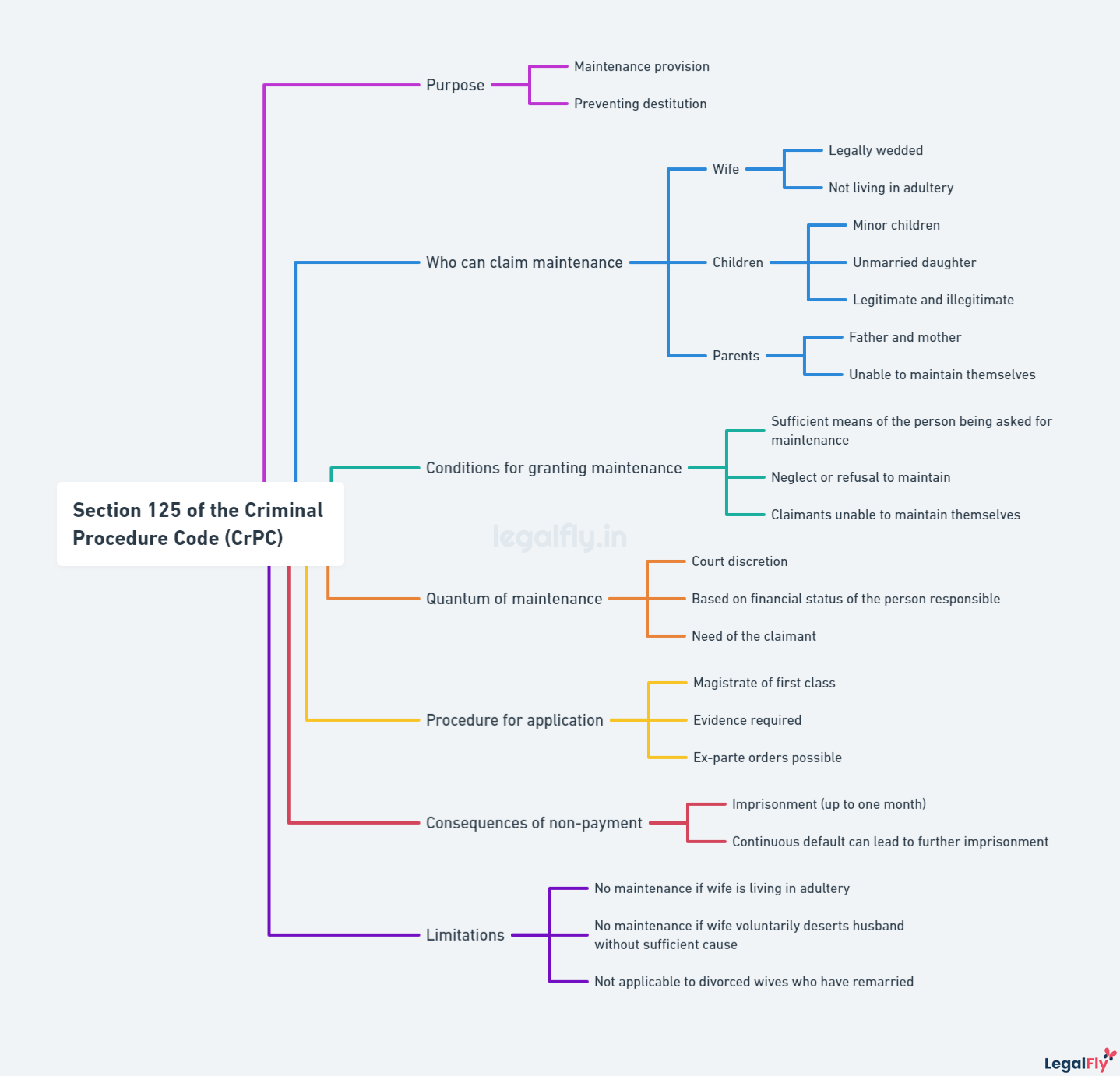
Section 125 of the Code of Criminal Procedure (CrPC), 1973: This is a secular provision designed as a social safety net. Its primary purpose is to prevent vagrancy and destitution by compelling individuals with sufficient means to provide maintenance for their dependent relatives, including a wife, children, and parents who are unable to maintain themselves. Crucially, the law's explanation of "wife" explicitly includes a divorced woman who has not remarried. It is applicable to all Indian citizens, regardless of their religion.
The mind map below gives a clear overview of the purpose, scope, and conditions of Section 125.
- Muslim Personal Law (Shariat): The traditional interpretation of Muslim personal law, as argued by Shah Bano's husband, holds a different view on post-divorce maintenance. The husband's obligation is primarily limited to:
- Providing maintenance during the iddat period (a waiting period of roughly three months after divorce).
- Returning the mehr or dower, which is a sum of money or property agreed upon at the time of marriage, payable to the wife.
The conflict arose when Shah Bano, a Muslim woman divorced under personal law, sought relief under the secular CrPC. Her husband, Mohd. Ahmed Khan, argued that he had fulfilled all his duties under his personal law and, therefore, the secular law could not impose any further obligations on him.
The Supreme Court's 1985 Judgment: A Judicial Deep Dive
After the case made its way through lower courts, a five-judge Constitution Bench of the Supreme Court delivered its verdict in April 1985. The judgment, authored by Chief Justice Y.V. Chandrachud, systematically dismantled the husband's arguments.
Let's begin with a video that outlines the journey of the case to the Supreme Court and the core elements of its final verdict.
Shah Bano Case: How One Woman’s Battle Rewrote Indian Law! | StudyIQ IAS English
This StudyIQ IAS video provides a concise summary of the case facts and the court's ruling.
Watch from the background of the case. Pay close attention to: Shah Bano's claim under Section 125 CrPC. Her ex-husband's defense based on the iddat period and mehr. The Supreme Court's conclusion that Section 125 is a secular provision applicable to all, and that maintenance can be claimed even after the iddat period.
The video provides an excellent overview. Now, we will examine the specific legal logic the Court employed by looking directly at excerpts from the judgment. This will allow you to see precisely how the court constructed its argument.
[PDF] Mohd. Ahmed Khan vs. Shah Bano Begum and Ors. (23.04.1985 - SC)
Reading these selected paragraphs from the original Supreme Court judgment will reveal the court's core legal reasoning.
Please read the following paragraphs from the judgment text: First, focus on paragraph 7, beginning "Under Section 125(1)(a)..." This section establishes the court's primary finding: Section 125 is secular. The court explains that the provision's purpose is to prevent destitution, making the religion of the parties "wholly irrelevant." Next, read paragraph 16, which starts with "These statements..." Here, the court addresses the apparent conflict between Section 125 and personal law. It ingeniously argues that there is no real conflict. It states that personal law does not contemplate a situation of a destitute divorced wife, and Section 125 simply provides a remedy for that specific situation. Then, examine paragraphs 17 through 25, starting with "There can be no greater authority..." In this remarkable section, the court reinforces its argument by citing the Quran. It quotes Aiyats (verses) 241 and 242 to argue that Islam itself imposes an obligation on husbands to provide for their divorced wives, directly countering the orthodox interpretation. Finally, read paragraphs 26 and 27, beginning with "The second plank..." This is the court's decisive rejection of the husband's claim that paying mehr (dower) absolves him of further duty. The court concludes that mehr is a consideration for the marriage, not a payment on divorce, and therefore does not satisfy the conditions of Section 127(3)(b) of the CrPC.
To consolidate your understanding of these complex legal points, let's turn to a more straightforward summary that explains the court's rationale.
Mohd. Ahmed Khan vs. Shah Bano Begum and Others (1985)
This analysis from the iPleaders blog breaks down the court's decision into its essential components.
Please read the section titled "Judgement of the case," focusing specifically on the sub-headings: "Ratio decidendi behind the judgement": This explains the legal principles the court relied on, such as the secular nature of Section 125, its social purpose, and the conclusion that it overrides personal law in case of conflict. "Observations made by the Supreme Court": This part details how the court interpreted the term "wife" to include divorced women of all religions and clarified that personal law does not prohibit maintenance beyond the iddat period.
As you can see from these readings, the Supreme Court's judgment was not a simple declaration but a meticulous deconstruction of the legal arguments. The court did not just impose a secular law over a religious one; it went to great lengths to argue that its decision was not only consistent with the secular constitution but also harmonious with a compassionate reading of Islamic scripture itself.

The court's key findings were:
- Section 125 CrPC is secular and applies to every citizen, including Muslim women.
- The obligation under Section 125 is absolute and is not affected by the personal law of the parties if a divorced wife is unable to maintain herself.
- There is no conflict between Section 125 and Muslim Personal Law, as the latter does not specifically address the issue of a destitute divorced wife. The court even found support for maintenance in the Quran.
- Mehr is not a payment "on divorce" but a mark of respect for the wife. Therefore, paying it does not excuse a husband from his maintenance obligations under secular law.
The judgment was widely seen by progressives and women's rights groups as a victory for gender justice and a step towards a more uniform application of law. However, by interpreting religious texts and prioritizing a secular code, it triggered the massive political backlash we discussed in the previous lesson.
Conclusion
In this lesson, we moved beyond the political slogans to analyze the intricate legal reasoning of the 1985 Shah Bano judgment. We dissected the core conflict between the secular mandate of Section 125 CrPC and the traditional interpretation of Muslim Personal Law regarding maintenance for divorced women.
Key Takeaways:
- The Supreme Court established the primacy of Section 125 CrPC as a secular law aimed at preventing destitution, applicable to all Indians regardless of faith.
- It resolved the conflict with personal law by arguing that Section 125 fills a void, providing a remedy where personal law is silent on the fate of an indigent divorced woman.
- The court bolstered its argument by citing Quranic verses that it interpreted as mandating fair provision for divorced wives.
- It definitively ruled that mehr (dower) is a consideration for marriage, not a settlement on divorce, and thus cannot be used to escape maintenance obligations under the CrPC.
This judgment was a masterclass in judicial interpretation, aimed at upholding social justice within the existing legal framework. However, its effect was not contained within the courtroom. In our next lesson, we will analyze the political motivations and calculations that led the Rajiv Gandhi government to pass the Muslim Women (Protection of Rights on Divorce) Act in 1986, a law designed specifically to overturn this landmark judgment.