Welcome back. In our previous lesson, we conducted a deep dive into the legal architecture of the 1985 Shah Bano judgment, appreciating how the Supreme Court meticulously upheld a secular law to ensure social justice for a destitute divorced woman. We saw how the court even cited the Quran to argue that its decision was harmonious with a compassionate reading of Islamic scripture.
Today, we shift our focus from the courtroom to the cabinet room. This lesson will analyze the complex political rationale that drove the Rajiv Gandhi government—armed with an unprecedented parliamentary majority of over 400 seats—to pass the Muslim Women (Protection of Rights on Divorce) Act in 1986, a law specifically designed to overturn the Supreme Court's landmark verdict. We will explore the intense political storm that erupted and the calculations that led the government to prioritize perceived political stability over a celebrated judicial pronouncement on gender rights.
The Backlash: From Judicial Victory to Political Crisis
The Supreme Court's judgment was initially celebrated by progressives, women's rights advocates, and even key members of the government as a victory for secularism and gender equality. Arif Mohammad Khan, a young and articulate minister in Rajiv Gandhi's government, famously delivered a powerful speech in Parliament defending the court's decision.
However, this view was not universally shared. The judgment triggered an immediate and ferocious backlash from conservative Muslim groups, led by the All India Muslim Personal Law Board (AIMPLB). They framed the verdict not as an issue of women's rights, but as a grave threat to their religious identity and an unacceptable encroachment by the judiciary into Muslim Personal Law (Shariat).
Shah Bano Case: How One Woman’s Battle Rewrote Indian Law! | StudyIQ IAS English
This video from StudyIQ IAS English explains the initial negative reaction to the judgment.
Watch the segment from the beginning of the backlash. Notice how the AIMPLB successfully framed the issue as an "encroachment" on minority rights and Muslim personal law, launching large-scale protests to pressure the government.
The slogan "Islam in danger" was mobilized, and the issue escalated from a legal debate into a full-blown political crisis. The pressure on the government was immense, with massive demonstrations across the country.
How SC order blunts Rajiv Gandhi’s '86 'ShahBano' Act denying Muslim women alimony under secular law
In this segment from ThePrint, veteran journalist Shekhar Gupta, who covered the story in 1986, recounts the scale of the protests.
Watch his description from the massive Muslim protests, where he mentions a rally of over half a million people in Bombay (now Mumbai), illustrating the intensity of the opposition the government faced.
The Electoral Panic: Politics Overrules Principle
For the Congress party under Rajiv Gandhi, this massive mobilization translated into a direct electoral threat. Having traditionally relied on the consolidated support of the Muslim community as a key part of its voter base, the party began to panic. This fear was not abstract; it was cemented by a significant electoral defeat.
In December 1985, the Congress party lost a crucial by-election in the Kishanganj constituency in Bihar, a traditional stronghold. The seat was won by Syed Shahabuddin, a prominent leader of the anti-judgment movement. This loss was interpreted by the Congress high command as a direct referendum on the Shah Bano issue and a sign that the Muslim vote was slipping away.
How SC order blunts Rajiv Gandhi’s '86 'ShahBano' Act denying Muslim women alimony under secular law
Shekhar Gupta's analysis directly links this electoral loss to the government's change of heart.
Watch the segment from the discussion on by-election losses. He explains how the panic set in after the Kishanganj defeat, which was seen as a direct result of the party's initial support for the Supreme Court judgment. This is the pivotal moment where political calculation began to eclipse legal principle.
The rationale shifted from upholding a court judgment to placating a significant vote bank. The priority became political survival and maintaining social coalitions, even at the cost of reversing a progressive legal reform.
[PDF] shah bano begum case - ijrpr
This academic paper provides a clear analysis of the government's political motivations.
Read the section titled "Political and Legislative Response". Focus on the paragraph that begins "The ruling government...". This passage concisely explains how the government, initially supportive of the judgment, buckled under pressure from religious groups and political opponents, deciding to legislate in an effort to "placate the aggrieved sections of the Muslim population and to maintain political stability."
A Divided Government and a Principled Resignation
The decision to overturn the judgment was not unanimous within the government. It created a deep rift inside the Congress party.
On one side were senior leaders like P.V. Narasimha Rao and N.D. Tiwari, along with prominent Muslim leaders like Najma Heptulla, who argued that the Congress could not afford to alienate the Muslim clergy and risk losing its minority vote bank. They pushed hard for a legislative reversal.
On the other side was a smaller, more liberal faction led by Arif Mohammad Khan. He argued passionately that capitulating to the orthodox clergy would be a betrayal of the Congress party's secular principles and a grave injustice to Muslim women.
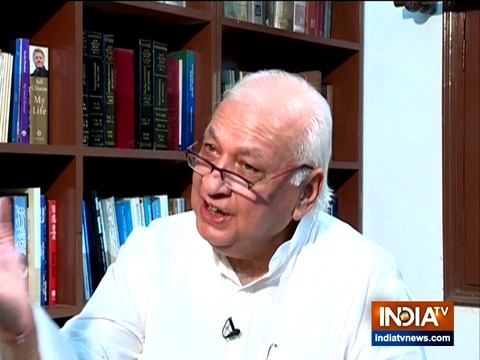
When the government finally decided to introduce the bill to overturn the judgment, Arif Mohammad Khan, in a dramatic and principled stand, resigned from his ministerial post.
'Rajiv was pressured by Narasimha Rao, Najma Heptulla during ...
In this interview with the Hindustan Times, Arif Mohammad Khan explains his decision to resign.
Read the section under the question "Why did you resign?". Focus on his statement, "After a 59-minute speech...". This captures the personal and ethical conflict at the heart of the political decision, highlighting the chasm between his public defense of the judgment and the government's subsequent actions.
The Legislative Reversal: The 1986 Act
The political pressure campaign and electoral panic culminated in the passage of the Muslim Women (Protection of Rights on Divorce) Act, 1986. The explicit purpose of this law was to nullify the Supreme Court's judgment.
The key provisions of the Act were:
- It restricted a divorced Muslim woman's right to claim maintenance from her ex-husband to the iddat period only (roughly three months post-divorce).
- After the iddat period, the responsibility for maintaining the woman was shifted to her own relatives (like her parents or brothers).
- If her relatives could not support her, the responsibility would fall to the state Waqf Board, a body that manages Muslim charitable endowments.
Effectively, the Act removed divorced Muslim women from the purview of the secular Section 125 of the CrPC, creating a separate legal framework for them and absolving the ex-husband of any long-term financial responsibility. This was a direct capitulation to the demands of the AIMPLB.

The 'Balancing Act': A Controversial Deal over Ayodhya?
The story doesn't end there. Many political analysts argue that the government, aware that passing the 1986 Act would be widely seen as "appeasement" of Muslim conservatives and would anger many Hindus, engaged in a political "balancing act."
In February 1986, just as the Muslim Women Bill was being debated, a local court in Faizabad ordered the unlocking of the gates of the disputed Babri Masjid in Ayodhya, allowing Hindus to worship inside. The state government, run by the Congress, did not oppose this, and the national broadcaster, Doordarshan, gave the event extensive coverage. This act is seen by many as a concession to Hindu sentiment to counteract the political fallout from the Shah Bano reversal.
Arif Mohammad Khan himself has publicly stated his belief that this was part of a "deal."
'Rajiv was pressured by Narasimha Rao, Najma Heptulla during ...
In the same interview, Khan elaborates on the connection between the Shah Bano case and the unlocking of the Ayodhya site.
Read his comments starting from "This backlash forced the government...". He argues that the Ayodhya move was a "handy ploy to divert the attention" and offset the political blowback from the Shah Bano legislation.
This alleged balancing act had monumental consequences, inadvertently pouring fuel on the nascent Ram Janmabhoomi movement and setting the stage for one of the most significant political conflicts in modern Indian history, which we will explore in detail in a later module.
Conclusion
In this lesson, we analyzed the political rationale behind the Rajiv Gandhi government's decision to overturn the Shah Bano judgment. We moved from the court's legal reasoning to the complex world of vote-bank politics, electoral fear, and communal pressures.
Key Takeaways:
- The government's decision was driven by electoral panic following intense backlash from conservative Muslim groups and a key by-election loss.
- The political rationale was to placate an aggrieved vote bank and maintain political stability, prioritizing this over the principles of gender justice and judicial supremacy.
- The decision caused a deep rift within the ruling party, leading to the principled resignation of minister Arif Mohammad Khan.
- The resulting Muslim Women Act of 1986 legislatively nullified the Supreme Court's verdict, creating a separate and less favorable maintenance law for divorced Muslim women.
- Many analysts view the subsequent unlocking of the Babri Masjid as a political "balancing act" to appease Hindu sentiment, a move with far-reaching consequences.
The Shah Bano controversy was far more than a legal case; it became a crucible where the competing demands of secular law, religious identity, gender justice, and electoral politics clashed. In our next and final lesson on this topic, we will evaluate why the Shah Bano case remains such a defining moment in India's political and legal landscape, and examine how the 1986 Act was itself challenged and reinterpreted by the judiciary in later years.