In our last two lessons, we explored the Shah Bano case from two critical angles: first, the Supreme Court's landmark 1985 judgment upholding a secular law for maintenance, and second, the political maelstrom that led the Rajiv Gandhi government to legislatively overturn that very judgment in 1986. We've seen the legal reasoning and the political calculations.
Now, we will synthesize this understanding to address a crucial question: Why does this one case, concerning one woman's fight for a meager maintenance sum, still echo so powerfully in India's political and legal landscape almost four decades later? This lesson moves beyond the historical facts to evaluate why the Shah Bano affair remains a defining moment—a crucible where the foundational ideas of Indian secularism, minority rights, and gender justice were tested and, in many ways, reshaped for generations to come.
A Defining Moment for India's Political Vocabulary
The Shah Bano case was not just a legal battle; it was a watershed moment that crystallized the political narratives that dominate India to this day. For the rising Hindu nationalist movement, the Congress government's reversal of the Supreme Court's verdict was the ultimate proof of what they termed "pseudo-secularism."
This charge, which you've encountered in our previous modules, posits that the secularism practiced by parties like the Congress was not a principled distance from all religions, but a system of "appeasement" toward minority communities for electoral gain. The 1986 Act became Exhibit A in this argument.
Nehru to Modi: The evolution of secular thought in Indian ...
This academic paper traces the evolution of secularism in Indian politics and places the Shah Bano case at a critical juncture.
First, read the subsection "Rajiv Gandhi: Contradictions and the Deepening Crisis of Secular Credibility" to see how the case is framed as a turning point. Next, read the subsection “Pseudo-Secularism” versus “Positive Secularism”. Pay attention to how the author explains the BJP's ideological argument, noting that Shah Bano was used as proof of this critique. Finally, in the "Key Findings" section, observe the conclusion that after Shah Bano and other events of that era, secularism lost its status as a unifying principle and became a contested electoral strategy.
The Shah Bano case, therefore, armed the BJP with a powerful and easily understood narrative that it used to mobilize its base and challenge the Congress's decades-long political dominance. The case transformed an abstract ideological debate into a tangible political issue with clear villains and victims in the public imagination.
A Crucible for Conflicting Rights
Beyond the political rhetoric, the case exposed deep, unresolved tensions within the Indian constitutional framework. It became a battlefield where fundamental, and seemingly contradictory, principles clashed head-on.
Truth Behind the Shah Bano Case!
This video provides a concise evaluation of the case's legacy, framing it in terms of the fault lines it exposed.
Watch the section from the narrator's evaluation, which clearly lists the "uncomfortable questions" the case raised.
As the video highlights, the Shah Bano affair forced the nation to confront several critical dilemmas:
- Gender Justice vs. Minority Rights: Should the fundamental rights of an individual citizen—in this case, a woman's right to a life of dignity (Article 21) and equality (Article 14)—be subordinated to the collective rights of a religious group to follow its personal laws (Article 25)?
- Judicial Power vs. Parliamentary Sovereignty: What is the proper balance between the Supreme Court's role as the guardian of the Constitution and Parliament's authority to make and unmake laws? The 1986 Act was a stark instance of the legislature using its brute majority to nullify a judicial verdict aimed at protecting fundamental rights.
- The Uniform Civil Code (UCC) Debate: The Supreme Court's judgment itself lamented the failure to implement Article 44 of the Constitution, which directs the state to establish a UCC. The controversy propelled this long-dormant constitutional provision into a live and highly polarized political issue, where it has remained ever since.
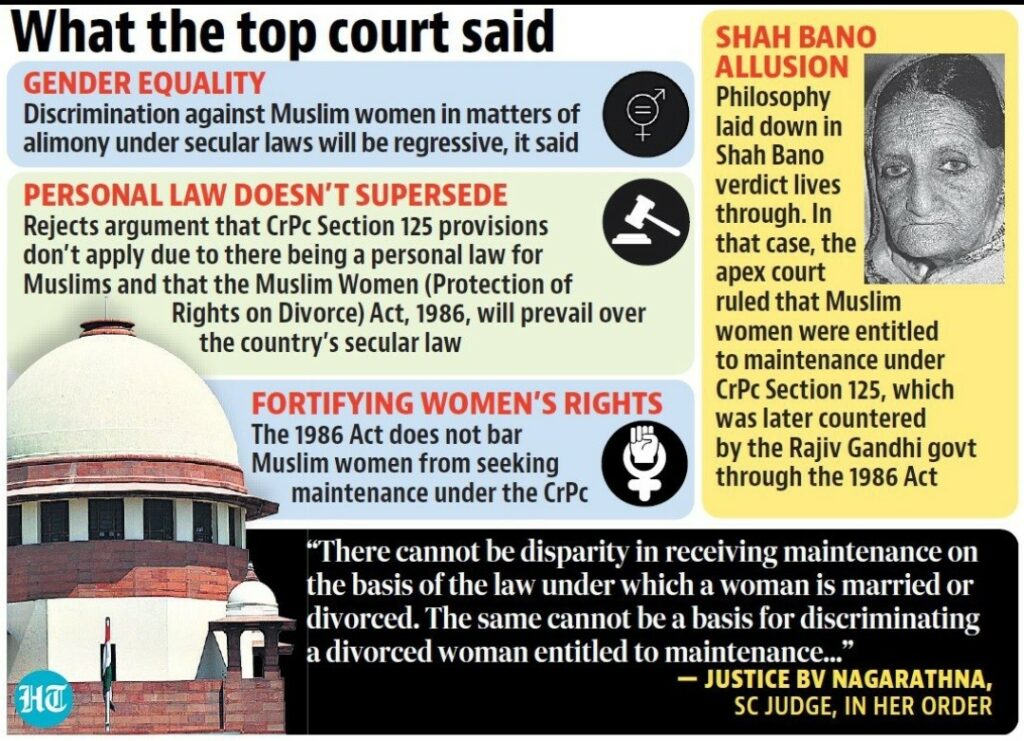
A Lesson in "Judicial Statecraft"
The political firestorm that followed the 1985 judgment has also led to decades of reflection within the legal community about judicial strategy. Some scholars argue that while the judgment's substance was progressive, its delivery lacked the sensitivity needed for such a volatile issue, a concept known as "judicial statecraft."
The critique suggests that the Court's tone and authorship may have inadvertently contributed to the backlash. For instance, the judgment was authored by a Hindu Chief Justice, Y.V. Chandrachud, who delved into an interpretation of the Quran. While legally permissible, this was perceived by conservative groups as an outsider encroaching on their sacred texts, making the verdict easier to delegitimize.
[PDF] Strong Courts: Judicial Statecraft in Aid of Constitutional Change
This fascinating academic article analyzes why the Shah Bano judgment failed to stick, contrasting it with other cases and introducing the idea of judicial statecraft.
First, quickly review the summary of the case and its legislative reversal in the section titled "India: Shah Bano". This will refresh your memory of the events. Start at the case summary. Next, focus on the analysis in subsection "c. Authorship". Note the critique that the court took a less sensitive approach by not including its sole Muslim judge on the bench and having a Hindu judge interpret the Quran. The author argues this approach turned out to be "fatally tone deaf." Finally, read the section "Shah Bano and Shayara Bano". This section contrasts the 1985 case with the 2017 Shayara Bano case, which banned instant triple talaq. Notice the differences in approach: the 2017 case was heard by a multi-faith bench, which engaged more civil society actors and adopted a more respectful tone. This different strategy resulted in Parliament ratifying the court's decision, not overturning it.
This comparison is vital. It shows that the legacy of Shah Bano includes a long-term institutional learning process. The judiciary, having seen its progressive judgment nullified by political force, has since often adopted more collaborative and sensitive approaches when dealing with issues of personal law, striving to bring about reform from within a community's legal framework rather than imposing it from the outside.
The Judicial Counter-Offensive: The Danial Latifi Case
The story did not end with the 1986 Act stripping divorced Muslim women of their rights under Section 125. In a remarkable display of judicial creativity, the Supreme Court revisited the issue in the 2001 case of Danial Latifi & Anr vs Union Of India.
The petitioners in Danial Latifi challenged the constitutionality of the 1986 Act itself. Instead of striking down the law—which would have created another major political confrontation—the Court chose to reinterpret it. The 1986 Act stipulated that a husband must make "a reasonable and fair provision and maintenance" to his ex-wife within the iddat period.
The Supreme Court ingeniously ruled that this "reasonable and fair provision" was not merely for the three-month iddat period, but a one-time payment that must be sufficient to sustain the woman for the rest of her life. In essence, the Court upheld the letter of the 1986 law but completely transformed its spirit, effectively restoring the financial protection that the original Shah Bano judgment had granted. This was judicial statecraft in action, achieving a just outcome without directly challenging Parliament's legislative power.
Conclusion
The Shah Bano case stands as a landmark in modern Indian history not because of the legal principle it established—which was quickly overturned—but because of the enduring fault lines it exposed and the political and judicial trajectories it set in motion.
Key Takeaways:
- Political Vocabulary: It provided the "pseudo-secularism" and "minority appeasement" narrative with its most potent example, fundamentally shaping the ideological battlefield of Indian politics.
- Conflicting Rights: It starkly highlighted the unresolved constitutional conflict between individual fundamental rights (gender justice) and collective religious rights (personal laws).
- Institutional Tension: It serves as the classic case study for the tension between judicial review and parliamentary supremacy, prompting a long-term evolution in judicial strategy.
- The UCC Debate: It single-handedly revived the debate on a Uniform Civil Code, transforming it from a dormant constitutional directive into a persistent and polarized political demand.
- Unintended Consequences: The political effort to "balance" the fallout from the case by unlocking the Babri Masjid had catastrophic consequences, fueling the Ram Janmabhoomi movement and deepening communal divides.
The case was a mirror held up to Indian democracy, and the complex, often fractured, reflection it revealed continues to define the nation's political discourse.
In our next module, we will explore other contemporary flashpoints where these same tensions play out. We'll begin by examining the Citizenship Amendment Act (CAA) and dive deeper into the arguments for and against the Uniform Civil Code, both of which are direct descendants of the debates ignited by Shah Bano.