Welcome back. In our previous lesson, we traced the origins of the BJP, from its predecessor the Bharatiya Jana Sangh, through the Janata Party experiment, to its formation in 1980. We noted that the party's initial "Gandhian socialist" platform was a strategic attempt at moderation. However, the political landscape of the late 1980s and early 1990s would provide the catalyst for a sharp, decisive turn towards a more assertive Hindutva politics.
This lesson focuses on one of the most tragic and politically potent events of that era: the 1990 exodus of Kashmiri Pandits. Your specific interest in this topic during our initial conversation highlighted its importance in understanding contemporary Indian politics. Our goal here is twofold. First, we will establish the historical context and the series of events that led to the mass displacement of the Pandit community. Second, and more critically for this course, we will analyze how this profound human tragedy was framed and integrated into a national narrative of Hindu victimhood, becoming a powerful engine for political mobilization that continues to resonate today.
The Valley on the Brink: Context for the Exodus
To understand the events of 1990, we must first look at the preceding years in Jammu and Kashmir. The 1980s were a period of escalating political instability and growing radicalization.
The following video by Nitish Rajput provides a detailed account of the political machinations and the rise of separatism that set the stage for the conflict.
This video breaks down the complex political developments in Jammu & Kashmir during the 1980s.
Watch these two key segments to understand the political context: Political Instability (02:18-05:27): This part explains the power struggles involving Farooq Abdullah, Ghulam Mohammad Shah, and the central government's interventions, which created a political vacuum and fueled resentment. The Religious Turn (08:44-10:16): Pay close attention to how the movement began to shift from a political, pro-independence stance to a religiously charged, Islamist one. The video notes how "anti-India sentiments were converted into anti-Hindu sentiments," a crucial transformation for the events that followed.
As the video explains, a key turning point was the widely alleged rigging of the 1987 state assembly elections. This event disillusioned a vast number of Kashmiris, pushing many young men away from democratic politics and towards militancy. Pakistan's intelligence agency, the ISI, saw an opportunity. Fresh from aiding the Afghan Mujahideen against the Soviets, it began to replicate the model, providing funds, training, and arms to militant groups in Kashmir like the Jammu and Kashmir Liberation Front (JKLF) and the more radical, pro-Pakistan Hizbul Mujahideen.
A Campaign of Terror and the Night of January 19th
The growing insurgency quickly took on a sinister, communal character. Militants began a systematic campaign of targeting prominent members of the Kashmiri Pandit community. This was not random violence; it was a deliberate strategy to decapitate the community's leadership and instill widespread fear.
India's Most Chilling Historical Event: The Kashmir Exodus
The channel "A Day In History" details the specific, targeted nature of the violence against the Pandit community in 1989.
Watch the segment from 05:16 to 06:58. It chronicles the assassinations of figures like lawyer Tika Lal Taploo and retired judge Nila Kanth Ganjoo. Note the explicit threats published in newspapers, which called for non-Muslims to leave the valley, making the militants' intentions clear.
This campaign of terror culminated in the winter of 1989-1990. The kidnapping of Rubaiya Sayeed, the daughter of the Union Home Minister, and the government's subsequent capitulation to the militants' demand to release their comrades, emboldened the extremist groups immensely. An atmosphere of impunity and fear gripped the valley.
The situation reached its horrifying climax on the night of January 19, 1990. With the state government having resigned and the new Governor, Jagmohan, yet to take full control, a security vacuum existed.
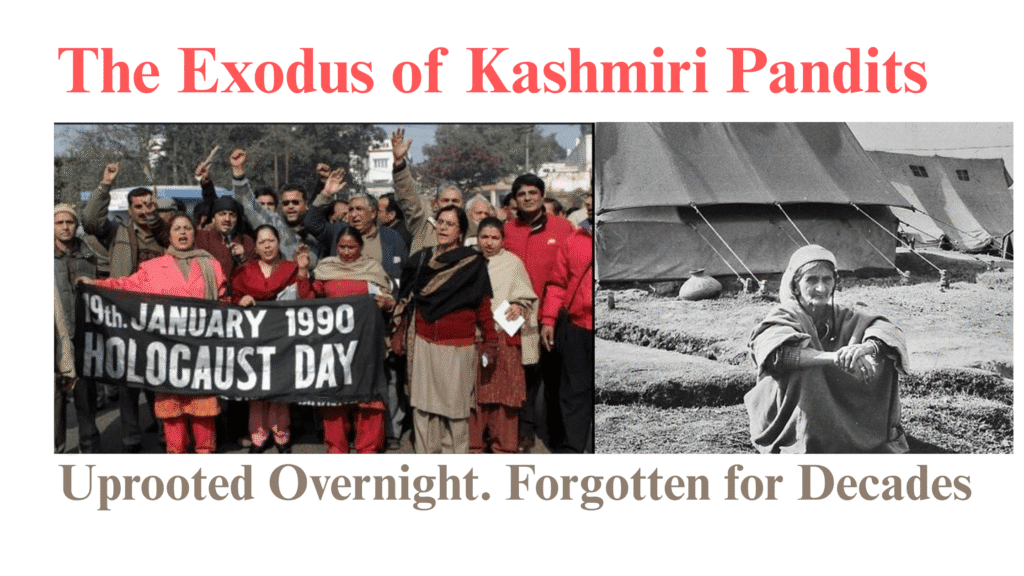
Throughout that night, mosques across the valley reportedly broadcast incendiary messages, demanding that Pandits leave Kashmir. Slogans of "Raliv, Galiv ya Chaliv" ("Convert, Die or Flee") echoed through the streets. Masked men roamed freely, and the Pandit community, a tiny minority, felt completely abandoned and terrified.
The following video describes the chilling events of that night and the immediate aftermath.
Returning to the Nitish Rajput video, this section focuses on the specific events that triggered the mass exodus.
Watch the segment from 12:05 to 15:03. It details the public threats, the hit lists, the chaos of January 19th, and the heart-wrenching decision faced by hundreds of thousands of Pandits to flee their ancestral homes, often with little more than the clothes on their backs.
In the days and weeks that followed, a vast majority of the Kashmiri Pandit population fled the valley, becoming refugees in their own country.
Crafting the Narrative: From Tragedy to Political Weapon
The exodus was an undeniable human tragedy. However, its political significance lies in how it was subsequently framed and utilized. The Hindu nationalist movement, which the BJP represented politically, saw the exodus not as a complex issue of failed governance and regional insurgency, but as a straightforward and powerful symbol.
The following article from the Pulitzer Center provides a critical analysis of how the exodus narrative was constructed.
To Understand India, Listen to the Pandits of Kashmir - Pulitzer Center
This article explains how the complex political context was flattened into a simple communal narrative.
Please read the introduction to this article. Focus on how the author argues that the exodus played a pivotal role in framing the Kashmir conflict as purely communal. The author states the event was massively exploited as proof of a grand Islamist conspiracy against Hindus.
This framing was incredibly effective. It achieved several political goals simultaneously:
- It Validated the "Hindu Victimhood" Narrative: The exodus became the Exhibit A for the argument that Hindus were persecuted and in danger ("Hindu khatre mein hai") even in India, their supposed homeland. It transformed a theoretical fear into a visceral, contemporary reality.
- It Simplified a Complex Conflict: By presenting the issue as a simple case of Muslim aggression against Hindus, it obscured the complex political history of Kashmir, including the state's role in creating alienation and the diverse nature of Kashmiri aspirations.
- It Fueled Political Mobilization: The story of the Pandits became a powerful rallying cry. It was used in speeches, pamphlets, and articles to evoke anger and a sense of grievance, consolidating a Hindu votebank that felt its identity and safety were under siege.

Modern Echoes: The Kashmir Files
This narrative is not just a relic of the 1990s. It remains a cornerstone of political discourse today, most powerfully illustrated by the 2022 blockbuster film, The Kashmir Files. The film, endorsed by the highest levels of the Indian government, presented a version of the exodus that was criticized by many historians and journalists for its inaccuracies and for promoting a starkly Islamophobic agenda.
This academic paper offers a sharp critique of the film as a work of propaganda.
[PDF] The Exodus of Kashmiri Pandits from the Valley of Kashmir - IJFMR
This paper analyzes The Kashmir Files as a political tool that weaponizes the Pandit tragedy.
Please read the following sections: The Abstract: Note how the author argues the film is an insidious instrument that constructs a "half-truth" to rouse grudge against Muslims. The section on Propaganda: This part explicitly states that the "political mobilization of the Kashmiri Pandit families... is over-simplified in order to further India’s political agenda" and that the film plays the card of Hindu Victimization. The Conclusion: The paper concludes that the film's purpose is not to seek justice, but rather to show "whom to hate," solidifying its role in political mobilization.
The success and controversy surrounding The Kashmir Files demonstrate the enduring power of the exodus narrative. It shows how a historical trauma, when filtered through a specific ideological lens, can be continuously reactivated to serve present-day political objectives. For the Pandits themselves, however, many feel their tragedy has been politically exploited while their core demands for justice and rehabilitation remain unfulfilled, a sentiment expressed in both the videos and articles you've reviewed.
Conclusion
In this lesson, we have examined the tragic 1990 exodus of the Kashmiri Pandits and its instrumentalization in Indian politics. This was not just another event in the long-running Kashmir conflict; it was a watershed moment that fundamentally reshaped the narrative of Hindu nationalism.
Key Takeaways:
- The 1990 exodus occurred in a context of severe political instability, rigged elections, and a Pakistan-backed Islamist insurgency that systematically targeted the Kashmiri Pandit minority.
- The events of January 19, 1990, marked a turning point, creating an atmosphere of terror that led to the mass flight of the Pandit community from the Kashmir Valley.
- This human tragedy was strategically framed by Hindutva movements as a clear-cut case of religious persecution, serving as powerful evidence for the narrative of "Hindu victimhood."
- This narrative was used to delegitimize Kashmiri political aspirations, justify hardline security policies, and, most importantly, mobilize a consolidated Hindu vote bank by creating a shared sense of grievance and fear.
- Contemporary media, like the film The Kashmir Files, demonstrates the continued use of this potent narrative to fuel political polarization.
The story of the Pandits provided the BJP with a powerful emotional and ideological weapon as it moved away from the moderate "Gandhian socialism" of its early years. In our next lesson, we will explore the other, even larger, pillar of this mobilization strategy: the Ram Janmabhoomi movement and L.K. Advani's Rath Yatra, which took the politics of religious identity to an unprecedented national scale.