Welcome back. In our previous lesson, we analyzed how the tragic exodus of the Kashmiri Pandits was framed as a narrative of Hindu victimhood and used as a potent tool for political mobilization. This provided the Hindutva movement with a powerful, contemporary example of its core argument: that Hindus were under threat even in their own country.
Building on this, we now turn to the largest and most consequential act of mass mobilization in modern Indian history: L.K. Advani's 1990 Rath Yatra and the broader Ram Mandir campaign. While the Kashmiri Pandit exodus provided an emotional touchstone, the Ayodhya movement was a deliberate, nationwide political project designed to unite a fragmented Hindu polity under a single, powerful symbol. In this lesson, we will analyze the Rath Yatra not just as a journey, but as a turning point that fundamentally changed the grammar of Indian politics, shifting its focus towards religious identity and street-level mobilization.
The Political Chessboard: Mandal vs. Mandir
To understand the strategic brilliance and timing of the Rath Yatra, we must first look at the political landscape of 1990. The National Front government, led by Prime Minister V.P. Singh and supported from the outside by both the BJP and the Left parties, made a historic decision: it announced its intention to implement the recommendations of the Mandal Commission. This would reserve 27% of government jobs for Other Backward Classes (OBCs).
This move, known as the "Mandal" decision, triggered widespread protests and threatened to deeply divide Hindu society along caste lines. For the BJP, this was a significant political challenge. Its goal was to build a consolidated pan-Hindu identity, but Mandal politics was highlighting the internal fissures and competing interests within that very identity. The party needed a powerful, emotional counter-narrative that could transcend caste divisions. The answer was "Mandir" (Temple).
The following video from India Today explains how the BJP officially adopted the Ram Janmabhoomi cause and positioned it as a direct response to Mandal politics.
BJP And The Rise Of Hindutva: In-depth Review Of The Ram Janambhoomi Movement
This documentary segment details the political context of the late 1980s and the strategic launch of the Rath Yatra.
Watch the initial part of the video, focusing on these two points: The Palampur Resolution (00:22-01:05): This section shows how the BJP, at its 1989 Palampur executive meeting, formally adopted the Ram Temple as a political goal. A Foil for Mandal (01:30-02:08): Pay close attention to the narration which explicitly frames the Rath Yatra as a "perfect foil for the Mandal agitation," designed to counter its divisive impact with the unifying politics of Hindutva.
The stage was thus set for a monumental political confrontation: Mandal, which sought to mobilize voters on the basis of caste identity and social justice, versus Mandir, which aimed to consolidate them under a single religious and cultural identity.
The Anatomy of a Mass Movement
L.K. Advani's Rath Yatra, launched on September 25, 1990, was not a conventional political tour. It was a meticulously crafted piece of political theatre, designed to blur the lines between politics, religion, and mythology.
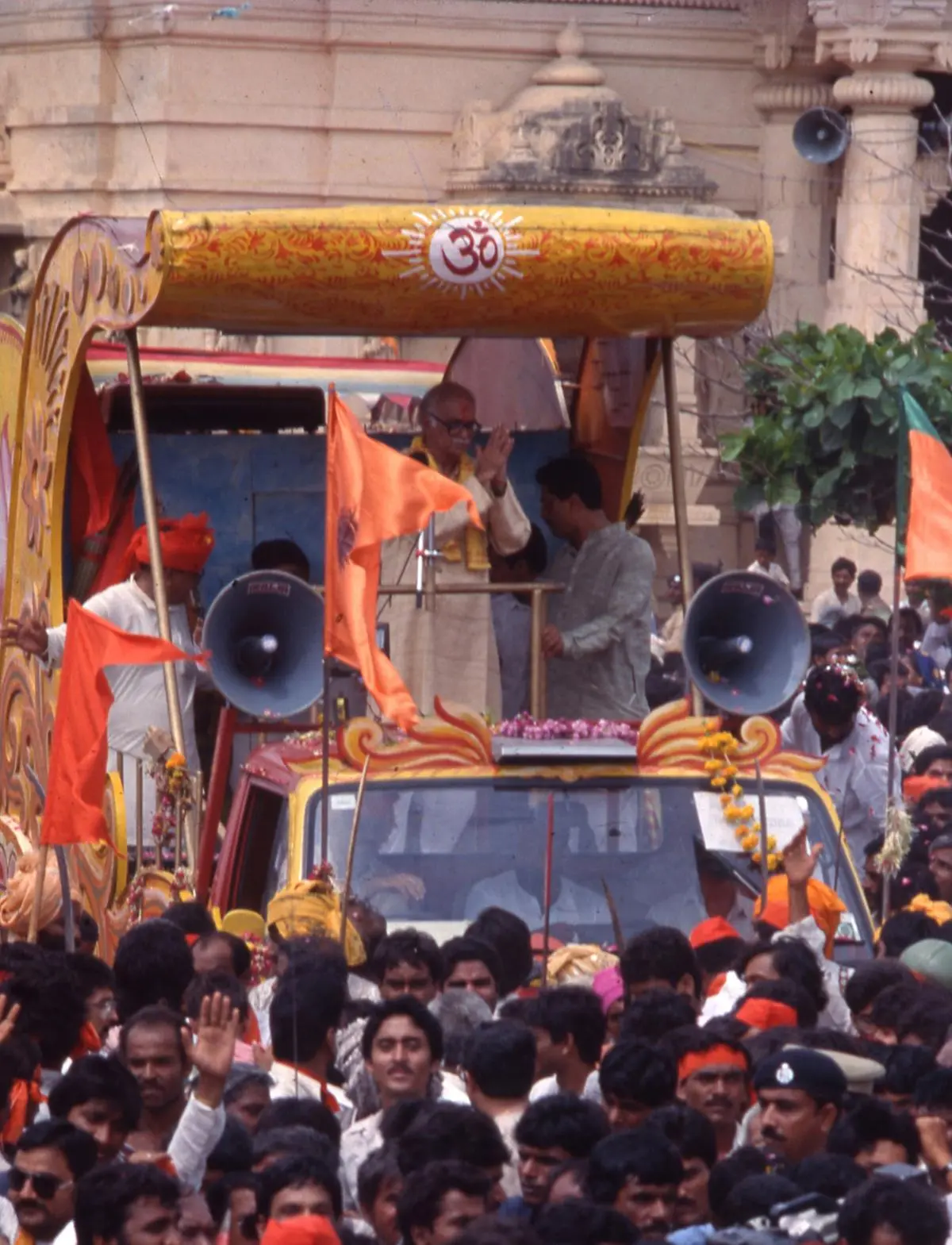
Every element was saturated with symbolism:
- The Rath: The vehicle itself was a modified Toyota minibus, but it was designed to look like a mythical chariot (rath). This deliberately blended the ancient with the modern, transforming a political journey into a pilgrimage.
- The Route: The yatra started from the Somnath temple in Gujarat and was planned to culminate in Ayodhya, Uttar Pradesh. This was no arbitrary choice. The Somnath temple, famously rebuilt after Independence following historical desecrations, was a powerful symbol of Hindu revival. By linking Somnath's "reconstruction" to Ayodhya's "liberation," the BJP framed its campaign as the completion of a historical-civilizational mission.
- The Rituals: Along the route, Advani was greeted with religious ceremonies. People offered coconuts, applied tilaks, and brought pots of holy water. This transformed a political leader into a revered figure leading a sacred quest.
The following article provides a detailed analysis of the yatra's design and its unprecedented impact.
The 1990 Rath Yatra: How Advani's Ayodhya march turned a ...
This Moneycontrol article breaks down how the yatra was conceived and executed, turning a niche political issue into a nationwide phenomenon.
Read the first few sections of the article, focusing on: The introduction: Note how it states the yatra stitched together disparate efforts into a single, powerful street mobilization. The symbolic route: Pay attention to the section Origins: From Somnath to Ayodhya, which explains the strategic significance of the start and end points. The nature of the crowds: Read about how the yatra became a "travelling spectacle," creating a feedback loop of media attention and swelling crowds that went far beyond formal party workers.
As the article highlights, the Rath Yatra was a turning point because it moved the Ayodhya dispute from closed-door negotiations into the public square. It was, as the academic paper "Reconfiguring Indian Democracy" notes, a prime example of how "ritualized movement and mythic imagery could be integrated into modern democratic mobilization strategies."

From Mobilization to Confrontation
The yatra was immensely successful in mobilizing support, but it also left a trail of communal tension and violence. As the chariot moved through states, the charged atmosphere often erupted into clashes.
The journey reached its dramatic climax in Bihar. The state's Chief Minister, Lalu Prasad Yadav, had positioned himself as a staunch opponent of the yatra. On October 23, 1990, he ordered the arrest of L.K. Advani in the town of Samastipur.
Advani's arrest was the spark that lit the fuse.
- Fall of the Government: In response, the BJP immediately withdrew its support for the V.P. Singh government at the Centre. Lacking the BJP's 85 MPs, the government lost a no-confidence vote and collapsed.
- The Call for Kar Seva: The VHP and other Sangh affiliates called on volunteers (kar sevaks) to defy the government and converge on Ayodhya on October 30.
- Violence in Ayodhya: The Chief Minister of Uttar Pradesh, Mulayam Singh Yadav, sealed Ayodhya to prevent the kar sevaks from reaching the Babri Masjid. In the ensuing clashes, police opened fire on the activists, leading to several deaths. These deaths created "martyrs" for the cause and deepened the sense of grievance among its supporters.
This entire sequence—the arrest, the fall of the government, and the violence in Ayodhya—is covered in detail in the India Today documentary.
BJP And The Rise Of Hindutva: In-depth Review Of The Ram Janambhoomi Movement
This segment of the documentary provides a chronological account of the yatra's dramatic halt and its violent aftermath.
Watch the section from 03:32 to 08:38. It covers Advani's arrest in Samastipur, the BJP's withdrawal of support, and the violent confrontation between kar sevaks and the police in Ayodhya on October 30 and November 2, 1990.
Analysis: Why Was the Yatra a Turning Point?
The Rath Yatra was more than just a successful campaign; it fundamentally reconfigured Indian politics. It represented a paradigm shift in political mobilization.
- It established the primacy of identity politics: The yatra demonstrated that an emotional appeal to religious identity could be a more powerful mobilizing force than economic promises or caste-based calculations. It successfully created a consolidated Hindu votebank that helped the BJP's parliamentary tally grow from just 2 seats in 1984 to 85 in 1989 and 120 in 1991.
- It shifted the arena of politics: The yatra took politics out of the hands of elites and into the streets. It showed that a mass movement, fueled by emotion and symbolism, could challenge and even bring down a national government. As one analyst put it, Advani transformed the BJP from a "cautious parliamentary party into a mass mobilization movement."
- It set the national agenda: After 1990, the Ram Mandir was no longer a fringe issue. It became the central, defining fault line in Indian politics, forcing every party to take a stand.
- It laid the groundwork for 1992: The yatra created what the Liberhan Commission later called a "mass consciousness" and built the organizational muscle that made the mass mobilization for the December 1992 demolition of the Babri Masjid possible.
The following short video powerfully summarizes how Advani's strategy transformed the BJP and Indian politics.
From Rath Yatra to Modi Era: How Advani Changed Indian Politics
This video offers a concise analysis of Advani's strategic shift towards mass mobilization.
Watch the key segment from 02:25 to 03:39. It explains how Advani understood that "mobilization works, emotion works, and identity also works," and used the Rath Yatra to turn the BJP into a "cultural and emotional movement."
Conclusion
L.K. Advani's Rath Yatra was a masterclass in political engineering. It took a long-standing, localized religious dispute and, through the masterful use of symbolism, spectacle, and media, transformed it into a national movement that redrew India's political map. It successfully countered the caste-based politics of the Mandal Commission by forging a powerful, overarching Hindu identity.
Key Takeaways:
- The Rath Yatra was strategically timed to counter the caste-based divisions of Mandal politics with the unifying call of the Ram Mandir.
- The campaign's design, using a 'Rath' and a route laden with religious symbolism, brilliantly fused political goals with the emotions of a pilgrimage.
- It proved to be a new and powerful model of mass mobilization that relied on identity, emotion, and spectacle, drawing in vast numbers of people outside formal party structures.
- The political consequences were immediate and immense: the yatra directly led to the collapse of the central government and set the stage for violent confrontations in Ayodhya.
- Most importantly, the yatra marked a definitive turning point, establishing religious identity as a central axis of Indian politics and paving the way for the BJP's rise from a marginal party to a dominant national force.
The yatra brought the Ayodhya dispute to a boiling point and made the construction of a temple a non-negotiable demand for millions. In our next lesson, we will step back from the politics of mobilization to examine the core of the issue itself: the contested historical and legal claims in the Ram Janmabhoomi-Babri Masjid dispute.