Welcome back. In our previous lesson, we analyzed L.K. Advani's 1990 Rath Yatra, a pivotal moment of political engineering that transformed the Ayodhya dispute into a nationwide mass movement. That campaign brought the issue to a boiling point, placing immense pressure on the political and judicial systems. Now, we will step back from the high-voltage politics of mobilization to dissect the very heart of the conflict: the complex and deeply contested historical and legal claims that underpinned the Ram Janmabhoomi-Babri Masjid dispute for over a century.
This lesson unpacks the arguments presented by both Hindu and Muslim litigants in the long legal battle over the 2.77-acre site in Ayodhya. We will move beyond the headlines to examine the evidence—from ancient scriptures and colonial-era travelogues to archaeological reports and legal doctrines—and understand how the Indian judiciary, culminating in the Supreme Court's 2019 verdict, navigated this labyrinth of faith, history, and law.
The Disputed Site: An Overview
At the center of the dispute is a specific plot of land in Ayodhya. Before its demolition in 1992, this site housed a three-domed structure known as the Babri Masjid. The area was physically partitioned, a distinction that became critical in the legal proceedings.

The conflict stems from two fundamentally opposing narratives about the site's history:
- The Hindu Claim: The site is the
Janmabhoomi, the exact birthplace of Lord Ram. A grand temple, first built by Ram's son Kush and later rebuilt by King Vikramaditya, existed there. This temple was allegedly demolished in 1528 on the orders of the Mughal emperor Babur, and the Babri Masjid was built in its place using its rubble. - The Muslim Claim: The Babri Masjid was built by Babur's commander, Mir Baqi, in 1528 on vacant or non-religious land. It served as a mosque for continuous public worship by the Muslim community for over 460 years until it was desecrated in 1949.
The timeline below gives a snapshot of the key milestones in this long and contentious history.
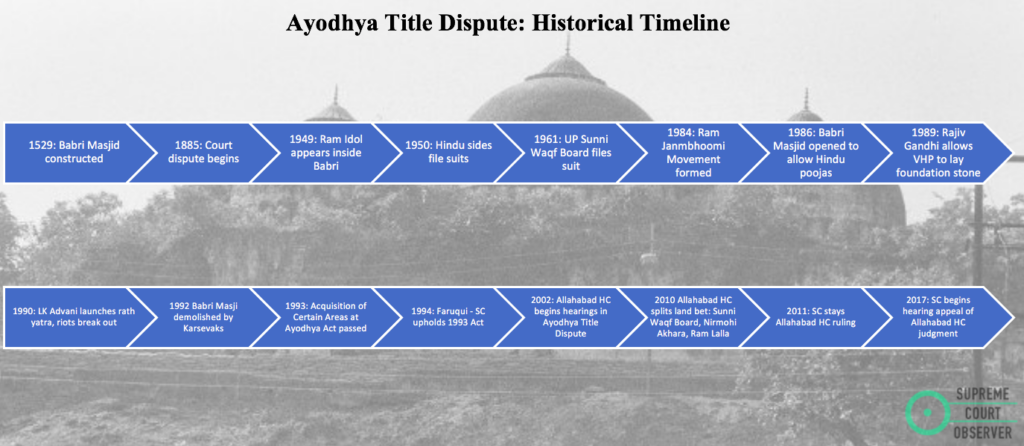
Tracing the Legal Battle
While the conflict has medieval origins, the legal battle began in the colonial era and intensified significantly after India's independence.
The video below provides a clear chronological account of how the dispute evolved from a local issue into a multi-party legal war.
This video from Nitish Rajput provides a narrative history of the legal and social conflicts at the site, starting from the British era.
Please watch the following segments to understand the genesis of the modern legal dispute: Early Conflicts (10:03-12:19): This part covers the first recorded conflicts in the 1850s, the British partition of the site, and the first lawsuit in 1885 by Mahant Raghuvar Das to build a temple on the Ram Chabutra. The 1949 Flashpoint (13:13-15:49): This is a crucial section detailing the installation of the Ram Lalla idol inside the central dome of the mosque in December 1949, the government's response, and the locking of the premises. The Main Lawsuits (15:50-16:59): This section explains how the initial lawsuits were filed by various Hindu parties (like Gopal Singh Visharad and Nirmohi Akhara) and the Sunni Waqf Board, setting the stage for the decades-long court battle.
As the video explains, the 1949 installation of the idol was a pivotal moment. It effectively stopped Muslim worship at the site and transformed the dispute into a formal legal case centered on property rights. Several parties filed suits, but the main contenders who fought the case to its conclusion in the Supreme Court were:
- Nirmohi Akhara (Suit of 1959): A Hindu monastic order, they did not claim ownership but sought
shebaitirights—the legal right to manage the temple and serve the deity. - Sunni Central Waqf Board (Suit of 1961): The board claimed title and possession of the land, arguing it was a
waqf(a religious endowment in Islamic law) property. - Ram Lalla Virajman (Suit of 1989): This suit was filed on behalf of the deity, Lord Ram himself, who was represented as a "juristic person" under Indian law. This party claimed absolute title and ownership of the birthplace.
The Core Arguments: Faith, History, and Law
The decades of litigation revolved around a set of core arguments concerning archaeology, scripture, continuous possession, and unique legal doctrines. The following reading provides a sharp, tabular summary of the central points of contention.
[PDF] Ram Janmabhoomi Dispute: Historical, Political, and Legal ...
This research paper provides a concise overview of the historical dispute and the legal claims.
First, read the introduction and the section on Early History to solidify your understanding of the timeline. Then, focus your attention on the table under the heading PRO-TEMPLE VS. PRO-MOSQUE ARGUMENTS. This table is the most direct summary of the competing claims regarding archaeological evidence, scriptures, faith, and legal principles.
The table you just reviewed presents the clash of narratives in its starkest form. Let's delve deeper into how the Supreme Court analyzed three of the most critical legal and evidentiary issues: archaeological findings, the claim of adverse possession, and the concept of a juristic person.
The following video offers an accessible explanation of the Supreme Court's reasoning on these complex points.
This video by BYJU'S IAS breaks down the key legal principles the Supreme Court used to arrive at its 2019 verdict.
Watch the segment from 21:46 to 26:51. Pay close attention to the explanation of: Preponderance of Possibilities: The standard of proof used in civil cases. Adverse Possession: The legal doctrine the Muslim side invoked and why the court rejected it. ASI Findings: How the court interpreted the Archaeological Survey of India's report. Continuous Worship: The evidence presented by the Hindu side to prove their uninterrupted presence at the site.
Deconstructing the Supreme Court's Verdict
The Supreme Court's final judgment is a 1,045-page document that meticulously sifts through every piece of evidence. The court concluded that the dispute was, at its core, a title suit to be decided based on evidence of possession, not on faith or belief alone.
The following reading is an excerpt from a detailed summary of the verdict. It explains the court's final analysis of the title claims by synthesizing all the evidence. While legally dense, it is essential for understanding the nuanced logic behind the final decision.
[PDF] Summary-of-the-Ayodhya-Verdict.pdf
This document provides a comprehensive summary of the Supreme Court's judgment. This section marshals all the evidence to reach a conclusion on the title dispute.
Please read the entire section titled Analysis on Title (Paragraph 788, points I to XVIII). This is the most crucial part of the verdict's summary. As you read, focus on how the court weighs different types of evidence: Point I & II: What the ASI report did and did not prove about the "pre-existing underlying structure." Point IV & V: How the court treated historical travelogues and the continuous faith of Hindus versus the evidence of Muslim worship. Point VI, VII, & VIII: The significance of the 1857 railing, the Ram Chabutra, and how it established Hindu possession of the outer courtyard. Point XVIII: The final summary of conclusions, which differentiates between the claims over the outer and inner courtyards.
As you've read, the Court arrived at a nuanced conclusion. It found that the evidence clearly established that Hindus were in exclusive and unimpeded possession of the outer courtyard. In contrast, the inner courtyard was a "contested site," where both parties had competing claims, and neither could prove exclusive possession. The court also held that the Muslims were wrongly deprived of the mosque in 1949 and that its demolition in 1992 was an "egregious violation of the rule of law."
Conclusion
The Ram Janmabhoomi-Babri Masjid dispute was far more than a simple property issue; it was a battle over Indian history, identity, and the nature of secularism itself. The legal case that unfolded over seven decades forced the judiciary to navigate a minefield of contested historical narratives, deeply held religious beliefs, and complex legal doctrines.
Key Takeaways:
- Contested History: The core of the dispute was a clash between two irreconcilable historical claims: the existence of a pre-existing Ram temple versus the construction of the Babri Masjid on vacant land.
- Key Legal Litigants: The main legal battle was fought between the Nirmohi Akhara (claiming management rights), the Sunni Waqf Board (claiming ownership as waqf property), and Ram Lalla Virajman (the deity, claiming ownership as a juristic person).
- Evidentiary Challenges: The court had to weigh various forms of evidence, including archaeological findings (the ASI report), historical texts, travelogues, and oral testimonies, ultimately deciding the case on the "preponderance of probabilities."
- The Primacy of Possession: The Supreme Court's final decision rested heavily on evidence of possession. It concluded that Hindus had established clear possession of the outer courtyard, while the inner courtyard had been a contested space where Muslims were ultimately ousted unlawfully in 1949.
Having now examined the deep-seated historical and legal foundations of the dispute, our next lesson will return to the political timeline. We will analyze the 1992 demolition of the Babri Masjid—the moment the legal and political tracks of this conflict collided with devastating force—and explore its immediate, violent aftermath, which irrevocably altered India's social and political fabric.