Introduction
In our previous lesson, we examined the powerful anti-Hindi agitations in Tamil Nadu, which demonstrated how linguistic and cultural identity can fuel intense regional politics and create lasting friction within the federal structure. Today, we will explore another critical dimension of inter-state tension: the competition over shared natural resources. When a river flows through multiple states, who gets to decide how its water is used? This question is at the heart of some of India's most protracted political and legal battles.
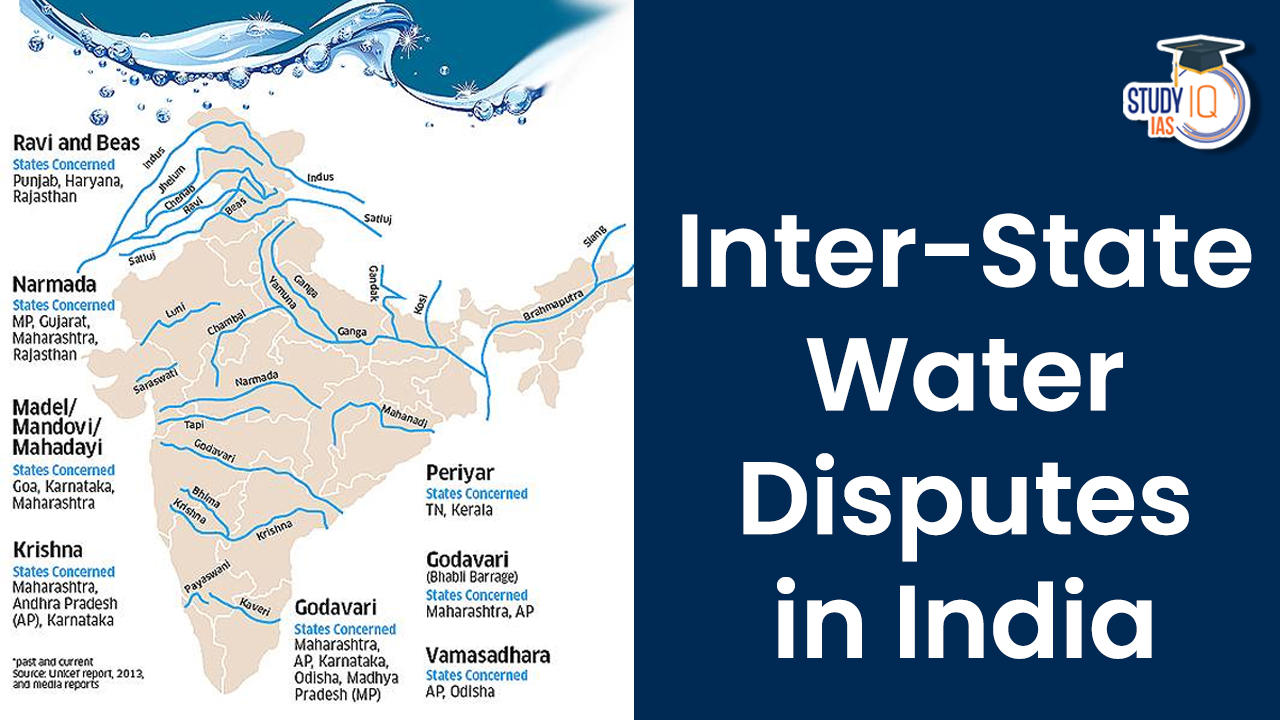
This lesson will analyze the persistence of these inter-state resource conflicts. We will dissect the constitutional and legal frameworks designed to resolve them and explore why they often fail to bring lasting peace. To ground our analysis, we will focus on two major examples: the century-old Cauvery dispute between Karnataka and Tamil Nadu, and the more recent but equally volatile Mahanadi dispute between Chhattisgarh and Odisha. By the end, you will understand the complex interplay of history, economics, politics, and law that makes water a perpetual flashpoint in Indian federalism.
The Legal Framework for a Fluid Problem
Before we examine the specific disputes, it's essential to understand the legal architecture India has for dealing with them. The framers of the Constitution were aware of the potential for conflict over shared rivers.
- Article 262 of the Constitution empowers Parliament to create laws for the adjudication of any dispute or complaint with respect to the use, distribution, or control of the waters of any inter-state river.
- Crucially, Article 262(2) also allows Parliament to bar the Supreme Court and other courts from exercising jurisdiction over such disputes.
Acting on this power, Parliament enacted the Inter-State River Water Disputes Act (ISRWDA) in 1956. This Act allows the central government to constitute a temporary Water Disputes Tribunal whenever a state government requests one and the Centre is satisfied that negotiations have failed. The tribunal's award is meant to be final and binding, having the force of a Supreme Court decree.
However, this system has been plagued by problems, which is a major reason for the persistence of these conflicts. The following discussion from Sansad TV provides an excellent overview of the challenges with the existing system and the rationale behind a proposed amendment to create a single, permanent tribunal.
The Big Picture - Single Tribunal for River Water Disputes
This video discusses the legal framework for river water disputes, the historical problems with ad-hoc tribunals, and the proposed reforms.
Please watch the following segments: The legal backdrop: This section explains the origins of the ISRWD Act of 1956 under Article 262. Problems and proposed solutions: Here, the speaker details the long delays in constituting tribunals and how the 2019 Amendment Bill aims to create a permanent body to speed things up. Politicization of the issue: This part highlights how these disputes spill over into high-stakes political and emotional battles, using the Cauvery dispute as an example. The implementation problem: The discussion here focuses on the core challenge—the difficulty of implementing a tribunal's award, especially when there are no real disincentives for non-compliance by states.
As the video makes clear, the legal process is often characterized by extreme delays, political interference, and a fundamental difficulty in enforcing verdicts on defiant state governments. This creates a cycle where disputes fester for decades, moving between tribunals, governments, and the Supreme Court.
Case Study 1: The Cauvery Dispute – A Zero-Sum Game
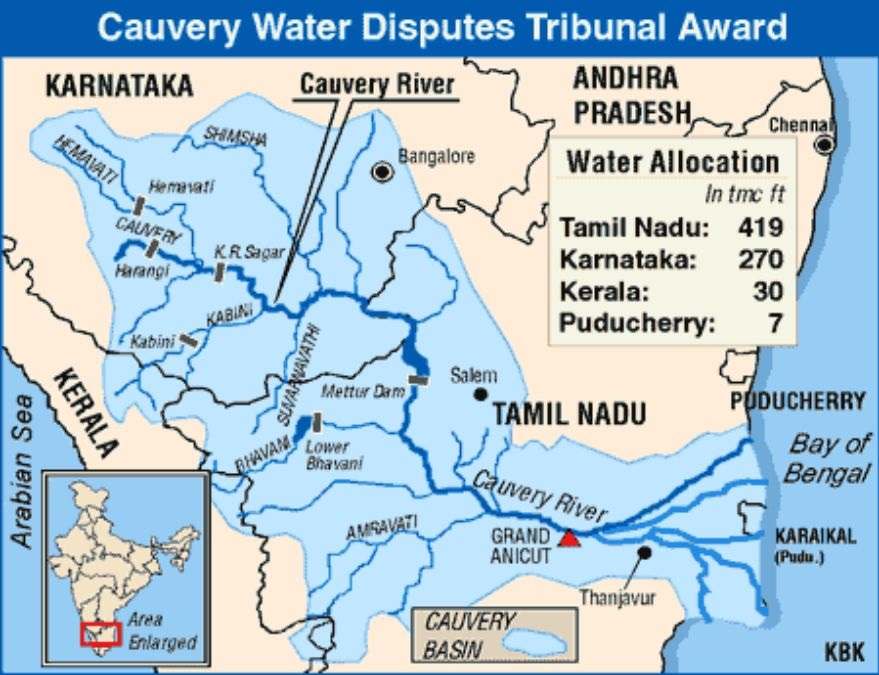
The Cauvery (or Kaveri) water dispute is the quintessential example of an intractable resource conflict in India. It is a legacy dispute, with roots stretching back over a century, involving the states of Karnataka and Tamil Nadu as the primary parties, along with Kerala and the Union Territory of Puducherry.
The animated video below provides a clear and concise explanation of the river's geography, the history of the conflict, and the key reasons for its persistence.
Complete Kaveri River Issue Explained using Animation | Karnataka & Tamil Nadu | StudyIQ IAS English
This StudyIQ video explains the geography, history, and core reasons behind the unending Cauvery water dispute.
Please watch the following sections: The river and its basin: This will familiarize you with the river's course, its tributaries, and its unique dependency on both the Southwest and Northeast monsoons. The genesis of the dispute: This crucial segment covers the pre-independence agreements of 1892 and 1924, the establishment of the Cauvery Water Disputes Tribunal (CWDT), its final award in 2007, and the Supreme Court's 2018 verdict that modified the allocations. The core reason for persistence: Pay close attention to this final part, which explains the fundamental problem of the Cauvery basin.
Let's break down the key analytical points from the video:
-
Historical Rights vs. Federal Equality: The dispute is fundamentally a clash between two principles. Tamil Nadu, as the lower riparian state, bases its claims on prior appropriation—it has historically relied on and developed agriculture around Cauvery water, a right codified in the pre-independence agreements (1892, 1924) when it was part of the Madras Presidency. Karnataka, the upper riparian state, argues for equitable sharing, asserting that those old agreements were unfair and that as a sovereign state in the Indian Union, it has an equal right to use the water originating in its territory for its own development.
-
A Demand-Supply Mismatch: As the video powerfully concludes, the single most important reason for the Cauvery dispute's persistence is that the basin is over-allocated. The combined demand for water from all four parties is far greater than the river's average flow. Unlike other disputed rivers like the Narmada or Godavari, which have surplus water, the Cauvery has almost no "unused" water. This creates a zero-sum game: in a year with a poor monsoon, any water given to Tamil Nadu is seen as water taken away from Karnataka's farmers and cities, and vice versa.
Case Study 2: The Mahanadi Dispute – Politics, Industry, and a River's Health
While the Cauvery dispute is a legacy conflict, the Mahanadi dispute between Odisha and Chhattisgarh is a stark example of a modern water conflict fueled by rapid industrialization and partisan politics.
The conflict erupted in 2016 when Odisha (the downstream state) accused Chhattisgarh (the upstream state) of unilaterally constructing a series of barrages and industrial projects that were severely restricting water flow into the vital Hirakud Dam in Odisha.
The following academic paper provides a multi-faceted analysis of the dispute, which we will use to understand its political and economic drivers.
[PDF] The Mahanadi river water dispute saga
This paper details the root causes and various dimensions of the Mahanadi conflict.
Please read the following sections: First, review the section titled Mahanadi River Water Dispute: Major Root Causes (p. 26). Pay attention to the core allegation made by Odisha against Chhattisgarh. Also, note the counter-argument that the conflict is not about farmers, but about water-guzzling industries in both states. Next, read the section Diverse Perspective of Water Rights and the Mahanadi Water Dispute, focusing specifically on The fourth core perspective is the Political Perspective (p. 27-28). This section is critical. Analyze how the dispute became entangled in inter-party rivalries between the BJD (ruling Odisha) and the BJP (ruling at the Centre and, at the time, Chhattisgarh). Notice the table that breaks down the political positioning of each actor.
The Mahanadi case presents a different, yet equally complex, set of factors:
-
Development vs. Environment: Unlike the Cauvery, where the fight is primarily between agricultural interests, the Mahanadi dispute is heavily driven by industrial demand. Both states are mineral-rich and have prioritized industrialization, leading to massive water requirements for power plants and factories. The conflict is thus framed as a battle between Chhattisgarh's right to develop and Odisha's right to protect its existing agriculture, livelihoods, and the river's ecology.
-
Politicization and Federal Tensions: The Mahanadi dispute is a classic case study in how water conflicts are weaponized in partisan politics. As the reading highlights, the BJD government in Odisha framed the issue as an existential threat and accused the BJP-led central government of siding with the BJP-led Chhattisgarh government. The conflict became a primary electoral issue, used to mobilize regional sentiment against the central government and the upstream state. This directly echoes the themes of regional identity we saw in the anti-Hindi agitations.
Conclusion
The persistence of inter-state water disputes is not a failure of just one institution, but a systemic problem rooted in a combination of factors. As we have seen through the case studies of the Cauvery and Mahanadi rivers, these conflicts endure because of legal delays, deep-seated historical grievances, intense political mobilization, and, most critically, the growing gap between the demand for and supply of water.
Key Takeaways:
- Flawed Legal Framework: While Article 262 and the ISRWD Act provide a mechanism for dispute resolution, the process of setting up tribunals is slow, and their awards are incredibly difficult to enforce, leading to decades of litigation.
- Legacy vs. Modern Conflicts: The Cauvery dispute is a legacy conflict based on historical claims of water rights, made intractable by a fundamental demand-supply deficit. The Mahanadi dispute, by contrast, is a modern conflict driven by post-2000 industrial development and intense partisan politics.
- Water as a Political Tool: In both cases, water is not just a resource but a powerful symbol. It is used by regional parties to assert states' rights, mobilize voters against neighboring states, and challenge the authority of the central government.
- The Core Problem: Ultimately, legal and political solutions can only manage the problem. The underlying driver of these conflicts is increasing water scarcity, a consequence of population growth, agricultural patterns, and industrialization. Until this fundamental challenge is addressed, water will remain a potent source of conflict in India's federal system.
In our next lesson, we will revisit the theme of language and culture by analyzing the recurring "Hindi imposition" controversy, examining how it continues to fuel anti-central government sentiment and reinforces regional identities in Southern and Eastern India.