Introduction
In our last lesson, we delved into the intellectual and social origins of the Dravidian movement, focusing on Periyar's revolutionary Self-Respect Movement. We saw how a potent ideology was forged, one that centered on anti-casteism, rationalism, and a fierce pride in a distinct, non-Sanskritic Dravidian identity. This ideology, however, was not destined to remain a purely social phenomenon.
This lesson examines the explosive political manifestation of that ideology: the anti-Hindi agitations. We will analyze how the question of a national language became a flashpoint for conflict, transforming the linguistic and cultural pride of Tamil Nadu into a formidable political force. We will trace the history of this resistance from its early stirrings in the 1930s to the massive, student-led revolution of 1965 that permanently redrew the state's political map. By the end, you will understand the deep-rooted causes of this conflict and its profound consequences in shaping Tamil Nadu's unique political identity within the Indian union.
The First Sparks: The Agitations of 1937-1940
The battle over language did not begin with the Indian Constitution. The first major confrontation occurred in 1937, a full decade before independence. The newly elected Congress government of the Madras Presidency, led by C. Rajagopalachari (Rajaji), introduced a policy making Hindi compulsory in schools.
This decision was the perfect catalyst for the ideas we explored in the last lesson. Periyar's Self-Respect Movement and its political ally, the Justice Party, immediately framed this move not as a benign educational policy, but as an act of cultural imperialism. It was portrayed as an attempt by the "Aryan" North to impose its language and, by extension, its Brahminical culture on the Dravidian South.
The following video from The News Minute provides a concise overview of this first wave of protests and introduces the key figures who led the resistance.
Tamil Nadu’s century long fight against Hindi imposition | LME 63
This segment explains the origins of the anti-Hindi agitations, starting with the 1937 protests against Rajaji's policy.
Please watch from the beginning of the topic. Pay close attention to the roles of Periyar and C.N. Annadurai, and the tragic emergence of the first "language martyrs," Thalamuthu and Natarajan, whose deaths galvanized the movement.
This early agitation, which ultimately forced the government to withdraw the order in 1940, set a crucial precedent. It established a clear narrative: the defense of the Tamil language was synonymous with the defense of Tamil identity against northern cultural hegemony. It also demonstrated that organized, popular protest could successfully resist policies dictated from above.
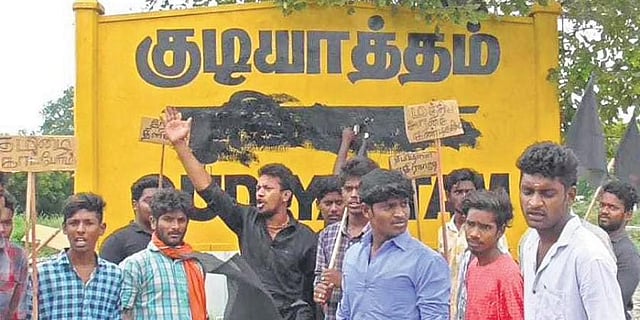
Constitutional Anxieties and the Brewing Storm
When the Constituent Assembly debated the future of India, the language question was one of the most contentious issues. After intense debate, a compromise was reached, known as the Munshi-Ayyangar formula. It was enshrined in Article 343 of the Constitution:
- Hindi in Devanagari script would be the official language of the Union.
- English would continue to be used for all official purposes as an associate official language for a period of 15 years from the commencement of the Constitution (i.e., until January 26, 1965).
- After 15 years, Parliament could provide for the continued use of English.
This 15-year deadline was a ticking clock that created immense anxiety in non-Hindi-speaking states, particularly Tamil Nadu. To address these fears, Parliament passed the Official Languages Act of 1963. Prime Minister Jawaharlal Nehru assured non-Hindi speakers that English would continue as an associate language as long as they wished. However, the Act used the ambiguous phrase that English "may continue to be used," rather than the definitive "shall." This ambiguity did little to quell the fears that after January 26, 1965, Hindi would become the sole official language, placing non-Hindi speakers at a severe disadvantage.
The following reading explains the dual nature of the anxiety that gripped Tamil Nadu's student population in the run-up to 1965.
[PDF] The 1960's Student Revolution in Tamil Nadu - Jetir.Org
This section from the paper "The 1960's Student Revolution in Tamil Nadu" details the specific fears that fueled the student movement.
Please read the section titled II. THE BREWING STORM, starting from The roots of the 1967 revolution and continuing to the end of the section at ...powder kegs waiting for a spark. As you read, focus on the two distinct fears: Economic Survival: The fear that making Hindi the sole language for central government jobs and exams (like the UPSC) would effectively lock Tamils out of these opportunities. Cultural Erasure: The deeper fear that the imposition of Hindi would marginalize the Tamil language and the cultural identity tied to it. Note also how college literary associations (Tamil Manrams) became clandestine hubs for political organization.
The 1965 Revolution: When the Students Took Over
As the January 1965 deadline approached, the Dravida Munnetra Kazhagam (DMK), led by C.N. Annadurai, called for a day of mourning on January 25th. However, the students were primed for something far more drastic. The situation exploded when a student procession in Madurai clashed with Congress party workers. The news spread like wildfire, and what was planned as a symbolic protest metastasized into a statewide insurrection led almost entirely by students.
The following video provides a detailed timeline of how the 1965 agitation unfolded, highlighting its violent nature and the extreme sacrifices made by the protestors.
Hindi Imposition and Agitation History of Tamil Nadu | இந்தி எதிர்ப்பு வரலாறு | English subtitle
This Vikatan TV documentary provides a powerful account of the 1965 agitations, with archival footage and detailed narration (with English subtitles).
Watch the segment from the beginning of the 1965 events. This part covers the passing of the Official Languages Act, the DMK's opposition, the first self-immolation by Chinnasamy which ignited the students, the spread of violent protests and police suppression, and the many subsequent deaths.
The 1965 agitation was a watershed moment for several reasons:
- Student Leadership: With most DMK leaders pre-emptively arrested, students organized themselves, forming the Tamil Nadu Students' Anti-Hindi Agitation Council to coordinate strikes and protests across the state.
- Extreme Sacrifice: The movement was marked by a grim wave of self-immolations, which transformed a political protest into a deeply emotional crusade. These acts of "martyrdom" shocked the nation and demonstrated the extraordinary depth of feeling on the issue.
- Brutal State Response: The Congress government in the state, led by Chief Minister Bhaktavatsalam, responded with a brutal crackdown. The deployment of paramilitary forces and police firings on student protesters, resulting in dozens of deaths, caused the government to lose all moral authority in the eyes of the public.
Consequences: A New Political Order
The firestorm of 1965 had immediate and permanent consequences, reshaping both national policy and Tamil Nadu's political landscape.
1. National Policy Change
The intensity of the protests forced the central government to retreat. Prime Minister Lal Bahadur Shastri went on air to reiterate Nehru's assurance, promising that English would continue to be used for inter-state and Union-state communication as long as non-Hindi states desired it. This promise was formalized with the Official Languages (Amendment) Act of 1967, which replaced the ambiguous "may" with the definitive "shall," thereby guaranteeing the indefinite use of English as an associate official language.
2. The Rise of the DMK and the Fall of Congress
The 1965 agitation was the political death knell for the Congress Party in Tamil Nadu. The students, angered by the violent crackdown, did not let their energy dissipate. They transformed from agitators into the DMK's dedicated campaign army for the 1967 general elections.
[PDF] The 1960's Student Revolution in Tamil Nadu - Jetir.Org
These sections of the "Student Revolution" paper analyze the direct link between the 1965 agitation and the 1967 election outcome.
First, read the section IV. FROM AGITATORS TO CAMPAIGNERS, from When the dust of the 1965 agitation settled to ...of unseating the Congress. Focus on the strategy of the "Cycle Brigades" and how students became the grassroots "foot soldiers" for the DMK. Next, read section V. THE VICTORY AND THE 'RECIPROCITY OF POWER'. This section details the DMK's landslide victory, including the symbolic defeat of Congress titan K. Kamaraj by a student leader, and Annadurai's subsequent implementation of the Two-Language Policy.
The result of the 1967 election was a political earthquake. The DMK swept to power, and the Congress party was decimated, never to regain its footing in the state. This victory marked the permanent arrival of Dravidian parties as the dominant political force in Tamil Nadu.
3. The Two-Language Policy
One of the first acts of Annadurai's new government was to institutionalize the core demand of the protests. In 1968, the Tamil Nadu assembly passed a resolution scrapping the Centre's "Three-Language Formula" (which mandated learning Hindi, English, and a regional language). In its place, Tamil Nadu formally adopted its unique Two-Language Policy, making only Tamil and English compulsory in its schools. This policy remains a cornerstone of the state's identity and a point of federal friction to this day.

Conclusion
The anti-Hindi agitations were far more than a simple protest over language; they were the violent, passionate culmination of the Dravidian identity movement we studied previously. Fueled by a potent mix of cultural pride and economic anxiety, these agitations, particularly the student-led revolution of 1965, fundamentally altered the course of Indian politics.
Key Takeaways:
- Ideological Roots: The anti-Hindi stance was a direct political expression of the Dravidian ideology, which viewed Hindi as a tool of North Indian cultural and political domination.
- Dual Drivers: The agitations were driven by both a fear of cultural erasure and the practical, economic fear of being disadvantaged in a Hindi-centric job market.
- The 1965 Turning Point: The student-led agitation of 1965, marked by self-immolations and a brutal state response, destroyed the Congress party's credibility and propelled the DMK to power.
- Lasting Consequences: The agitations had three major outcomes: the legal guarantee for the indefinite use of English at the national level, the permanent establishment of Dravidian parties as the rulers of Tamil Nadu, and the state's adoption of its unique Two-Language Policy.
These events cemented a unique political identity for Tamil Nadu, one defined by fierce regional pride, a deep skepticism of the central government's intentions on cultural matters, and a political landscape dominated by its own homegrown Dravidian parties.
In our next lessons, we will continue to explore the dynamics of regionalism and federal tensions, looking at persistent inter-state resource conflicts like the Cauvery water dispute, and evaluating how the "Hindi imposition" controversy continues to be a recurring flashpoint in contemporary Indian politics.