Introduction
In our previous lesson, we analyzed the enduring constitutional standoff between the judiciary's collegium system and the executive-backed NJAC, framing it as a fundamental tension between judicial independence and democratic accountability. We saw how institutions grapple for control over appointments, a conflict central to the separation of powers.
This lesson marks our shift from institutional conflicts to the direct relationship between the state and the individual, beginning our module on civil liberties. We will examine one of the most contentious laws in the Indian Penal Code: Section 124A, the law on sedition. Our goal is to analyze the use of Section 124A from its colonial origins as a tool to crush the freedom struggle to its contemporary application against journalists, activists, and dissenters. You'll trace its journey through Indian history, understanding how a law branded "obnoxious" by Nehru and used against Gandhi has survived and is deployed in the world's largest democracy today.
From the British Crown to the Indian Freedom Struggle
To understand the controversy surrounding sedition, it's essential to recognize that it was not designed for a democracy. Its roots lie in monarchical England, created to protect the ruler—then considered divinely appointed—from criticism. The law was imported into India with a clear and specific purpose.
Explained: The Law of Sedition in India & Freedom of Expression | UPSC/IAS 2021
This video from BYJU'S IAS provides a compelling narrative of how and why sedition entered Indian law. It vividly illustrates its primary function as a weapon against the nationalist movement.
Please watch the first two segments of the video: Start by watching the explanation of the law's origin, from its definition to its incorporation into the Indian Penal Code in 1870. Note the initial rationale related to the Wahhabi movement and the broader goal of curbing nationalist propaganda. Next, watch the detailed case studies of its use against Lokmanya Tilak and Mahatma Gandhi. Pay close attention to how the courts interpreted "disaffection" to mean a mere "absence of affection" and how Gandhi, in his trial, pleaded guilty, famously calling Section 124A the "prince among the political sections of the Indian Penal Code designed to suppress the liberty of the citizen."
The trials of Tilak and Gandhi are not mere historical footnotes; they establish the core political character of the sedition law. It was conceived and applied as an instrument to criminalize political dissent and delegitimize the demand for self-rule. As you saw, Tilak was convicted for articles justifying Shivaji's actions and for possessing a card with the names of books on explosives, while Gandhi was convicted for articles encouraging non-cooperation. In neither case was there a direct act of violence by the accused; their words and ideas were put on trial.
Sedition in a Free India: A Paradoxical Survival
Given its colonial baggage and its use against the very figures who founded modern India, the survival of Section 124A after 1947 is a central paradox. The Constituent Assembly debated it intensely.
Initially, leaders like K.M. Munshi successfully argued for the word "sedition" to be dropped as a permissible restriction on the fundamental right to freedom of speech. However, the law itself, Section 124A of the IPC, was never repealed. This set the stage for a prolonged constitutional battle.
To understand how the law was legally re-calibrated for a democratic India, we will turn to a landmark Supreme Court judgment.
The Law of Sedition and India: An Evolutionary Overview
This article from The Hindu Centre for Politics and Public Policy traces the complex legal journey of Section 124A after independence.
Please read the section titled "VI. Sedition’s uneven journey in free India." You can find this part after the discussion of Mahatma Gandhi's trial. Focus on these key developments: The Constituent Assembly debate where Munshi argued for its removal. The early Supreme Court judgments in Romesh Thapar and Brij Bhushan, which led to the First Constitutional Amendment in 1951, adding "public order" as a restriction on free speech. The crucial 1962 Constitution Bench judgment in Kedar Nath v State of Bihar. This is the most important part. The Supreme Court upheld the constitutionality of Section 124A but significantly narrowed its scope, ruling that it could only be applied to acts that incite violence or have a clear tendency to create public disorder.
The Kedar Nath Singh judgment created what is supposed to be the definitive legal test for sedition in India: strong criticism of the government is permissible, even if it is harsh or offensive. A citizen has the right to say or write whatever they like about the government, its measures, and its officials. Sedition is only committed when words or actions have the explicit intention or tendency to incite violence and disturb public order. This judicial "reading down" of the law was a compromise, an attempt to reconcile a colonial-era provision with a democratic constitution.
Contemporary Application: A Tool for "Hair-trigger" Cases?
Despite the clear standard set by the Supreme Court in Kedar Nath, the application of Section 124A in recent years has become a major source of controversy. The infographic below shows the key legal changes and a troubling statistic.
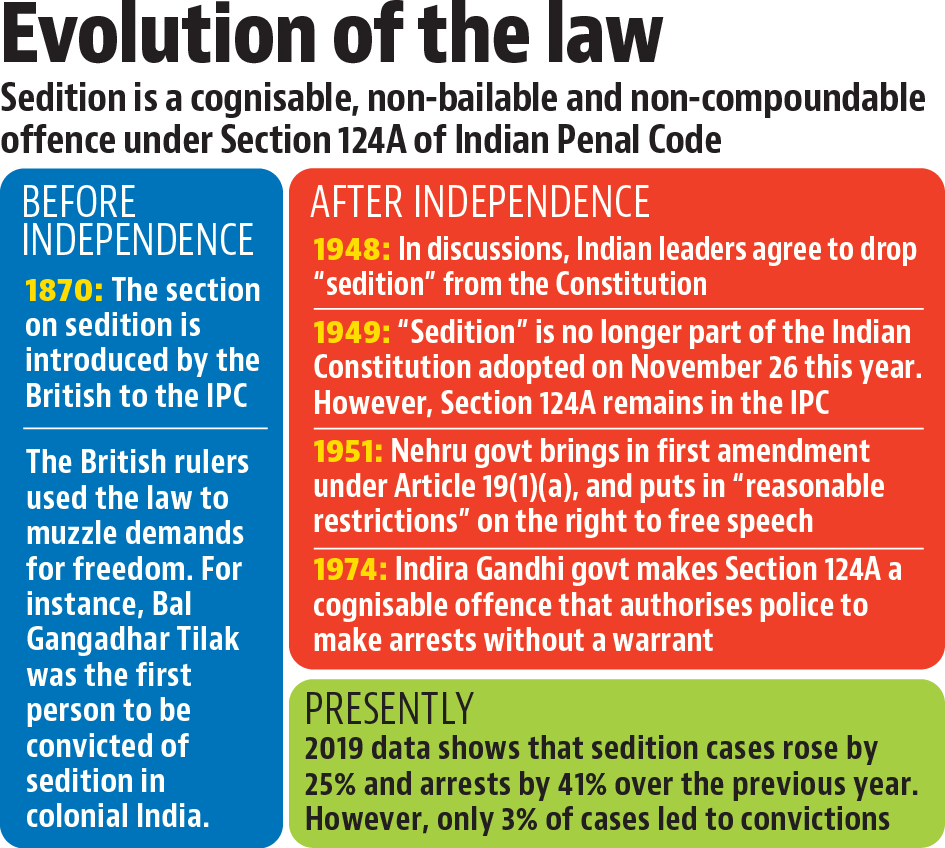
The data suggests a significant gap between the number of people arrested and the number ultimately convicted. Critics argue this shows the law is used not to secure convictions for sedition as defined by the Supreme Court, but as a tool to harass and silence government critics. The process—arrest, denial of bail, and a lengthy trial—becomes the punishment.
The image below presents a gallery of such "hair-trigger" cases, putting faces to the statistics.
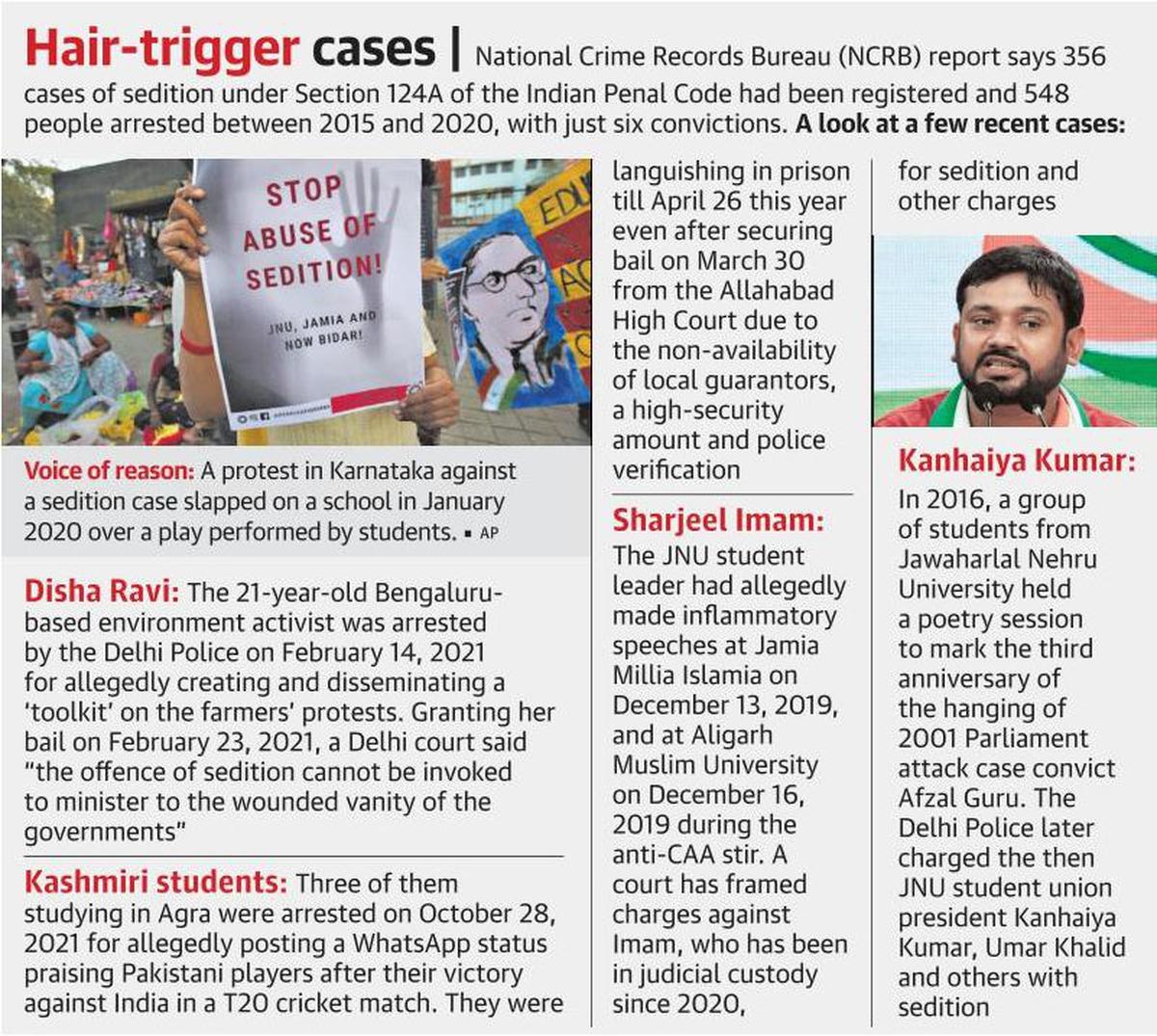
These cases often involve journalists, activists, students, and even artists, and they rarely meet the strict Kedar Nath test of inciting violence.
[PDF] The Law of Sedition in India: Historical Origins, Judicial ... - IJFMR
This academic paper provides brief but clear summaries of several modern cases where Section 124A was invoked, illustrating the pattern of its alleged misuse.
Please read the section titled "Case Studies of Misuse." It begins with the historical cases of Tilak and Gandhi and then moves to contemporary examples. Focus on the cases of Aseem Trivedi, Kishorchandra Wangkhem, Vinod Dua, and Disha Ravi. Notice the nature of their "offences": satirical cartoons, a critical Facebook post, a YouTube video critiquing government policy, and editing a protest "toolkit."
These cases demonstrate a consistent pattern where the police and lower courts often apply the law to speech that is merely critical or unpalatable to the government, ignoring the high threshold of inciting violence set by the Supreme Court. This has led to a phenomenon known as a "chilling effect," where citizens may self-censor out of fear of being targeted by such a stringent law.
In a significant development in May 2022, the Supreme Court of India, acknowledging the widespread misuse of the law, passed an interim order effectively putting Section 124A in abeyance. It urged the central and state governments to refrain from registering new FIRs under this provision while the government reconsiders the law. This has placed the future of this 152-year-old law in a state of uncertainty.
Conclusion
In this lesson, we have traced the long and contentious journey of Section 124A. We've seen how a law created by a colonial power to suppress demands for freedom was paradoxically retained by a democratic republic and continues to be a flashpoint in the debate on civil liberties.
Key Takeaways:
- Colonial Origins: Section 124A was introduced into the Indian Penal Code in 1870 by the British, not to maintain public order, but to criminalize political dissent and suppress the nationalist movement.
- The Kedar Nath Standard: In 1962, the Supreme Court upheld the law's constitutionality but limited its scope, ruling that sedition only applies to speech or acts that have a clear tendency to incite violence or create public disorder.
- Contemporary Misuse: In modern India, the law is frequently used against journalists, activists, and students for speech that is critical of the government but does not meet the Kedar Nath test. This is evidenced by a sharp rise in cases coupled with an extremely low conviction rate.
- The "Chilling Effect": The primary impact of the law today is not in securing convictions but in the process itself, which serves as a form of punishment and discourages free expression.
- An Uncertain Future: The Supreme Court has currently put the operation of Section 124A on hold, acknowledging the need for the government to re-examine this colonial-era provision.
In our next lesson, we will continue our exploration of laws impacting civil liberties by turning to another powerful and controversial statute: the Unlawful Activities (Prevention) Act (UAPA). We will examine its key provisions and analyze its use through the prominent case study of the Bhima Koregaon arrests.