Introduction
In our last lesson, we closely examined the Supreme Court's 2015 judgment that struck down the National Judicial Appointments Commission (NJAC). We focused on the majority's reasoning: that the NJAC violated the 'basic structure' of the Constitution by dismantling the 'primacy' of the judiciary in appointments, which the court held was an essential component of judicial independence.
This lesson concludes our module on the judiciary by zooming out from the legal specifics of that case to the fundamental principles at its heart. We will evaluate the entire collegium-NJAC standoff as a key example of the deep-seated tension between two vital democratic ideals: judicial independence and democratic accountability. This is not a simple question of which system is 'better', but rather an exploration of the difficult trade-offs that every mature democracy must navigate in deciding who appoints its judges.
The Two Poles of the Debate
At the core of the conflict between the collegium and the NJAC are two competing visions of how to best protect the integrity of the judiciary.
- Judicial Independence: This principle argues that judges must be free from external pressure, especially from the executive branch of government, to deliver impartial justice. Since the government is the most frequent litigant in the courts, proponents of this view argue that giving it a say in appointments creates an unacceptable conflict of interest.
- Democratic Accountability: This principle holds that in a democracy, all branches of government must be accountable to the people. An institution where judges appoint themselves is seen as an anomaly—a self-perpetuating, unelected body with immense power but no public oversight.
The infographic below neatly summarizes the key features of the two models that represent these opposing philosophies.
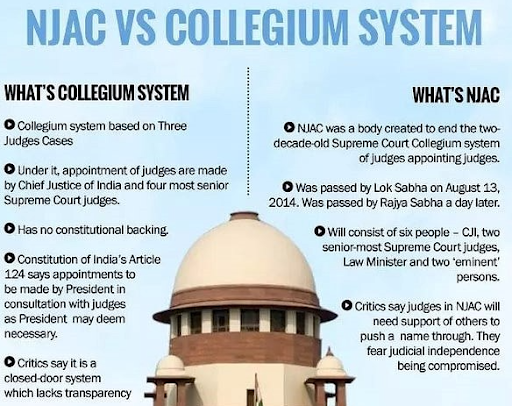
This sets the stage for the core dilemma. To fully appreciate the arguments on both sides, it's essential to understand the justifications and critiques of each system.
Collegium System EXPLAINED For Prelims & Mains + PYQs & SC Judgments | Sarmad Mehraj | Polity UPSC
The following segment from an Unacademy IAS lecture provides a balanced and detailed breakdown of this debate. The speaker articulates the arguments for the collegium, the criticisms against it, the arguments for the NJAC, and the practical realities that complicate the discussion.
Please watch the segment from the debate section. As you watch, focus on mapping the key arguments: In favor of the Collegium: Why is it seen as a necessary shield for judicial independence? How does it supposedly address issues like executive interference and judicial vacancies? Against the Collegium: What are the main charges leveled against it, such as lack of transparency and "nepotism"? In favor of the NJAC: How was its diverse composition intended to enhance accountability and public trust? The Reality Check: Pay close attention to the examples of Saurabh Kirpal and Gopal Subramanium. How do these cases challenge the idea that the collegium system has completely removed executive influence?
Unpacking the Tension
As the video makes clear, this isn't a simple binary choice. Let's structure the evaluation by examining each side of the tension more closely.
The Argument for Independence: The Collegium as a Fortress
The strongest argument for the collegium system is historical. As you saw in the video, the executive's supersession of senior judges in the 1970s—punishing those who ruled against the government—created a deep-seated fear of political interference. The Second and Third Judges Cases, which established the collegium, were a direct judicial response to this perceived threat.
The logic is straightforward:
- The executive is the country's largest litigant.
- Allowing the executive a decisive role in appointing the judges who will hear its cases creates a potential for "reciprocity" and compromises impartiality.
- Therefore, to ensure judges can rule without fear or favor, the judiciary must have the final word ("primacy") in appointments.
In this view, the collegium, for all its flaws, is a necessary fortress to protect the rule of law from a potentially overbearing executive. The Supreme Court's decision in the Fourth Judges Case was the ultimate defense of this fortress, treating judicial primacy not just as a preference but as a non-negotiable part of the Constitution's 'basic structure'.
The Argument for Accountability: The NJAC as a Democratic Corrective
The counter-argument is equally powerful and rests on a fundamental democratic principle: no institution should be an island unto itself. Critics argue that the collegium system, born out of judicial interpretation rather than constitutional text, creates an unaccountable "imperium in imperio"—an empire within an empire.
The key arguments against the collegium, and therefore for a model like the NJAC, are:
- Opacity: The collegium's deliberations are secret, with no formal criteria or public record of why one candidate is chosen over another. This is often described as the "secret garden of the judiciary."
- Lack of Accountability: If poor appointments are made, there is no mechanism to hold the collegium accountable.
- "Uncle Judges": The closed nature of the system is often accused of fostering nepotism, where the relatives of sitting or former judges are favored.
The NJAC was Parliament's attempt to address these issues by creating a hybrid body. By including the Law Minister (representing the executive) and "eminent persons" (representing civil society), it sought to introduce transparency and shared accountability into the process, making it more aligned with practices in other major democracies like the UK, South Africa, and Canada.
The Dissenting View: Questioning the Core Premise
The 4:1 majority in the NJAC judgment prioritized independence. However, the lone dissenter, Justice J. Chelameswar, provided a powerful critique that goes to the heart of our evaluation. He argued that the majority conflated "judicial independence" with "judicial primacy," treating them as one and the same.
A legal research paper provides a clear analysis of this crucial distinction.
[PDF] Judicial Independence and Reformation of The Collegium System
This paper delves into Justice Chelameswar's dissenting opinion, offering a sharp analysis of the accountability argument.
Please read the section "2.1 Analysis of The Dissenting View of Justice Chelameswar" (p. 3). Focus on his argument that distinguishes between a 'basic feature' and the 'basic structure'. He argued that while judicial independence is part of the basic structure, the primacy of judges in appointments is not. This challenges the very foundation of the majority judgment.
Justice Chelameswar's dissent essentially argues that one can have a robustly independent judiciary without granting judges a monopoly over appointments. He suggested that the presence of the executive and laypersons in the NJAC was not a threat to independence but a necessary component of democratic checks and balances. The majority, in his view, protected the judiciary's power at the expense of its accountability.
This brings us to the crux of the evaluation: The NJAC standoff was a moment where the Supreme Court had to choose between two competing democratic goods. It chose to maximize independence, arguing that accountability mechanisms like the NJAC posed an existential threat. Critics argue it was a self-serving choice that entrenched an opaque and undemocratic system.
Conclusion: An Unresolved Standoff
The collegium-NJAC conflict is a defining chapter in the story of Indian democracy, perfectly illustrating the enduring tension between the need for an independent judiciary and the principle of democratic accountability. Our evaluation shows that there are no easy answers, only difficult trade-offs.
Key Takeaways:
- The debate is framed by two core principles: judicial independence, which argues for insulating judges from political influence, and democratic accountability, which demands that all state power be subject to oversight.
- The collegium system is the ultimate expression of judicial independence, created by the judiciary itself to guard against executive interference. However, it is heavily criticized for its opacity and lack of accountability.
- The NJAC was a legislative attempt to restore democratic accountability by creating a mixed-body for appointments. The Supreme Court struck it down, arguing that it compromised judicial primacy, which it deemed essential for independence.
- The reality is complex. As cases like that of Saurabh Kirpal show, the executive retains significant informal power to delay or block appointments, demonstrating that even the collegium system does not guarantee absolute judicial control.
- Ultimately, the standoff remains unresolved. The NJAC was defeated, and the collegium was reinstated, but its fundamental flaws and the questions about its democratic legitimacy persist, ensuring this debate will continue.
Having examined this critical institutional conflict over the separation of powers, our next module will shift focus to the relationship between the state and the individual. We will begin by analyzing the use of contentious laws like Section 124A (sedition) and the UAPA, exploring the contentious terrain of civil liberties and state power.