Introduction
In our previous lesson, we established the legal framework of the Unlawful Activities (Prevention) Act (UAPA), noting how its stringent provisions, especially Section 43D(5) and its interpretation in the Watali judgment, reverse the standard principle of "bail is the rule, jail is the exception." We saw how this creates a system where the process itself can become a form of punishment through prolonged pre-trial detention, a situation the Supreme Court attempted to mitigate in the K.A. Najeeb case by invoking the fundamental right to a speedy trial.
Today, we move from legal theory to stark reality. This lesson aims to analyze the Bhima Koregaon case and the death of Stan Swamy in custody as a case study on the use of UAPA against activists. By examining the competing narratives, the nature of the evidence, and the human consequences of this case, you will see precisely how the legal architecture of the UAPA plays out in one of the most significant and polarizing civil liberties cases in modern India.
The Spark: Bhima Koregaon and the Elgar Parishad
The case originates from two interconnected events in late 2017 and early 2018. To understand the context, it's essential to grasp the historical significance of the Battle of Koregaon.
On January 1, 1818, a small force of the British East India Company, composed largely of soldiers from the Mahar Dalit community, defeated the numerically superior army of the Peshwa, a Brahmin ruler. For many in the Dalit community, this event is not seen as a victory for colonialism, but as a symbolic triumph against the oppressive caste hierarchy of the Peshwa regime. Commemorating this battle has been a long-standing tradition.
Bhima Koregaon case: Who are the accused, how many are still in jail & what's the status of trial
This video from ThePrint provides a concise overview of the events that triggered the case.
Watch the initial segment that explains the origins of the case, covering the Elgar Parishad conclave on December 31, 2017, the historical context of the Battle of Bhima Koregaon, and the violent clashes that occurred on January 1, 2018, during the 200th-anniversary commemoration.
As the video explains, the violence on January 1, 2018, led to two conflicting lines of investigation. The initial FIRs blamed right-wing Hindutva leaders for instigating the attacks on the Dalit gathering. However, the focus of the police investigation soon pivoted to a second FIR, which alleged that the Elgar Parishad event itself—a gathering of activists, jurists, and intellectuals—was where inflammatory speeches were made that incited the violence. This shift in focus is the crux of the entire case.
The Bhima Koregaon Arrests: The Story So Far
This article from the Supreme Court Observer lays out the initial sequence of events and the conflicting narratives.
Please read the first two sections, starting with A tale of two FIRS. This will clarify how the investigation moved from blaming the perpetrators of the violence to blaming the organizers and speakers at the Elgar Parishad event.
What began as an investigation into a riot transformed into a nationwide probe into an alleged conspiracy, leading to the arrest of 16 individuals over several months. These were not people present at the site of the violence, but prominent lawyers, academics, poets, and activists from across the country.
The State's Case: A Conspiracy Against the Nation
The arrested individuals were not just charged with incitement but were accused under the stringent provisions of the UAPA. The investigating agency, first the Pune Police and later the National Investigation Agency (NIA), argued that the Elgar Parishad was merely a front for a much larger conspiracy orchestrated by the banned terrorist organization, the Communist Party of India (Maoist).
The prosecution's narrative, laid out in charge sheets and bail hearings, depicted a deep-rooted plot to "wage war against the nation," overthrow the government, and seize political power through armed revolution. To understand the legal basis for holding these activists without bail, it is invaluable to examine the court order that first rejected their bail applications, as it reveals the prosecution's arguments and how the court applied the UAPA framework we studied.
[PDF] COMMON ORDER ON CRI. BAIL APPLICATION NOS. 3170/18 ...
This is the full text of the November 2019 order from the Pune Sessions Court rejecting the bail applications of several of the accused. It is a dense legal document, but it provides a direct window into the state's case.
Your focus should be on understanding the logic of the prosecution and the court, not on memorizing every detail. Please read the following parts: Brief Facts of the Case (Paras 4-10): Skim this section to see how the investigation expanded from the Elgar Parishad event to a "much larger conspiracy." Submissions on Behalf of State (Paras 35-39): Read the prosecution's core argument, which alleges that the accused were active members of the CPI (Maoist) involved in recruiting, fundraising, and planning to overthrow the government. Reasons (Paras 40-49): This is the most critical section. Read from this point. Note how the judge explicitly references Section 43D(5) of the UAPA and the Watali judgment, stating that the court's job is not to assess the admissibility of evidence but to determine if the accusation is "prima facie true." This directly connects to our last lesson. Evidence Discussed (Paras 63-71): Skim the court's discussion of the alleged letters and documents recovered from the accused's devices. These documents, discussing a "Rajiv Gandhi type incident," funding, and military operations, formed the basis of the "prima facie true" conclusion. Conclusion of the Order (Paras 77-80): Read the final reasoning, where the judge concludes that the accusation is prima facie true and therefore, due to the express bar in Section 43D(5), the applicants cannot be released on bail.
This court order is a textbook example of the UAPA in action. The defense's arguments about evidence fabrication and lack of direct proof were dismissed at the bail stage, with the court bound by the Watali precedent to take the prosecution's material at face value.
The Counter-Narrative: Planted Evidence and Targeted Dissent
The defense and a wide range of civil rights organizations have consistently argued that the accused are victims of a state-sponsored conspiracy to silence dissent. The primary evidence against them—a series of incriminating letters and documents allegedly found on their computers—has been challenged as fabricated.
This claim received substantial support from a US-based digital forensics firm, Arsenal Consulting, which was hired by the defense team to analyze the electronic devices seized by the police.
Documents Planted On Computers: New Report After Stan Swamy's Death | Reality Check
This NDTV special report features an interview with the president of Arsenal Consulting and breaks down their findings. It presents the core of the "planted evidence" theory.
Watch the entire video. Pay close attention to these key points: The initial findings regarding malware on Rona Wilson's computer. The analysis of Surendra Gadling's hard drive, showing how malware was sent via email and used to deliver documents to a hidden folder. The evidence that the attacker was simultaneously planting files on the computers of multiple accused. The statement from Arsenal's president, Mark Spencer, calling this one of the most serious cases of evidence tampering his firm has ever encountered due to its scale and duration. The confirmation that the documents were planted and never opened by the accused.
The Arsenal reports fundamentally challenge the integrity of the entire prosecution case. If the key evidence that forms the "prima facie true" accusation was planted by an unknown attacker, the very basis for the arrests and the denial of bail collapses.
Stan Swamy: "Jail Ruined My Body"
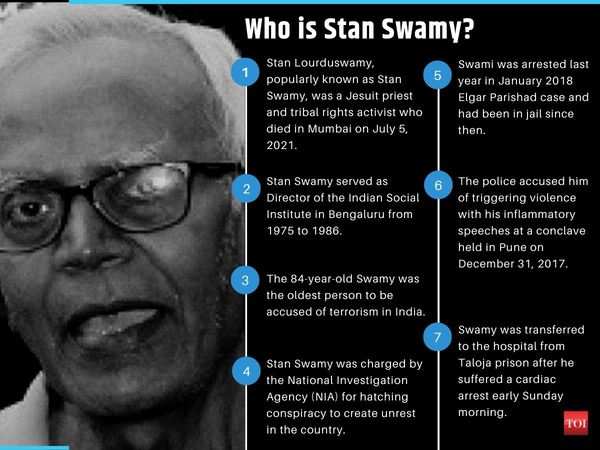
The human cost of this legal battle is most tragically embodied in the case of Father Stan Swamy, an 84-year-old Jesuit priest and tribal rights activist from Jharkhand. He was the oldest person to be accused of terrorism in India.
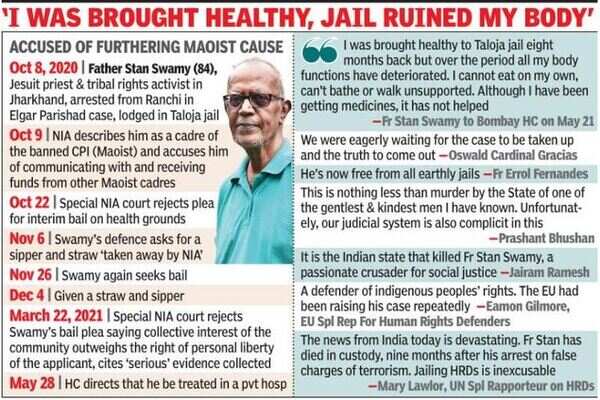
Arrested in October 2020, Swamy suffered from Parkinson's disease and other age-related ailments. His health deteriorated rapidly in prison. His repeated bail pleas on medical grounds were rejected, with the NIA court applying the same "prima facie true" logic and arguing that the collective interest of the community outweighed his personal liberty.
One of the most telling episodes was the NIA's initial opposition to his request for a straw and sipper, which he needed because the tremors from Parkinson's made it difficult for him to drink from a glass. The agency took weeks to respond, sparking widespread public outrage at the perceived lack of basic humanity.
On July 5, 2021, after being transferred to a private hospital following a court order, Stan Swamy died of a cardiac arrest. He died as an undertrial, never having had the chance to prove his innocence in court. His death in custody became a global symbol of the human rights implications of the UAPA, illustrating in the most final way how the "process is the punishment."
A System of Delayed Justice
Stan Swamy's death was the most tragic outcome, but the prolonged incarceration of the other accused also highlights the systemic issues. The trial has yet to formally begin, as charges have not been framed by the court even years after the first arrests.
Several accused have since been granted bail, but almost always after years of imprisonment and intervention by higher courts, reinforcing the principles we discussed in the last lesson:
- Sudha Bharadwaj was granted "default bail" on a technicality—the court that extended her detention was not competent to do so.
- Varavara Rao, an 82-year-old poet, was granted bail by the Supreme Court purely on medical grounds.
- Vernon Gonsalves and Arun Ferreira were granted bail by the Supreme Court after nearly five years in custody, with the court explicitly citing the violation of their right to a speedy trial, a direct application of the K.A. Najeeb precedent.
- Gautam Navlakha was recently granted bail by the Supreme Court, which noted the inordinate trial delay and observed that merely holding certain literature would not automatically attract UAPA charges.
These releases, while welcome for the individuals, underscore the dysfunction of the system. Liberty was not granted at the initial stage based on the merits but was won only after years of detention violated their fundamental constitutional rights.
Conclusion
The Bhima Koregaon case serves as a powerful and distressing case study of the UAPA in practice. It brings together all the elements we have discussed: the expansion of an investigation from a local incident to a national conspiracy, the use of a low "prima facie" evidence threshold to deny bail, profound questions about the authenticity of digital evidence, and the devastating human cost of prolonged pre-trial detention.
Key Takeaways:
- The Power of Narrative: The case began with two competing FIRs, and the state's decision to pursue the "Maoist conspiracy" narrative, while sidelining the "Hindutva instigators" narrative, shaped the entire trajectory of the investigation.
- UAPA's Bail Hurdle in Practice: The repeated denial of bail to the accused, including an ailing octogenarian like Stan Swamy, demonstrates how the "prima facie true" standard, as interpreted in the Watali case, creates an almost insurmountable barrier to liberty.
- The Planted Evidence Controversy: The forensic findings by Arsenal Consulting cast a serious shadow over the prosecution's case, suggesting that the very evidence used to deny bail may have been maliciously planted.
- Process as Punishment: The death of Stan Swamy in custody and the years spent in jail by others before the trial has even begun are the ultimate manifestation of the principle that "the process is the punishment."
- Constitutional Safeguards as a Last Resort: The intervention of the Supreme Court to grant bail based on the right to a speedy trial (Najeeb precedent) shows that constitutional rights can act as a check, but often only after individuals have already paid a heavy price.
In our next lesson, we will continue exploring the intersection of law, state power, and civil liberties by examining another facet of this issue: using the arrests of journalists like Siddique Kappan and Mohammed Zubair to illustrate the criminalization of dissent. This will shift our focus from activists to the press, but the underlying tensions remain the same.