Welcome back. In our previous lesson, we established the foundational principles of caste in Indian elections, exploring the difference between varna and jati and dissecting the logic of 'caste arithmetic'. We saw how regional parties in the Hindi heartland built powerful, but often narrow, political coalitions based on dominant caste groups, such as the Yadavs.
Today, we will analyze one of the most significant political shifts of the last decade: the strategy deployed by the Bharatiya Janata Party (BJP) under Narendra Modi to systematically dismantle these traditional vote banks. This lesson addresses how the BJP successfully attracted a substantial portion of the Other Backward Classes (OBC) vote, a feat that has fundamentally reconfigured India's political landscape. We will explore the dual approach of social engineering and welfare delivery that allowed the party to challenge and overcome long-standing caste-based loyalties.
The Core Strategy: Fracturing the OBC Monolith
As we discussed, the 'OBC' category is not a unified bloc. It is a large, heterogeneous administrative grouping of thousands of distinct jatis, each with its own social standing, economic status, and political aspirations. The central innovation of the BJP's strategy was to recognize and exploit the internal hierarchies and resentments within this umbrella category.
For decades, regional 'social justice' parties built their power by consolidating the votes of a few numerically and socially powerful OBC jatis—often referred to as Dominant OBCs. In Uttar Pradesh and Bihar, the Yadavs are the quintessential example. While these parties claimed to represent all backward classes, many smaller, less powerful communities—often called Non-Dominant OBCs, Most Backward Classes (MBCs), or Extremely Backward Classes (EBCs)—felt that the benefits of reservation and political power were being monopolized by these dominant groups.
The BJP's strategy was to drive a wedge into this fault line. It positioned itself as the champion of the overlooked and marginalized non-dominant jatis, arguing that the established regional parties had practiced a form of political nepotism, favouring their own core communities at the expense of others.
The following analysis from the Carnegie Endowment for International Peace clearly articulates this approach.
The Resilience of India's Fourth Party System
This research paper explains how caste mobilization has shifted over time, detailing the BJP's specific innovation in the current political era.
In the subsection "Dominant and Nondominant Castes," focus on the analysis of the BJP's success. The authors note that the party's key innovation was to exploit the inequalities within the broader caste groupings. In states like UP and Bihar, this meant building a counter-coalition to the dominant Yadavs and Jatavs who formed the base of rival parties.
The Hindi Heartland: A Laboratory for Social Engineering
This strategy of consolidating non-dominant castes was not just a theory; it was patiently executed across the Hindi heartland, with each state serving as a laboratory for perfecting the model. The article "Politics Of The Invisible" provides an exceptional deep-dive into how this was achieved.
Politics Of The Invisible: Inside BJP's Non-Dominant Caste Strategy ...
This article from Swarajyamag details the BJP's long-term project of mobilizing politically marginal communities across North India. It offers specific case studies of Bihar, Uttar Pradesh, and Haryana.
Please read the following sections to understand the practical application of this strategy: Start with the introduction, which sets the stage by describing the BJP's mobilization of non-dominant communities. In "Bihar: The Non-Yadav OBC Mobilisation," observe how the BJP countered the RJD's 'Yadavisation' by systematically cultivating non-Yadav OBCs like Kushwahas, Kurmis, and Koeris. In "Uttar Pradesh: The Main Arena," see how the model was perfected. The BJP aggregated communities like Kurmis, Mauryas, and Lodhis who felt excluded from the Samajwadi Party's dominant bloc. Finally, in "Haryana: The 35 Versus 1 Formula," understand how the BJP adopted and amplified a pre-existing political divide to consolidate non-Jat communities against the long-standing political dominance of the Jats.
The Twin Engines of Mobilization
The BJP's success wasn't just based on highlighting social divisions. It was powered by a two-pronged approach that combined symbolic representation with tangible material benefits, fundamentally altering the relationship between the citizen and the state.
1. Representation and Recognition
The first engine was providing visible political power and recognition to leaders from these non-dominant communities. This went beyond mere rhetoric.
- The party consciously promoted and gave prominent positions to politicians from non-Yadav OBC and non-Jatav Dalit backgrounds.
- In states like Haryana, the appointment of Manohar Lal Khattar, a non-Jat, as Chief Minister in 2014 was a powerful signal that broke decades of Jat political hegemony.
- Across UP and Bihar, leaders from communities like Kurmis, Mauryas, and Kushwahas were elevated to positions of power, giving their communities a sense of pride and a stake in the new political order.

2. The 'Labharthi' Varg: A New Political Identity
The second, and arguably more transformative, engine was the creation of a new political identity: the labharthi, or beneficiary. This was achieved through the Modi government's large-scale welfare schemes, particularly after 2014.
Programs providing cooking gas (Ujjwala), toilets (Swachh Bharat), housing (Awas Yojana), and direct cash transfers were designed to reach beneficiaries directly, using the Jan Dhan-Aadhaar-Mobile (JAM) trinity. This had a profound political effect:
- Bypassing Intermediaries: For the first time, state benefits reached households without the approval or involvement of the local village strongman or caste leader, who had traditionally acted as gatekeepers.
- Creating a Direct Link: This fostered a direct relationship between the individual voter and the central government, led by Prime Minister Modi. The state was no longer an entity accessed through a local patron; it was accessible directly.
- A Cross-Caste Identity: While these schemes were caste-neutral in theory, they disproportionately benefited the poorest households, which are heavily populated by non-dominant OBC and Dalit communities. This created a new 'beneficiary class' that cut across jati lines but was anchored in the experience of receiving tangible benefits from the government.
This mechanism is expertly explained in the "Politics Of The Invisible" article.
Politics Of The Invisible: Inside BJP's Non-Dominant Caste Strategy ...
This section of the article explains the shift from a politics of recognition to a politics of direct delivery.
Please read the section "The Mechanism: From Recognition to Delivery." Pay close attention to the argument that welfare delivery became the party's central political technology. The key insight here is that when a beneficiary received government aid without needing a local leader's help, the fundamental political equation changed. The author calls this the "strategic exclusion of the intermediary to facilitate the direct inclusion of the invisible."
Institutionalizing the Strategy: The Rohini Commission
The BJP's political project of appealing to non-dominant OBCs was also accompanied by a significant policy initiative: the Justice Rohini Commission. Established in 2017, its official mandate was to explore the sub-categorization of the central OBC list.
The stated goal was to examine the equitable distribution of the 27% OBC reservation and to see if a few dominant castes were taking the lion's share of the benefits. The commission was tasked with working out a mechanism to ensure that smaller, more marginalized OBC groups also received a fair share of reservations in jobs and education. This move provided an institutional framework for the BJP's political narrative.
The following video from The Hindu provides a clear overview of the commission and its political significance.
Rohini Panel and Patna HC order| How will it impact caste politics in 2024 polls? | The Hindu
This video discusses the political impact of the Justice Rohini Commission's report on OBC sub-categorization.
Watch the first segment to understand the two key events being discussed: the Rohini Commission and the Bihar caste survey. Next, focus on the explanation of the commission's remit. The key task was to examine how the 27% OBC reservation was distributed and whether it was accruing to only a few dominant communities. Finally, listen to the analysis of how this fits into the BJP's wider political project. The arrival of Narendra Modi, himself from an OBC background, brought in the support of non-Yadav OBCs, and the reinterpretation of Mandal politics is seen as an antidote to the BJP's success. The Rohini Commission is a key part of this reinterpretation.
The Evidence of Success
The effectiveness of this multi-pronged strategy is clearly visible in electoral data. The BJP's vote share among OBCs has surged, while the support for traditional caste-based regional parties has eroded.
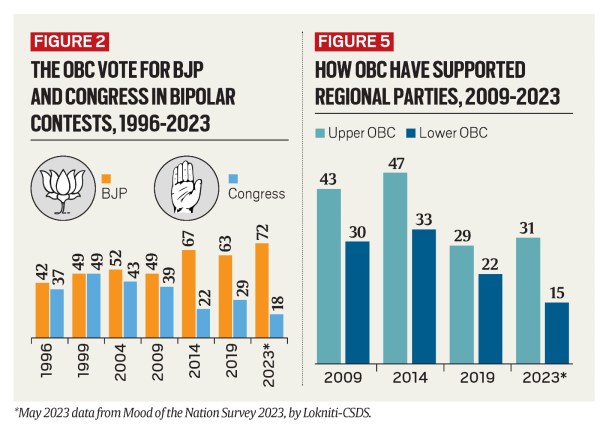
Furthermore, this electoral success translated into increased representation. The Carnegie paper we consulted earlier notes that the 2024 election saw an
Conclusion
The BJP's strategy to win over the OBC vote represents a masterful re-engineering of caste politics. It did not eliminate caste from the political equation; instead, it demoted it from a "political sovereign to a political variable." By identifying and exploiting the internal contradictions within the OBC bloc, the party built a new, formidable coalition that challenged the decades-long dominance of regional social justice parties.
Key Takeaways:
- Fracturing the Monolith: The core of the strategy was to separate 'dominant' OBCs from 'non-dominant' ones, appealing to the latter's sense of marginalization.
- Twin Engines of Success: This was achieved through two parallel mechanisms: symbolic representation (promoting non-dominant leaders) and the creation of a 'labharthi' (beneficiary) class through direct welfare delivery, which weakened traditional caste intermediaries.
- Institutional Framework: The establishment of the Justice Rohini Commission to explore OBC sub-categorization provided a formal policy rationale for this political project.
- A New Political Equation: This strategy has successfully created a broad social coalition for the BJP, combining its traditional upper-caste support base with a significant section of non-dominant OBCs and Dalits, fundamentally altering electoral arithmetic in India.
In our next lesson, we will examine the political fallout of these developments. The BJP's success has prompted a powerful counter-move from opposition parties: a renewed and vociferous demand for a national caste census. We will analyze why this demand has become so politically explosive and what its implications are for the future of reservation policy in India.