Welcome to the next lesson in our exploration of Indian politics. In our previous session, we examined the rise of the Samajwadi Party and the Rashtriya Janata Dal, analyzing how leaders like Mulayam Singh Yadav and Lalu Prasad Yadav built formidable political machines on the foundation of specific caste coalitions, most notably the Muslim-Yadav (M-Y) alliance.
Today, we will broaden our lens to understand the fundamental mechanics of how caste operates across the entire Indian political landscape. We are moving from the specific examples of UP and Bihar to the general principles that govern electoral strategy in much of the country. This lesson will dissect how caste identity shapes the choices of both voters and political parties. We will explain the crucial difference between the concepts of varna and jati, demystify the term 'caste arithmetic', and explore how these factors influence voting behavior and the all-important process of candidate selection.
The Grammar of Caste: Varna vs. Jati
To understand the role of caste in modern elections, we must first clarify our terms. The word "caste" is often used as a monolithic concept, but it encompasses two distinct ideas: varna and jati. The failure to distinguish between them can lead to a fundamental misunderstanding of Indian society and politics.
-
Varna (literally 'color' or 'order') is the four-fold theoretical hierarchy described in ancient religious texts. It divides society into broad categories: Brahmins (priests, scholars), Kshatriyas (warriors, rulers), Vaishyas (merchants), and Shudras (laborers). Those outside this system were historically deemed "untouchables," now referred to as Dalits. This is a schematic, pan-Indian, and largely theoretical framework.
-
Jati (literally 'birth' or 'lineage') refers to the thousands of distinct, endogamous, and often occupation-based communities that exist on the ground. These are the social groups people actually belong to and identify with in their daily lives—such as Yadav, Jat, Kurmi, Reddy, Vokkaliga, Maratha, etc.
Modern electoral politics is a game of jatis, not varnas. A political party doesn't seek to mobilize all "Shudras"; it seeks to build a coalition of specific jatis like Kurmis, Koeris, and Paswans.
The following video provides an excellent deep dive into this distinction. It explains how jatis are the actual human communities that are then slotted into the theoretical varna system.
Understanding Caste in India (Jati & Varna)
This video, "Understanding Caste in India," helps clarify the complex relationship between Jati, Varna, and class. It also addresses some common ideological arguments you might encounter in debates about caste.
First, watch the segment that offers a clear definition of Jati vs. Varna. This is the most critical distinction for our lesson today. Next, watch the portion that deconstructs the argument that caste is a "European construction." It explains how this narrative is used to rebrand and whitewash the indigenous hierarchical system. This is a useful perspective to understand, given your interest in analyzing competing narratives. Finally, the video explains how caste and class are distinct but deeply interconnected. Dr. B.R. Ambedkar described caste as an "artificially enclosed class," a concept that helps explain why economic progress alone doesn't erase caste discrimination.
Now, let's solidify these concepts with a formal definition from a textual resource.
[PDF] Caste in Indian Politics: An Analysis and its Implications - IJCRT.org
This paper provides a concise introduction to the caste system's terminology.
In the section "CASTE SYSTEM IN INDIA," read the first few paragraphs that trace the origin of the word 'caste' and introduce the terms varna and jati. Pay attention to the part explaining that while early Europeans confused the terms, modern scholarship is more precise. Focus on the distinction highlighted by sociologist Andre Beteille, where Jati is the lived reality, while Varna is the theoretical model.
With this foundational understanding, we can now see how political parties use the reality of jati identity as the primary variable in their electoral equations.
The Engine of Electoral Politics: 'Caste Arithmetic'
If jati is the basic unit of social identity, then 'caste arithmetic' is the method by which political parties weaponize this identity for electoral gain. It is a cold, pragmatic calculation that often precedes any discussion of ideology or policy. The process generally involves three steps:
- Demographic Analysis: Parties conduct or commission detailed surveys of each electoral constituency to determine its precise jati composition. They want to know the exact numerical strength of each community.
- Coalition Building: No single jati is large enough to win a seat on its own in most parts of India. Therefore, the goal is to build a winning social coalition—an alliance of different jatis whose combined vote share is projected to be higher than that of their rivals. In the previous lesson, the M-Y (Muslim-Yadav) formula was a classic example of this.
- Candidate Selection: The candidate for the constituency is chosen with extreme care based on this arithmetic. Often, the candidate will belong to the numerically largest or most influential jati within the planned coalition. This individual is expected to act as a magnet, consolidating the votes of their own community while the party leadership secures the support of the other coalition partners.
This practice is a core element of modern Indian politics. The following resources explain this dynamic very clearly.
[PDF] Caste Politics And Its Evolution In Indian Political Framework
This paper directly explains how 'caste arithmetic' became a central feature of political strategy.
In the section "Political Integration of Caste," note the point that caste arithmetic is key to forming coalitions and selecting candidates. Then, in the section "Caste as a Political Tool," focus on the statements that caste-based voting often outweighs other considerations, and that as a result, parties choose candidates meticulously based on caste backgrounds.
The video below offers a very straightforward and practical illustration of this process.
The speaker in this "Opinion" segment boils down the logic of caste arithmetic using a recent election as an example.
Watch the segment from where he explains exactly how parties map the community demographics of a constituency to decide which candidate to field where. This is 'caste arithmetic' in action.
From Arithmetic to Action: Vote Banks and Mobilization
The logical outcome of caste arithmetic is the formation of 'vote banks'. A vote bank is a bloc of voters from a particular community who show consistent loyalty to a specific political party, often in exchange for symbolic recognition, political representation, or tangible benefits. By appealing to a community's sense of pride, security, and shared interest, parties aim to secure their votes en masse.
The influence of caste, however, is not a simple, one-way street. Its role in politics is complex and can lead to different outcomes, as visualized in the diagram below.
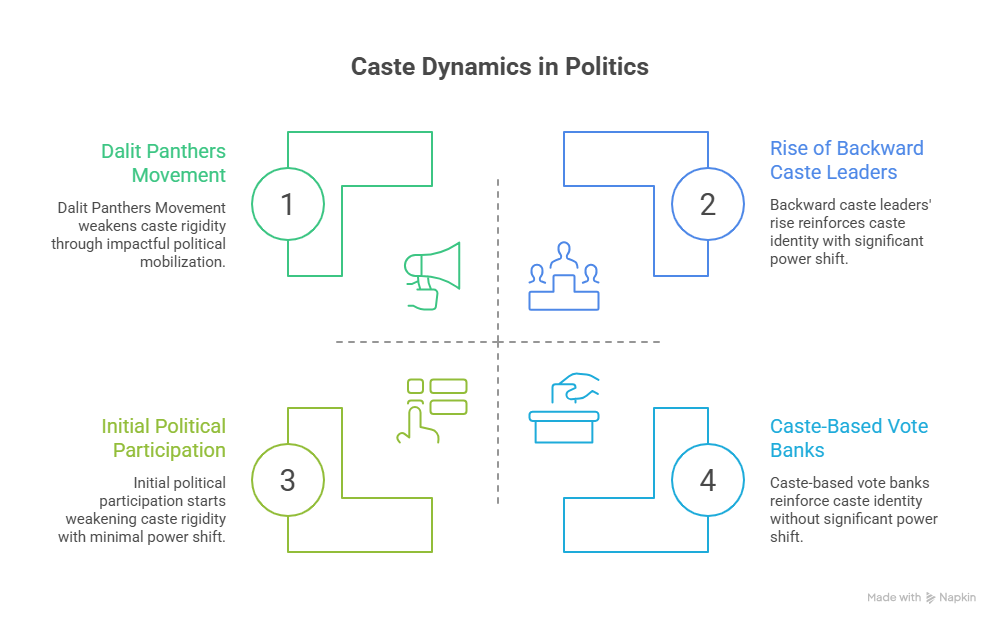
Let's break down these four dynamics:
- Impactful Mobilization (e.g., Dalit Panthers Movement): In this quadrant, political mobilization challenges the existing caste hierarchy and weakens its rigidity. This is often confrontational and aimed at radical social change, not just winning an election.
- Rise of New Elites (e.g., Backward Caste Leaders): As we saw in the last lesson, the rise of OBC leaders reinforced caste identity as the primary political marker, but it also led to a significant and real transfer of power from upper castes to backward castes.
- Initial Political Participation: When lower-caste groups first enter the political arena, their participation begins to challenge caste norms, but it often does so without an immediate, large-scale shift in the power structure.
- Caste-Based Vote Banks: This is the most common form in contemporary electoral politics. Parties appeal to and reinforce caste identity simply to win elections, but this mobilization doesn't necessarily lead to a fundamental change in the community's socio-economic status or a real shift in power. It's about securing votes, not about social revolution.
This fourth quadrant is what we typically refer to when discussing 'vote bank politics'. It's a transactional relationship where caste identity is the currency of electoral exchange.
[PDF] Caste in Indian Politics: An Analysis and its Implications - IJCRT.org
This paper elaborates on the concept of vote banks and the broader debate surrounding caste's role in politics.
First, in the section "ROLE OF CAST IN INDIA POLITICS," read point #1, "Vote Bank Politics," which describes this strategy of mobilizing caste communities to secure votes. Next, read the "CONCLUSION". It presents the two sides of the debate on caste's role, which aligns with your interest in understanding multiple perspectives. One view holds that caste politics is a negative, divisive force. The other view, associated with political sociologist Rajni Kothari, argues it has a positive, democratizing effect by giving a political voice to marginalized groups.
Conclusion
Today we've unpacked the core machinery of caste in Indian elections. Far from being a relic of the past, caste identity, specifically at the jati level, remains one of the most powerful determinants of political strategy and voter behavior.
Key Takeaways:
- Jati over Varna: Modern politics is a contest between coalitions of jatis (local, endogamous communities), not the four broad varnas of classical texts.
- Caste Arithmetic is Central: Political parties use 'caste arithmetic' to analyze constituency demographics, build winning social coalitions, and select candidates who can consolidate the votes of their community.
- The Logic of Vote Banks: This process leads to the creation of 'vote banks', where communities are mobilized to vote as a bloc based on appeals to shared identity, pride, and interest.
- A Double-Edged Sword: The politicization of caste is a contentious issue. It can be a tool for empowering marginalized communities and giving them a seat at the table. Simultaneously, it can reinforce social divisions, reward loyalty over merit, and hinder the development of a more universal, issue-based politics.
This model of caste arithmetic and vote-bank politics has defined the political landscape for decades. However, it is not static. In our next lesson, we will analyze the innovative strategies used by the BJP under Narendra Modi to disrupt these traditional calculations, attract a significant cross-section of the OBC vote, and forge a new kind of political coalition that challenges the very foundations of the 'social justice' parties.